Monday, April 24, 2006

Eagle Lake Zooarchaeology Conference

Well, I won’t make it to the SAA (Society for American Archaeology) meetings in San Juan, Puerto Rico this year (damn!). However, locally the 3rd Annual Stanley J. Olsen Eagle Lake Zooarchaeology Conference will be held again at the CSU Chico Field Station on the shores of lovely Eagle Lake in northeastern California. For more information, please see the conference website. I would encourage any student zooarchaeologists out there to come out and present papers or posters.

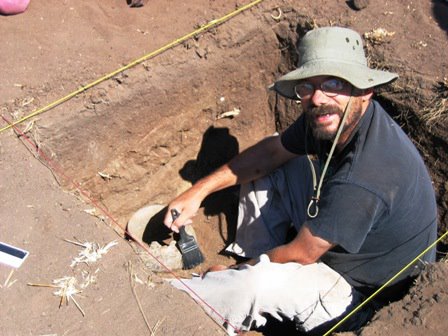
Of course, zooarchaeological research and presentations are the main focus, but a cadre of us spends the wee hours of each morning fishing for the mighty Eagle Lake trout. Below you see a stringer, not of Eagle Lake trout, but Tui chub – not good eating, but all are now comparative collections at various institutions in California and Utah (for those of you unfamiliar with zooarchaeology culture, we have this eccentric habit of throwing any dead thing into a bucket to get the bones). Left to right: myself, Jay Bogiatto (CSU Chico Biology Department and Field Station Director), and Frank Bayham (Faculty, CSU Chico Anthropology Department).

Sunday, April 23, 2006

More Scripture To Live By

Now, most of us understand that the Bible cannot be taken seriously as a "moral manual", in part because of its own endless contradictions. As an example, I have always heard the Christian Right use Leviticus as justification for considering homosexuality an abomination. Of course, I have also heard that Leviticus prohibits a number of other things you don't hear about from the Right. However, I had never seen the whole list laid out until I saw this. This is so good I have to post the whole letter here...(I also think Laura Schlessinger has the intellectual capacity of a carp) --


Laura Schlessinger is a US radio personality who dispenses advice to people who call in to her Radio show. On her radio show recently, she said that, as an observant Orthodox Jew, homosexuality is an abomination, according to Leviticus 18:22 and cannot be condoned under any circumstance.The following response is an open letter to Dr. Laura, penned by a US resident, and then posted on the Internet. It's funny, as well as appropriate.
-----------------------------------------------------------------------

Dear Dr. Laura:
Thank you for doing so much to educate people regarding God's Law. I have learned a great deal from your show, and try to share that knowledge with as many people as I can. When someone tries to defend thehomosexual lifestyle, for example, I simply remind them that Leviticus18:22 clearly states it to be an abomination. End of debate. I do need some advice from you, however, regarding some other elements of God's Laws and how to follow them.

1. Leviticus 25:44 states that I may possess slaves, both male andfemale, provided they are purchased from neighbouring nations. A friendof mine claims that this applies to Mexicans, but not Canadians. Can you clarify? Why can't I own Canadians?

2. I would like to sell my daughter into slavery, as sanctioned inExodus 21:7. In this day and age, what do you think would be a fair price for her?

3. I know that I am allowed no contact with a woman while she is inher period of menstrual uncleanliness - Lev.15: 19-24. The problem is how do I tell? I have tried asking, but most women take offence.

4. When I burn a bull on the altar as a sacrifice, I know it creates a pleasing odour for the Lord - Lev.1:9. The problem is, my neighbours.They claim the odour is not pleasing to them. Should I smite them?

5. I have a neighbour who insists on working on the Sabbath. Exodus35:2 clearly states he should be put to death. Am I morally obligated to kill him myself, or should I ask the police to do it?

6. A friend of mine feels that even though eating shellfish is an abomination - Lev. 11:10, it is a lesser abomination than homosexuality. I don't agree. Can you settle this? Are there 'degrees'of abomination?

7. Lev. 21:20 states that I may not approach the altar of God if I have a defect in my sight. I have to admit that I wear reading glasses.Does my vision have to be 20/20, or is there some wiggle-room here?

8. Most of my male friends get their hair trimmed, including the hair around their temples, even though this is expressly forbidden byLev 19:27. How should they die?

9. I know from Lev. 11:6-8 that touching the skin of a dead pig makes me unclean, but may I still play football if I wear gloves?

10. My uncle has a farm. He violates Lev.19:19 by planting two different crops in the same field, as does his wife by wearing garments made of two different kinds of thread (cotton/polyester blend). He also tends to curse and blaspheme a lot. Is it really necessary that we go to all the trouble of getting the whole town together to stone them?(Lev.24:10-16). Couldn't we just burn them to death at a private family affair, like we do with people who sleep with their in-laws? (Lev.20:14)

I know you have studied these things extensively and thus enjoy considerable expertise in such matters, so I am confident you can help.Thank you again for reminding us that God's word is eternal and unchanging.

Your adoring fan.

Saturday, April 22, 2006

The Christian Downtrodden

I see that DaveScot has post at Uncommon Descent indicating that 48% of Americans feel that those with strong religious beliefs are discriminated against. I would simply point out the following:

31% of Americans believe in the accuracy of astrology;

48% of Americans believe that UFOs are aliens who have visited earth over the years;

52% of Americans believe that bigfoot exists;

And of course,

53% of Americans believe humans came about exactly as the Bible describes;

I'll just let these hang in the air...

Christians As Conservationists

The latest issue of National Parks has an article by Peter Illyn, executive director of Restoring Eden, a ministry working to help Christians appreciate nature and make meaningful changes consistent with an environmental ethic. I believe the intended message is that Christians, evangelical Christians in particular, must take a more active role in environmental conservation and protection because love of the Creator goes hand-in-hand with love of the Creation. As Illyn suggests:

For those with a religious faith, it’s really a simple concept: If we love the Creator, we must take care of creation. It’s a philosophy that puts environmentalists and evangelicals in the same boat—awkward companions to say the least. Although their divergent belief systems have led them to view each other with a fair degree of mistrust, they have much in common.

Reading this reminded me of a series of articles appearing in Conservation Biology last year. David Orr, an ecologist at Oberlin College, in an article entitled “Armageddon Versus Extinction” (Orr 2005a), writes exquisitely regarding the negative effects of conservative, evangelical Christian belief systems on science in general, and biological conservation in particular. A particularly strident belief in end-times philosophy, biblical literalism, and an eagerness to deny any science that counters Scripture have coalesced well with conservative goals of reducing constraints (particularly environmental ones) on business and development. Right-wing conservative Christians have been placed in positions of power in environmental regulatory agencies across the nation, and the effect has been to take down whatever thin veils of environmental protection existed, outsource those responsible for ensuring environmental regulation, and to restrict science unless it favors unconstrained economic advance (or particular scriptural views). The relationship between conservative Christian evangelicals and conservation biology is not altogether clear. In fact, it’s quite schizophrenic. As Orr notes,

On one side, belief in the imminence of the end-times tends to make evangelicals careless stewards of our forests, soils, wildlife, air, water, seas and climate.

Yet there is also the other side, expressed currently in National Parks by Peter Illyn, which sees significant scriptural precedence for environmental conservation, species protection and ecosystem restoration. The problem, as Orr notes, is that right-wing conservatives have played to scriptural inerrancy and an end-times philosophy to gain evangelical support and open the door to a “grand larceny” of our nation’s resources. And many Christian evangelicals have enthusiastically jumped at the political opportunity:

…by becoming an active political force on the extreme right wing of U.S. politics, conservative evangelicals have made an unholy alliance with the vendors of fossil fuels, climate changers, polluters, sellers of weapons, the military, imperialists, exploiters, political dirty tricksters who assume that the ends they’ve chosen justify whatever means they use, spin artists, those willing to corrupt scientific truth for political gain, and those for whom law and the Constitution are merely scraps of paper…But against the example of Jesus who refused to be tempted by the prospect of holding political power, conservative evangelicals are now complicit with the political forces sweeping us toward more terrible violence and the avoidable catastrophes of climate change and ecological ruin.

But in accepting a greater political role, these same Christian conservatives (I would throw conservative Catholics into this mix as well) have abandoned scriptural integrity (at least with regard to views on the environment) in favor of quenching a lust for power. Whether knowingly, or being unwittingly duped by the politically slick who effectively stroke evangelical egos, conservative Christians are “aiding and abetting” forces of environmental destruction.

Orr’s comments naturally drew fire from Christians who consider themselves conservationists and who pointed out a number of evangelical organizations concerned with environmental protection (Johns 2005; van Dyke 2005, Stuart et al. 2005 and several others in those issues). Responses also tended to emphasize the fact that many evangelical Christians are not conservative. Fine…great. I think it is fair to say that no matter the particular characteristic or the group of people to whom we refer, us scientific types are always assuming a Poisson distribution and are concerned with a couple of sigmas around the mean, NOT the tails. There’s no expectation that a given population is completely uniform…we’ll leave make-believe black and white distinctions to FOX news.

But if you consider conservative Christians as a group, it is very, very, VERY difficult to consider them, especially in this day and age, to be pro-conservation. I have no doubt Christian organizations exist that are sincerely concerned with protecting “God’s Creation” from unconstrained human growth and resource exploitation. The problem is that these groups are few and more importantly, they currently have no voice in the national debate on this issue. In many respects this is not their fault; the current conservative media machine dominating the airwaves did not arise overnight and neither will successful opposition to it. But there is something running through their counter-arguments for which they can be faulted. Despite attempts by moderate and “environmental” Christians to distinguish themselves from their conservative cousins, they are still hamstrung by a backdrop of apologetics that makes their case for preserving God’s creation appear forced at best, and at worst, insincere, perhaps even phony. It is not at all clear that they wish to distance themselves from the conservative take-over of Christianity so much as they want to maintain Christian unity. “Wait, Wait” they cry, “Christianity is not a bad thing”. I’m sorry, but let’s be blunt: Christianity in the hands of conservatives IS a bad thing.

In Orr’s first article he makes it very clear the time may be past for a tolerant approach to the conservative Christian assault on the environment. Using Sam Harris’s book, The End of Faith (2004) as a springboard, Orr writes:

In his view [Sam Harris] religious faith – unmoored from fact, data, logic, and the procedures of verifiability – poses a mortal danger to civilization. His book is rather like a stern reprimand for foolish and dangerous religious thinking that has pervaded human cultures and now, with dispersion of weapons of mass destruction, threatens to undo civilization entirely. This is not the time, Harris writes, to preach tolerance of views that are patently disgusting, violent, and dangerous on a global scale, but rather a time to call fundamentalists – Muslim and Christian alike – to account.

This confrontational approach did not sit well with the “environmental” Christian respondents to Orr’s piece. They preferred a strategy of “Christian discourse” with their conservative brethren. That in itself is suggestive of a position more in line with defending Christian unity than advocating biological conservation. In a response article (Orr 2005b) Orr parries this notion beautifully:

Fourth, Stuart et al. say they are most disturbed by my call “for confrontation rather than dialog with evangelicals.” But I did no such thing. What I did was to ruminate a bit on the costs and benefits of various strategies without settling on any one in particular…There is a deeper issue, however; Stuart et al. are afraid, I think, of being impolite, of giving offense. But what particular style of Christian discourse would they propose? Would it be that of Moses who shattered the Ten Commandments at the feet of the backsliding Israelites? Or that of the Old Testament prophets who called wayward people to task with unsparing honesty? Or that of Jesus? How was it that he proposed to “dialogue constructively” with money changers in the temple?...

As much as I would like to see a Christian force behind environmental conservation (we can after all, use all the help we can get), I do not see that Christian conservationists are sufficiently distancing themselves from conservatives. Until that happens, the term “Christian conservationist” remains somewhat of an oxymoron.

There is another problem I have with the concept of conservative Christian conservationists. None of the respondents to Orr’s article defended science as the means for identifying and implementing conservation efforts and environmental protection. Turning back to the current National Parks article, Peter Illyn writes the following:

My faith tradition teaches that humans are unique in all of God’s creation—only we are made in the image of God, and we alone have the divinely given capacity of self-awareness and of free-will. We alone create art and music, build tools, and construct language. Humanity has an exceptional place in the created order, but we seem to have forgotten that we were created last and designed by God not to be independent of the rest of creation. We were made from the dust of the Earth, we are still connected to the Earth, and we will return to the Earth. This is the epiphany of interconnectedness.

If Illyn invokes this as a religious metaphor, that’s great…but the view does nothing to aid in conservation goals. If it is intended to a statement of science, then we have serious problems that really lie at the heart of differences between science and religion for approaching environmental preservation and sustainability. Our “interconnectedness” with the rest of the earth is rooted in our shared evolutionary history and ecological relationships with every aspect of every ecosystem across the planet. Humans may have the cognitive ability to create oral, written and artistic facades of uniqueness that serve to convince us of a special position within the hierarchy of life, but we are still ecological beings. We suffer from pandemics of disease; we must find and use resources and structure our social lives around those resources; when those run out, we must find more; we must compete, fend off attacks, raise our young to compete in the world and successfully raise their own offspring. And, a la Eric Pianka, we are as subject to vagaries of population pressure as bacteria in a Petri dish. Our archaeological past tells us that the human species has survived only because technology mediated its effect upon us or increased the efficiency with which we extract resources. But technology has not altered fundamental principles of competition, resource extraction and depletion, reproduction…or mortality. Technology has only changed the scale at which humans function within ecosystems. And make no mistake…along the way, there have been casualties, lots of casualties. The archaeological record is replete with extinct civilizations (it’s what keeps us archaeologists in business!)…most of whom exhibited “faith” in some kind of god or deity. But extinction ignores religion.

Illyn’s article and those responding to Orr are full of biblical platitudes, but none help the advance of conservation. None acknowledge science, particularly evolutionary theory, as a basis for understanding environmental protection. And none offer to assault the powerful conservative Christian community head-on for being scripturally defective. Until environmentally concerned Christians are willing to sacrifice Christian unity for the objectives of environmental preservation it will be difficult to broadly paint Christianity as anything but a foe of the Creation.

Johns, D. M. (2005) Orr and Armageddon: building a coalition. Conservation Biology 19(6): 1685-86.

Stuart, S. N. et al. (2005) Conservation theology for conservation biologists – a reply to Orr. Conservation Biology 19(6): 1689-92.

Van Dyke, F. (2005) Between heaven and earth: evangelical engagement in conservation. Conservation Biology 19 (6): 1693-96.

Orr, D. W. (2005a) Armageddon versus extinction. Conservation Biology 19(2): 290-92.

Orr, D. W. (2005b) A Response. Conservation Biology 19(6): 1697-98.

Sunday, April 16, 2006

Bone Fragments and Archaeology

Afarensis had a great post yesterday on the value of fossil bone fragments for what they can tell us, not only about species, but behavior as well. I've been meaning to comment on this site: it is one of the better resources for anthropology on the internet. He has most of the major archaeology journals bookmarked (some with free content) and as a professional archaeologist I use Afarensis frequently to aid in my research. He even has links to papers written by undergraduate advisor while at UC Davis: Henry McHenry (which also lists my first "professional" publication - a Current Anthropology comment Henry and I wrote in 1986).

The post nails a number of points regarding the science of "reconstructing" the anatomy of individuals from small bone fragments, especially the manner in which creationists frequently dismiss fossils as telling us anything important. As Afarensis suggests, such a view has less to do with fragmentary fossils telling a valid story than with the gross misunderstanding creationists have of skeletal anatomy. Afarensis discusses the value of small fragments for interpretation in human paleontology, but the same goes for zooarchaeology - the study of animal bone in archaeological sites. With the right expertise, even small fragments can yield a large amount of information. Information, by the way, that is testable against other observations and data.

This got me thinking about something else small (and large) fragments of animal bone can tell us; something that runs counter to the goals of Intelligent Design in particular: the nature of the Designer. The photo at left depicts a scatter of bones and bone fragments (they all happen to be from a zebra) around an obvious pile of ashes. Bone fragments include a skull fragment, ribs, and few vertebra, plus a collection of smaller fragments that all come from those same skeletal elements. This collection of bones and ash was "designed" in the sense that a Designer of higher intelligence was responsible for the patterning (in this case, the "Designers" happen to be Hadza hunters in Tanzania) and not "natural" agents such as lions, water transport or wind. Marks on many of the bones clearly come from the cutting action of knives and the pounding action of stones or other hard objects. Even small fragments of bone can identify the species and anatomical part from which they derive. Small fragments can also retain the evidence of "intelligent" involvement, such as cutmarks or unique fracture patterns.

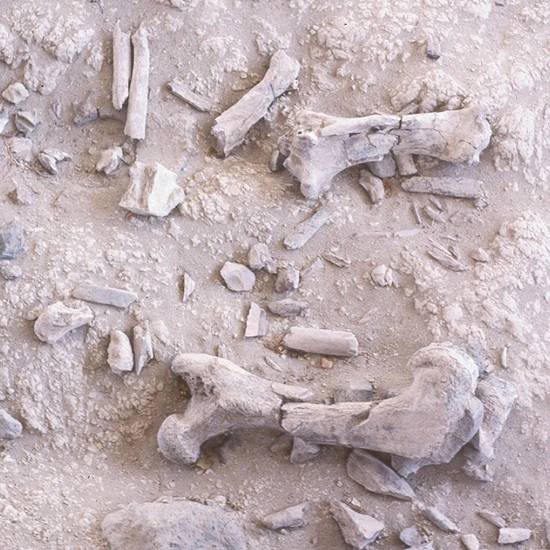
This collection is also designed (again by the same Hadza agents). Unlike the collection above, this shows different parts of the skeleton: lots of leg bones (femora, tibia, metapodials, carpals and tarsals, phalanges). Many of these also have the same tell-tale signs of human-induced damage from knives, rocks and other blunt instruments. Both assemblages differ markedly from "natural" bone assemblages that can be found on the African landscape (or any other continental landscape, for that matter). They are not like the bone assmblages left after lion kills, the scavenging of hyenas, or like collections from porcupines. They were not wind-blown, water transported or eroded into place. I also know
that this assemblage is different from the one above and suggestive of different behaviors on
the part of its human "designers". The study of both assemblages (and the data collected on each) is also a result of archaeological research (a particular kind of archaeological research called "ethnoarchaeology") and exemplifies the primary goal of archaeology.

Intelligent Design advocates frequently invoke archaeology as an analogy to the search for intelligent design in biological systems. But the archaeological study of bone assemblages, like other aspects of archaeology, shows clearly why it is far more advanced than intelligent design and why the latter fails as a science. Archaeology constantly generates and tests hypotheses about its observations; more to the point, these hypotheses specifically seek distinctions between the human designer and non-human counterparts. I can test observations about what makes hyena bone distributions different from human ones; I can test the physical attributes of cutmarks produced by cutting implements; I can test the distinction between carnivore damage and tool damage; I can test the bone pattern differences between kill sites and base camps; I can even test how water affects bone distribution. And in every case, the difficulty lies with empirically demonstrating that the designed assemblages are actually different from the "natural" assemblages...not the other way around. Historically, the assumption has generally been that this or that assemblage must have been designed by humans, simply because the discoverers could not conceive of anything in nature producing the same pattern. Of course, time and again, in the history of archaeology, it was shown that nature could easily come up with the same pattern. Designed complexity was not self-evident. Years of hard work, replicative studies and hypothesis testing were required to confidently tease human agents from non-human ones. Intelligent Design hasn't even attempted this kind of research.

Finally, as I've stated before, the explicit goal of archaeology is to understand the Designer. Patterning in the archaeological record, even apparently obvious patterns such as Easter Island stone heads or an obsidian arrowhead are only important in as much as they tell us something about their designers. The bone assemblages above tell me a lot about the circumstances under which they were produced. They even tell me something about the intentions and capabilities of the humans who produced them. Intelligent Design is not concerned about who the designer is...another reason why ID is not even closely related to archaeology.

Nor does ID generate applicable knowledge. Look at this final photograph from a fossil bone assemblage in East Africa. Because of research done on the bone assemblages above, archaeologists know that it contains both cut-marks and carnivore damage; it has been affected by water, but was deposited largely by human (designed) action; it's patterning is similar to that depicted in the second photo above, suggesting it was the result of a particular set of behaviors on the part of its designer. More importantly, it tells us that its designer was not quite human and did not behave the same way as the modern humans who produced the two bone assemblages above did. It also tells us the designer was constrained by behavior, mental capacity, technology and access to resources.

Intelligent Design is not analogous to archaeology. It doesn't even come close.

Saturday, April 15, 2006

Scary Indeed

This, indeed is scary (from Pharyngula this morning). Where is the rest of the so-called Christian community on this? I'm sorry, but until I see some major rebellion against this coming from the less fanatical Christians out there then one can only conclude that Christianity in America is being represented fairly by these folks. If this is not the American Taliban, they're certainly the best candidate out there.

Fear and Loathing in Las Vegas

My apologies for not updating frequently but it was Spring Break and the family and I just returned from Las Vegas. I had intended to write while there, but hey, it's Las Vegas....

I have to comment on something, however. I never intended this blog to be a personal online journal, but there's something my family and I encounter a lot in Reno and Las Vegas that has just started to bother the hell out me, and it's something I've never told the rest of the family. But I have to come out now and tell the world (or at least the 20 people who visit my blog each day!) how I fell about...buffets. My kids in particular love to go to buffets, especially those at the bigger casinos: Nugget, Atlantis, Peppermill, Aladdin, Tropicana, Palms...you get the picture, we've been to quite a few. But I've come to realize that buffets are the epitomy of American largesse, greed, rudeness, self-rightousness and above all, gluttony. I've never seen so many people, packing so many pounds, move so fast to get to the last Chinese egg roll. Maybe it's because I've spent so much time in rural and bush Africa, seeing friends go without a decent meal for days and never complain that this is starting to get to me. Last week I encountered a relatively rotund older woman and her husband rudely cutting in front of people to get to a particular food item. (I would have understood if they had been going for the Tandoori Chicken kabobs, which the staff was having trouble keeping stocked; but they were aiming for the mounds of mashed potatoes and fried chicken!). Forgive me, but these two could have fed a pride of lions for a year, yet they had that look of panic on their faces like Death was on their heels if they didn't make their food quota for the day. I was thinking the whole time I would have loved to have airlifted most of the patrons in the place to the middle of the Kalahari just to see how many would make it to Gaborone on foot.

Now look, I'll be the first to admit hypocrisy. I'm overweight myself (althought not nearly as much as the majority of buffet patrons I encounter - plus I'm actively working on it). And I still go to buffets, so my actions are counter to my words on the subject. Nor am I against overweight people. But really, how much food does one person need?

Monday, April 10, 2006

How Much Irony Will Be Discussed at This Event?

Via Red State Rabble, I see that Catholic apologist Mark Shea is speaking on what's wrong with Dan Brown's The Da Vinci Code at a Discovery Institute sponsored event. I notice that the new interview with Shea conveniently leaves out previous comments of his in which he suggests those who read The Da Vinci Code are "historically illiterate", something that was just too full of irony for me to pass up a month ago. This bonding of Catholic apologists with the intelligent design crowd is just further evidence that the Catholic Church has moved away from legitimate science.

Saturday, April 08, 2006

When Scripture Means What It Says

Just caught this item posted by Nick Matzke at Panda's Thumb. Apparently, Hovind's Dinosaur Adventure Land is in trouble because they never got a building permit. Hovind and the other creationists insist that complying with the law "...violates their "deeply held" religious beliefs, and that the church-run facility does not have to obtain permits". But I love the response by one of the Escambia county commissioners:

"Scripture also says 'Render unto Caesar what Caesar demands.' And right now, Caesar demands a building permit," County Commission Chairman Mike Whitehead said.

Of course, Hovind will counter with some other scriptural rabbit pulled out of the hat suggesting county misinterpreted the Bible. Apparently, Scripture doesn't mean what we think it means unless we think it means what they say it means (but only when it's convenient to mean it in that particular way...or when the moon is full on Tuesdays, in which all meanings are relative). Do we all get it?

Friday, April 07, 2006

Why the Religious Right Should Embrace Eric Pianka

Ok, as expected there is still no reason to believe that Eric Pianka actually advocated the death of 90% of humanity as Forrest Mims, Texas Governor Rick Perry, and the intellectually vacuous at Uncommon Descent have all hysterically claimed. In fact, Panda's Thumb reports that the wingnuts are in full retreat on the issue. They lied about what Pianka had to say and got caught with their hands in the cookie jar.

But I was wondering why all the hysteria over Pianka suggesting an ecological collapse and humanity's destruction? I would have thought all the Revelation believers would be ecstatic over Pianka's predictions. They seem to be looking forward to humanity's downfall with the same glee as Mims claims for Pianka (I sense another irony coming on)....

A plethora of End-Time preachers, tracts, films, and websites hawk environmental cataclysm as Good News -- a harbinger of the imminent Second Coming....Likewise, dispensationalist author Tim LaHaye's "Left Behind" novels -- at one point selling 1.5 million copies per month -- weave ecological disaster into an action-adventure account of prophesy.

So, sounding the clarion of imminent ecological disaster is OK, so long as it is coming from a 2000 year old fairytale but not an evolutionary ecologist? What, precisely, is the difference between buying into Revelations theology and listening to a Pianka speech?

Thursday, April 06, 2006

Did Johnston Get It Right?

Dispatches From the Culture Wars posted today on excerpts from an article by George Sim Johnston appearing in the Catholic magazine Crisis. Johnston authored a book on evolution in 1998, entitled Did Darwin Get It Right? Catholics and the Theory of Evolution, which I had the pleasure (or should I say, displeasure) of reading. Johnston appears to be assuming the lead as an authority on evolution to whom all good Catholics can turn if they have questions. The sad fact is that Johnston knows less about the specifics of evolutionary theory than I knew as a fourth grader at St. Thomas More Catholic School in Paradise, California (during a time when Catholics were truly interested in science education). Johnston's errors are legion, but the majority can be summarized as follows: he falsely defines aspects of evolutionary theory to create straw men that are easily knocked aside; he engages in serious "quote mining" to lift statements from professional scientists for purposes of leading his audience to conclusions never intended by the original authors; he relies on "authoritative" authors whose opinions have been refuted time and again; and his lack of knowledge regarding the fossil record would fill volumes, yet he confidently claims that no transitional fossils exist. Finally, his current Crisis article is nothing more than recycled passages from his 1998 book. Apparently for Johnston, nothing of scientific interest in evolutionary biology has happened since 1998. Even his anecdotes are re-hashed.

One recycled argument of Johnston's particularly struck me. In Did Darwin Get It Right? Johnston writes the following (p. 35):

"There is no fossil grandparent of the monkeys, for example. "Modern gorillas, orangutans, and chimpanzees spring out of nowhere," writes paleontologist Donald Johanson, discoverer of "Lucy." "They are here today; they have no yesterday."

In the current Crisis article he writes:

Bats, orangutans, bees, turtles all appear out of nowwhere and remain pretty much what we see today. There are no transitional forms to speak of.

Funny Johnston should rely on orangutans as an example of a species supposedly arising, fully developed, out of nowhere. More laughable is the fact that he somehow thinks the paleontological situation hasn't changed since 1998 (or more likely he hasn't bothered to look into it). Forget the fact that he takes Johanson out of context (read the entire passage from Lucy and you'll find Don does indeed think there is a "yesterday" for orangutans); forget even that in 1998 Johnston fails to mention Proconsul, Pliopithecus, Ramapithecus, Sivapithecus, Propliopithecus, Afropithecus, Dendropithecus, Limnopithecus and God knows how many other species, genera and families of potential hominoid ancestors were available; all of which showed so many transitional features between them that it is indeed, difficult to confidently construct phylogenetic trees. And as of today? Consider other hominoid fossils that may or may not show affinities specifically with the orangutan, such as Heliopithecus, Turkanapithecus, Kenyapithecus, and Ouranopithecus. Or how about the recently discovered fossils from Asia, such as Khoratpithecus and Lufengpithecus, both clearly showing orangutan characteristics?And what of Pierolapithecus? Johnston is clearly cherry-picking the information he wants to convey to his readers.

Finally, Johnston uses the most inane analogy to discuss the evolutionary concept of natural selection I have ever heard:

Natural selection simply eliminates what doesn't work. That's all it can do. But the destruction of the unfit does not explain the origin of the fit. As biologist Hans Driesch pointed out long ago, to say that natural selection "creates" anything is a bit like answering the question, "Why are there leaves on the tree?" with, "Because the gardener didn't prune them away." Or, as Arnold Lunn put it, it's like calling the Nazi air strikes creative because they left standing Westminster Abbey.

Brayton slays this idiocy with his usual flair:

This is just a ridiculous statement. Talk about horrible analogies. If the leaves on a tree could vary genetically and reproduce, as whole organisms do, then by "pruning away" less fit variations and keeping more fit ones, natural selection would indeed guide the creation of something new. If the buildings left standing by Nazi air strikes reproduced and turned into new buildings, and there was a reason why certain buildings were selected and allowed to reproduce, then natural selection would indeed guide the development of new types of buildings from old types of buildings. But neither leaves (as opposed to trees) nor buildings can reproduce, nor do they compete for resources. This is just a weak argument from very bad analogies.

Johston has ignored the bulk of information on evolutionary theory, taken a significant portion out of context, and largely mislead everyone about the rest. So let me provide a better analogy: If Johnston approached a history of Jesus Christ with the same intellectual integrity he has applied to evolution, he would ignore the four gospels and the majority of Apostolic letters. So, did Johnston Get It Right? Not even close. And Catholics serious about learning evolutionary theory would do well to give his book and articles a wide berth.

Tuesday, April 04, 2006

Swiftboating an Evolutionary Ecologist

This has been the subject of several blogs of late and my only aim here is to further spread the word about the lunacy that has erupted from the Right as a result of a recent talk given by University of Texas ecologist Eric Pianka. My first ecology course at UC Davis (decades ago) used Pianka's book, Evolutionary Ecology - and it's still proudly displayed in my office bookshelf. Nick Matzke's post at Panda's Thumb says it all:

The wingnut echo chamber has recently gone insane over the idea that Eric Pianka, an distinguished and much-loved ecologist at UT, advocates mass genocide by ebola in order to bring down world population. The allegation was leveled by disgruntled creationist Forrest Mims, and rapidly spread to the blogosphere via places like Dembski’s blog (three posts!) and Telic Thoughts, and then went to the Drudge Report and caused a national media firestorm appearing in my local paper by Monday morning. I smelled a rat from the beginning, and now I have been proved right. KXAN News36 in Austin, TX, has just debunked the whole thing, and for good measure has posted a 20-minute unedited interview with Pianka which everyone must watch to realize the full depravity of what the wingnuts have done here. Pianka says several times that Mims is a “crazy kook” that “distorted and changed everything I said.” The death threats that have flooded Pianka and the Texas Academy of Sciences are also a nice touch.

The unmitigated distortions of Pianka's talk promulgated by the Right are simply another in the long line of fake controversies (War on Christmas, War on Christians, War on Boy Scouts, War on Apple Pie) being used to demagogue anyone conservatives don't agree with. PZ Meyers properly referred to the efforts as the "Swiftboating of Eric Pianka". It's also clear that ID advocates like Dembski prefer that the concept of academic freedom be reserved for "unpopular" ideas of Intelligent Design advocates, and not the "unpopular" ideas of evolutionary ecologists like Eric Pianka. I wonder when O'Reilly will pick this story up and carry on the conservative propaganda?

Thursday, March 30, 2006

More on Farah's Lunacy

Several days ago, Ed Brayton over at Dispatches from the Culture Wars, posted comments on an article by Joseph Farah at WorldNetDaily entitled “Hitler’s Evolutionists”. Farah, citing an article in Archaeology entitled “Hitler’s Willing Archaeologists” rehashes the worn out creationist “evolution-leads-to-Hitler” argument that attempts to link evolutionary theory with the rise of the Nazi regime. This is, of course, a subset of the broader philosophy espoused by creationists and some Christian apologists, that “everything bad is the result of evolution; everything good stems from Christianity”, whether it’s Nazism, Communism, Columbine, abortion or a whole additional host of social ills. Brayton makes short work of Farah’s latest twist on this creationist myth by pointing out that even a superficial perusal of history reveals a much different story; one that Farah would rather his readership not know about. Hitler’s own writing and speeches show clearly that if he justified his ideology with any philosophical position, it was Christianity. Hitler claimed to be a Christian, cited biblical passages to justify his ideology, and was clearly familiar with centuries of church history documenting anti-Jewish attitudes on the part of many prominent Christian figures. Despite this, Brayton correctly clarifies that Christianity is no more to blame for the development of Hitler’s ideology than is evolutionary science:

Now, the Christian would obviously argue that what Hitler did was distort the true aims of Christianity, and I would agree with them. It is folly to blame Hitler's ideology of hatred on Christianity; his pathology was far deeper than a mere religious belief. But by the same token, neither was he motivated by a zeal for science. He was a manipulator who used every possible means to convince his followers to go along with him and changed his rhetoric depending on the nature of the audience he was speaking to. This should be obvious to any thinking person, which of course leaves Farah out right from the start.

Farah is the poster-boy for the creationist tactic of creating data where none exist while simultaneously ignoring volumes of legitimate information that counters his position. Brayton illuminated Farah’s idiocy with the light of reason, logic and a more comprehensive look at a available information. I would have left the whole issue there except that, as an archaeologist, I was curious about the connection Farah was attempting make between archaeology, Hitler and evolutionary theory. So I bought a copy of Archaeology and looked at the original article. It took only a few paragraphs to realize something I’ve always suspected of Joseph Farah: he needs to learn how to read.

The article is largely about Assien Bohmers, a Dutch national with a scientific background in soils analysis, stratigraphy and archaeology, who joined Heinrich Himmler’s elite research institute, the Ahnenerbe. The Ahnenerbe’s official mission was to “…unearth new evidence of the accomplishments and deeds of Germanic ancestors”. However, in reality it was clearly designed to bring “scientific methods” to bear on the question of a Germanic “Aryan” ancestry preferred by Hitler. Not only were the researchers tasked to identify common physical features between Germanic people and human fossils that were already being excavated in Germany and France, they were also to demonstrate the cultural superiority of these ancestors of the master race by showing significant developments in material culture. In other words, they were to cherry-pick data to demonstrate a preconceived notion to the larger public: everything culturally good originated from the Aryans; everything culturally bad originated with inferior races.

In reading through the article after having read Farah’s take on it, there were a number of issues that struck me. Brayton points out that in his own article, Farah cops to the fact that Ahnenerbe’s researches were manipulating data to demonstrate a particular viewpoint but doesn’t catch the relevance to doing proper science. Brayton demonstrates that is precisely the opposite of what science does. But the original article goes further in depth on this point, and is completely ignored by Farah. Despite the overt coercion from Himmler on what the Ahnenerbe researchers were to produce, many were clearly questioning the results, precisely because they were aware of the totality of the data. Bohmers reported enthusiastically to Himmler that his data suggested the ancestors of the Germanic race did not migrate in from the east as previously supposed, but “…must have developed in greater Germany”:

Bohmers was well aware, however, that the European scientific community would be considerably less enthralled by these ideas. Indeed, his foreign colleagues would need serious convincing, for Bohmers knew that many European scholars scoffed at the science of the Third Reich.

As I read through this, the depth to which Farah himself manipulated the article’s data to demonstrate his own warped sense of history became increasingly apparent. But the most egregious example was to come. Farah either didn’t read the whole article or (more likely) specifically ignored the following gem:

Himmler also found time to take Bohmers aside at a gathering to convey his personal views on the subject of human evolution. It must have been an instructive conversation. As Bohmers later reported, Himmler dismissed outright the notion that the human race was closely related to primates. He was also outraged by an idea proposed by another German researcher that the Cro-Magon arose from the Neanderthal. To Himmler, both these hypotheses were “scientficially totally false”. They were also “quite insulting to humans.”

Himmler, head of the SS and Gestapo, the person whose activities and ideology Joseph Farah would most like to lay at the feet of evolutionary theory, did not believe in evolution! In fact, it is quite clear that Himmler’s ideas on the subject of evolution were exactly the same as…Joseph Farah’s!

There was a final parallel I couldn’t help but notice. In an opening paragraph to the article I found the following description of Himmler’s need to establish the Ahnenerbe, which was partly to correct the fact that scholars had not uncovered evidence of the designers of the “master race”:

The answer to this problem, in Himmler’s mind, lay in more German scholarship – scholarship of the right political stripe. So he created the Ahnenerbe, which he conceived of as a research organization brimming with brilliant mavericks and brainy young upstarts who would publicly unveil a new portrait of the ancient world, one in which Aryans would be seen coining civilization and bringing light to the inferior races…”

The concept of conscripting “brainy young upstarts” to “publicly unveil” a new way of looking at things sounded vaguely familiar. And I didn’t have to go far to find where I had originally read it:

Scientific revolutions are usually staged by an initially small and relatively young group of scientists who are not blinded by the prevailing prejudices and who are able to do creative work at the pressure points, that is, on those critical issues upon which whole systems of thought hinge….The primary purpose of Phase II is to prepare the popular reception of our ideas. The best and truest research can languish unread and unused unless it is properly publicized….We intend these to encourage and equip believers with new scientific evidence's [sic!] that support the faith, as well as to "popularize" our ideas in the broader culture…

These are from the Discovery Institute’s Wedge document. Will ironies never cease?

Saturday, March 25, 2006

Maybe Mark Just Made A Mistake

I have been reading Bart Ehrman’s book, Misquoting Jesus, The Story Behind Who Changed the Bible and Why. It’s a great book, one that I would recommend to any of you interested in bible interpretation. Ehrman chairs the Department of Religious Studies at the University of North Carolina at Chapel Hill and is an authority on the history of the New Testament, the early church and the life of Jesus. I am just now getting through the body of the book, but there was a part in the Introduction, where Ehrman describes his personal odyssey leading to his current views on scripture, that has stuck with me in much in the same manner as the original episode stuck with him. Upon his arrival at Princeton Theological Seminary he took a course on the exegesis of the Gospel of Mark with Professor Cullen Story. Ehrman’s final term paper was to be on an interpretive problem of his choosing and the young student proceeded to develop a “long and complicated argument” that an apparent error in scripture was really not an error at all, but a problem of interpretation. Ehrman concludes:

I was pretty sure Professor Story would appreciate the argument, since I knew him as a good Christian scholar who obviously (like me) would never think there could be anything like a genuine error in the Bible. But at the end of my paper he made a simple one-line comment that for some reason went straight through me. He wrote: “Maybe Mark just made a mistake”.

Maybe Mark just made a mistake.

Shouldn’t that be our answer to a lot of the Bible-thumping done by the Christian Right?

Back to Blogging...

Sorry for an absence of posts this last week. I was out of town all week, first to California State University-Chico for a lecture on determining seasonality in archaeological sites; then to the Phoebe Hearst Museum in Berkeley for a couple of days to look at artifact collections from some Lassen County sites excavated in the 1940s. Had a great time, but was unable to connect for a blog post or two (not to mention taking in all the good food in the Bay Area - coming from northeastern California we were all like kids in a candy store with the ethnic food choices!). I'll start posting again shortly...

Sunday, March 19, 2006

Evening Grosbeaks Are Back


I'm not nearly the birder that B and B and some others are, but I've certainly come to enjoy watching the local avifauna. I have my copy of Sibley's (plus a few others) next to the binoculars near the patio door and try to keep the bird feeders clean and well stocked with an assortment of seed. During the summer, if I sit quietly on the deck next to the thistle seed bag, the goldfinches will come in and seem not to notice me. Even though I still have trouble with some identifications, I find it quite relaxing.

This morning some of my favorite birds, Evening Grosbeaks, came back in abundance (the photo doesn't show the other eight at the neighboring tree and feeder!). I consider this a sign of spring in our area as I don't see them in the winter, although the Sibley's map suggests they're probably here all year. It's good to see them again - they're like old friends.

The Oregon Juncos are still here, however; and that means we might still have some winter to go through...

Saturday, March 18, 2006

Archaeology and Creationism

I have yet to write on issues of archaeology in this blog, despite the fact that it’s my area of expertise. The creationism/evolution debates are most notably about biology, and of course it is biologists who contribute the greatest to blunting the flood of false information coming from creationist sources, be they of the young-earth or intelligent design varieties. Archaeology, however, has a significant role to play in the discussion, for a number of reasons. Like all other sciences, archaeology stands to loose credibility when its methods and concepts are twisted or falsified to prove an existing “truth” rather than engage in the honest search for knowledge. More importantly, archaeology is being co-opted by creationists to advance their agenda in ways that are not readily apparent to most archaeologists, let alone the rest of the science community.

First, archaeology is inextricably linked to human biological evolution, which is distasteful for creationists of all stripes. With the first flaking of a river cobble some 2.5 million years ago (or perhaps with the first use of digging sticks by Australopithecine ancestors a million years prior to that) the technological and material culture of humans went hand-in-hand with their biological evolution. To deny one is to deny the other, which means that Paleolithic archaeologists must also be concerned with human biological evolution and hence, evolutionary theory. Arguments against the evolution of horses, therapsids or dung beetles are by default arguments against human biological (and cultural) evolution. Archaeologists need to be as concerned with mutations in regulatory genes between chimps and humans as their geneticist counterparts. And because many of us deal in time scales measured in millions of years, archaeologists must also fight the same inane arguments against the efficacy of radiometric dating methods as any paleontologist. Nor does this concern necessarily end with later time frames. Despite a current rough limit of 10,000 years on prehistory in northern California, I am still occasionally met with comments in public forums that the earth can’t possibly be more than 6000 years in age (not to mention oddball creationist hypotheses such as Native Americans being descendant from lost Israeli tribes). Creationism follows archaeology throughout the latter's spheres of influence.

Second, archaeology is crucial to fundamentalist reconstruction of biblical history: if King David was a real person in the way the Bible suggests, then the Bible must be correct on other matters, including Genesis. And to this end, archaeological data are cherry-picked, archaeological concepts and methods misconstrued, and archaeologists’ statements taken out of context by creationists to provide “confirmation” of the particular version of biblical history that best serves them. Recent posts on the resurrection of the search for Noah’s Ark illustrate the frequency with which creationists cite archaeological terms to give the appearance of scholarly pursuit, without actually applying professional archaeological methods. Even legitimate archaeological discoveries are taken out of context to make broad proclamations that “archaeology proves the Bible” without due consideration for complex issues of correspondence between written and archaeological sources. The archaeological reality of Jericho no more “proves the Bible” than the archaeological reality of Troy “proves the Iliad”. In the context of archaeology, the Bible is simply another historical manuscript (one of thousands throughout the world and across time) that may or may not be useful for aiding interpretation of the archaeological record.

Third, archaeology’s greatest public benefit can also be its greatest weakness. Some aspects of archaeology, unlike other disciplines, are quite amenable to non-professional public involvement. Volunteers are not only welcomed, but frequently encouraged to participate in professional excavations. Digging square holes is not quantum physics, and most people with an interest in the past can be taught to dig and screen dirt with the best of us. Don’t get me wrong: there are frequently times when finesse, experience and skill are required for intricate excavation of special features and the skill level of most non-professionals is inadequate to the task – it is here where the professional archaeologist will usually take over. But a significant part of most large scale excavations is removing lots of dirt and not finessing the excavation of intricate features. Volunteers certainly make valuable contributions to archaeology and some gain a measure of expertise (I work with a few) – but they are not professional archaeologists. Excavation is really only a minor part of archaeology: it is the analysis and interpretation that requires significant expertise in the method and theory of archaeology, the ability to adhere to the methods of science, and skill at formulating cohesive arguments. Most non-professionals know the limits of their often significant contributions. Some, however, pick up a piece of pottery and suddenly become self-proclaimed experts in the field…and creationists will rush in and create expansive expertise out of shoveling dirt for a day faster than you can say “Indiana Jones”. We certainly have the usual creationist cast such as Carl Baugh, Willie Dye, Richard Fales and Clifford Wilson claiming to be professional archaeologists when they have no academic training, no professional field experience, and no track record of having produced reviewable contributions to the discipline. But there are also a growing number of Christian volunteers, willing to pay to participate in archaeological fieldwork in the Holy Land, who then return home to go on the “lecture circuit” and recount how their archaeological experiences are “proving the Bible correct”. Many clearly participate in order to gain a measure of professional authenticity that they then parade in front of home audiences. This is bad enough for archaeology, but it also broadly translates into the perception that these people can speak authoritatively on science in general. After all, they’ve participated with professional archaeologists on professional excavations. If they know something about potsherds, they must also know something about the failings of “macroevolution”, right?

Finally, Intelligent Design advocates have completely butchered archaeological principles by constantly citing archaeology as a metaphor for recognizing the presence of intelligent “design”. They seem to think there is an analogy to be drawn between an archaeologist’s recognition of intelligent design in artifacts with their own identification of intelligent design in biological systems. Nothing could be further from the truth. Design in archaeology is not “self evident” – the simple statement, “this is an obsidian arrowhead made by humans” belies centuries of thought on archaeological method and theory, ethnographic analogy, experimentation with raw materials and an appreciation for context. A lot of hard methodological and theoretical work has gone into understanding the signatures of human intervention in the natural world. The larger lessons of human “design” tell us more about the constraints on the designers rather than their abilities. More importantly, archaeologists never separate the design from the designer: understanding the material culture is only a proximate goal of archaeology. Archaeology’s ultimate goal is to understand human behavior, i.e. the nature of the designer. To suggest that direct study of the Designer is irrelevant is intellectual cowardice.

Archaeology is being used and abused by creationists of all stripes just like other disciplines. It’s time to start pointing out the falsehoods…

Friday, March 17, 2006

Of Links, Moms and Agnostics

I've spent some time updating my links to other interesting and thoughtful blogs (and alphabetizing, like everyone else!), so be sure to check them out. I have to mention one in particular, however: Agnostic Mom. She had comments on my DaVinci Hypocrisy post at her own blog and naturally, I wanted to see what she said about me (after all, it's all about ME isn't it?...So when do I get that Koufax award???....). Of course I stayed to read through some of her posts, which are all very good, but my eye kept coming back to the subtitle of her blog: Raising A Healthy Family Without Religion.

I despise the notion that morality requires religion. "Despise" isn't even strong enough. If that idea were to ever take animal form, I would track it down and kill it. I've known far too many wonderful and moral agnostics and atheists, gay people, Muslims, women who have had abortions (pick your pariah group in this country) and far too many religious assholes (including a few wearing the white collar) to even begin to think that morality ultimately has anything whatsoever to do with religion. Or that religion has anything to with raising a healthy, moral family. Being an archaeologist, somewhat familiar with roughly two and a half million years of human history, I also have serious trouble with the notion that "morality" was born 2000 years ago.

Yes, I know some good religious folks...and a couple atheist jerks. But my experience is that the numbers aren't stacked one way or the other. I certainly don't accept that religion is a prerequisite to raising a healthy, even spriritual, family. And it does my spirits well to know others are out there who feel the same way...so I'll be visiting Agnostic Mom on a regular basis. You should too!

Tuesday, March 14, 2006

Interesting....

Here's one the ID advocates are going to hate, but I find the argument intriguing. Apparently, from an evolutionary perspective, pregnancy isn't always the best thing in the world. More to the point, with all the potential health problems associated with pregnancy (for both the fetus and the mother) one has to question the credibility of a Designer, particularly when the views of intelligent design activists tend to coincide with anti-choice advocates who insist fetal tissue is divinely inspired. Certainly one has to question why pregnancy bears all the hallmarks of an "evolutionary tug-of-war" between mother and fetus and not perfect harmony as might be expected from a Designer.

A paragraph from the article:

In a 1993 paper, Dr. Haig first predicted that many complications of pregnancy would turn out to be produced by this conflict. One of the most common complications is pre-eclampsia, in which women experience dangerously high blood pressure late in pregnancy. For decades scientists have puzzled over pre-eclampsia, which occurs in about 6 percent of pregnancies.

Dr. Haig proposed that pre-eclampsia was just an extreme form of a strategy used by all fetuses. The fetuses somehow raised the blood pressure of their mothers so as to drive more blood into the relatively low-pressure placenta. Dr. Haig suggested that pre-eclampsia would be associated with some substance that fetuses injected into their mothers' bloodstreams. Pre-eclampsia happened when fetuses injected too much of the stuff, perhaps if they were having trouble getting enough nourishment.

Note the word "predicted"; prediction is something you can do with evolutionary theory. You can't do it with Intelligent Design.

And speaking of predictable:

Dr. Haig has enjoyed watching his theory mature and inspire other scientists. But he has also had to cope with a fair amount of hate mail. It comes from across the political spectrum, from abortion opponents to feminists who accuse him of trying to force patriarchy into biology.

"People seem to think, 'He must have a political agenda,' " Dr. Haig said. "But I'm not talking at all about conscious behaviors. I'm just interested in these mechanisms and why they evolved."

Forest Service Outsourcing

This is an ongoing issue with federal employees in land managment agencies, and I think it goes hand-in-hand with the GOP efforts to privatize public land B&B reported on some time ago.

Needless to say, these efforts are taking a drastic toll on federal employees' morale. I think the ultimate purpose is to do just this and purposefully limit the efficiency of the federal workforce so that private interests will be poised to take over.