Just got back from seeing the Da Vinci Code; quite frankly I was expecting to be disappointed (I was going primarily to flaunt the fact that I live in a country where the church has no authority and I can watch and read whatever the hell I want!). I was pleasantly surprised: I actually thought it was much better than the book!
On Thursday Pharyngula posted an interview with movie critic (and religious apologist) Michael Medved, who stated emphatically that the Da Vinci Code is,
... going to be a very big box office disappointment
and then...
Films that have anti-religious themes and particularly anti-Catholic themes and they never make a dime. They tend to do very, very badly at the box office.
So the expectation is that the Da Vinci Code shouldn't do anywhere near as well as, say, The Passion of the Christ. Well, apparently the first numbers are out and Medved missed it by a long shot. According to a post on Andrew Sullivan and associated links, the Da Vinci Code has been one of the largest first weekend smashes of all time. From Deadline Hollywood Daily:
Sony Pictures told me exclusively this morning that Da Vinci Code earned $224 million worldwide, making it the second biggest opening weekend of all time worldwide. (The only movie that did better was Star Wars 3, the last of the prequels, with $254 mil). That DVC figure broke down to $147 mil internationally, and $77 mil domestically. The studio told me that the film is the No. 1 all-time opening weekend internationally. DVC was #1 in predominantly Catholic countries Italy and Spain, and #1 or #2 in every South American territory...According to Box Office Mojo, DVC ranked #13 on the all-time U.S. opening weekend, behind Mel Gibson's The Passion of the Christ. But, internationally, DVC swamped Passion.
Actually, Passion was only the 11th best opening weekend, just over $6 million more than Da Vinci and in the scheme of things probably not statistically significant. Apparently Medved misrepresented the ideological foundations of all those Christians he expected to stay home in protest. Maybe God's trying to tell the conservative Christians something?
Sunday, May 21, 2006


A System For Morality
Agnostic Mom has an interesting piece in the Humanist News Network, entitled A System For Morality that you should read. As I've said here before, the suggestion that Christians are the only people with a moral code is not only wrong, it's a repugnant position to take. There is no historical basis for making that assumption, other than to start from the position that "I believe it, therefore it must be so". History has shown time and again that good and evil crosscut all cultures and religions through time, and no verifiable data exist to suggest that any one group holds the moral high ground consistently.
In a follow-up post, Agnostic Mom has this to say about morality in general:
What do I mean when I refer to right and wrong, good and bad, moral and immoral? And what about that extreme word, “evil?”
Wrong: Causing another person unnecessary pain or increasing the amount of pain and suffering in the world.
Bad: Causing another person unneccessary pain or increasing the amount of pain and suffering in the world.
Evil: Causing another person an excruciating and horrific amount of unnecessary pain or increasing the amount of pain and suffering in the world.
Immoral: Knowing you are causing another person unnecessary pain or increasing the amount of pain and suffering in the world. And doing it anyway when you have a choice to do otherwise.
Right, Good, and Moral: The opposite of the above.
I found this interesting, because it is basically the kind of moral code I've seen expressed in people throughout the world, particularly hunter-gatherer and pastoralist peoples I've lived with. This will not be a sufficient definition for Christian fundamentalists who demand the sole authority to make moral rules based on their own interpretations of scripture, but systems of morality are ingrained within cultures worldwide. Whether or not individuals choose to abide by those systems is dependent upon a variety of complicated factors of the kind that drive behavioral ecologists nuts. I would argue that economics is a significant driving force in making people violate (or modify) their intrinsic moral code, but that's a topic for another time; I would also suggest that over the last 40-60 years Christianity has actually morphed its own moral code to emphasize economic gain rather than spritual fullfillment - it has largely abandoned the substance of Christ's moral commandments to justify unlimited financial gain at the expense of just about everything else - again, another reason my family and I left the church - but again, a discussion for another time.
In a follow-up post, Agnostic Mom has this to say about morality in general:
What do I mean when I refer to right and wrong, good and bad, moral and immoral? And what about that extreme word, “evil?”
Wrong: Causing another person unnecessary pain or increasing the amount of pain and suffering in the world.
Bad: Causing another person unneccessary pain or increasing the amount of pain and suffering in the world.
Evil: Causing another person an excruciating and horrific amount of unnecessary pain or increasing the amount of pain and suffering in the world.
Immoral: Knowing you are causing another person unnecessary pain or increasing the amount of pain and suffering in the world. And doing it anyway when you have a choice to do otherwise.
Right, Good, and Moral: The opposite of the above.
I found this interesting, because it is basically the kind of moral code I've seen expressed in people throughout the world, particularly hunter-gatherer and pastoralist peoples I've lived with. This will not be a sufficient definition for Christian fundamentalists who demand the sole authority to make moral rules based on their own interpretations of scripture, but systems of morality are ingrained within cultures worldwide. Whether or not individuals choose to abide by those systems is dependent upon a variety of complicated factors of the kind that drive behavioral ecologists nuts. I would argue that economics is a significant driving force in making people violate (or modify) their intrinsic moral code, but that's a topic for another time; I would also suggest that over the last 40-60 years Christianity has actually morphed its own moral code to emphasize economic gain rather than spritual fullfillment - it has largely abandoned the substance of Christ's moral commandments to justify unlimited financial gain at the expense of just about everything else - again, another reason my family and I left the church - but again, a discussion for another time.
Bush Administration Taxes Teenagers
Bush and the Republican Congress raise taxes on teenagers with college savings funds.
Mr. Bush pledged in 1999 to veto any bill that raised taxes. In response to a question about the tax increase on teenagers in the new legislation, the White House issued a statement Friday that made no reference to the tax increase, but recounted the tax cuts the administration has sponsored and stated that President Bush had "reduced taxes on all people who pay income taxes."
Challenged on that point, the White House modified its statement 21 minutes later to say that Mr. Bush had "reduced taxes on virtually all people who pay income taxes."
Somebody please try to make the argument that the Bush administration is really for bettering the lives of all Americans and not just the wealthy. Please try....
Mr. Bush pledged in 1999 to veto any bill that raised taxes. In response to a question about the tax increase on teenagers in the new legislation, the White House issued a statement Friday that made no reference to the tax increase, but recounted the tax cuts the administration has sponsored and stated that President Bush had "reduced taxes on all people who pay income taxes."
Challenged on that point, the White House modified its statement 21 minutes later to say that Mr. Bush had "reduced taxes on virtually all people who pay income taxes."
Somebody please try to make the argument that the Bush administration is really for bettering the lives of all Americans and not just the wealthy. Please try....
Tuesday, May 16, 2006
What's Really Behind the Da Vinci Code Furor?
The Da Vinci Code opened this week and yes, I'm looking forward to seeing it. I happened to like the book and have thoroughly enjoyed Dan Brown's other novels, Angels and Demons and Deception Point. Other bloggers thought the book boring and have no interest in seeing the movie, but what can I say...I like Tom Clancy novels too. I read enough academic literature during the day that when evening comes around I much prefer the simplicity of being entertained, sitting in my chair with a beer, rather than having to think about the broader message of the author and whether he or she is conveying it in the proper genre of the day. When it comes to novels, just throw in a plot twist, a conspiracy or two, assassinate a couple of people and I'm pretty much good to go. I never interpret novels as accurate portrayals of history - that's where scholarship comes in. If a novel happens to tweak my interest in some historical figure or event, I drop the novel and do the hard work of scholarly research to find better information. I would like to think most people follow this course but in truth I really wonder. I can understand frustration on the part of the William Donahues, Mark Sheas and Pat Buchanans of the world over the expected interpretation of fiction as historically factual. Unfortunately the mindset is fairly common among the American public. Those who consider the Da Vinci Code as historically accurate are mental brethren with those who think FOX News is "fair and balanced", or that Jonathan Well's Icons of Evolution is a truthful summation of evolutionary theory.
I still can't help wondering why all the furor. I really don't think it's because Opus Dei gets a bum rap in Brown's book or because the Priory of Sion didn't really exist. I'm not even sure it really has anything to do with the proposal that Jesus married specifically to Mary Magdalene. That the book implies Jesus was not divine is certainly a point of contention, particularly given that Christ's divinity is a major tenet of Christianity. But I even wonder about that as the prime motivation. I don't think it's the specific historical inaccuracies of Brown's book that bother the Christian community so much as it is the broader implications that compel the audience to seek answers based on something other than Church authority. There is a general pall over the culture at large that simply does not believe the Church is telling the whole truth about its origins. And while Brown's book in and of itself does not provide a historically accurate road on which to seek answers, it definitely implies that there are questions for which answers can be legitimately sought from other sources (and when Brown suggests he simply hopes it will prompt more people to explore their religion in depth I think this is what he is driving at). And what orthodox Christians largely don't want the general populace to know is that those sources are becoming legion. Archaeology, biblical interpretation and historical research continue to at least complicate our view of early Christian origins if not outrightly contradict the current orthodoxy. Nor is this anything new, but in the age of easy access to information such ideas make the rounds more quickly to a larger audience than they would in the 13th Century. Of course the response by the Church and its defenders is to label anything that strays from orthodox interpretation as "heretical" or some current vernacular equivalent. In Born of A Woman: A Bishop Rethinks the Birth of Jesus (1992), John Shelby Spong makes a case that the virgin narrative of Isaiah was misunderstood by the gospel writers and that Isaiah was not talking about what everyone thinks he was talking about:
When one reads Isaiah 7:14 in the context of Isaiah's history, the first and most obvious fact that must be recorded is that Isaiah was not referring to the virginal conception of Jesus when he wrote this work. Isaiah was concerned with addressing God's challenge to Isaiah's own day, not with predicting the future course of events. (Spong 1992:76)
Spong is of course labeled as ignorant, a poor scholar, lacking in theological knowledge, or otherwise espousing "heretical" interpretations of scripture. He is in good company. A renewed interest in Gnosticism has given wide recognition to the hitherto unrecognized fact (at least among the broader populace) that many more gospels, letters and documents of faith were written in the centuries immediately following Christ than were included in the current Bible. Elaine Pagels, professor of Religious Studies at Princeton University, (and among others) has written extensively and provocatively about the Gnostic Gospels and the history of the early Church. In Beyond Belief: The Secret Gospel of Thomas (2003) she asks some scholarly questions that certainly parallel the theme of the Da Vinci Code:
Why had the church decided that these texts were "heretical" and the only the canonical gospels were "orthodox"? Who made those decisions, and under what conditions? As my colleagues and I looked for answers, I began to understand the political concerns that shaped the early Christian movement. (Pagels 2003: 33).
Are the apologists upset about Brown's specific, historically inaccurate portrayal of Constantine's role as the architect of the New Testament? Or is the real motive behind the outrage that Brown is bringing to a wider audience the fact that such questions are legitimately being asked by scholars like Pagels? Of course the Christian response to Pagels is to use the same language of division common to most apologetic arguments against their detractors: she's not intelligent, has no knowledge of scripture, and shouldn't even be allowed to study scripture from a historical perspective. She is in fact labeled a modern day heretic.
Of course through the centuries the church has been labeling as "heretical" anyone who disagreed with them. Iraneus, Bishop of Gaul, authored a five volume treatise, Against Heresies, in which he chastises the Gnostics and others as heretics for suggesting anything other than the four canonical gospels might have some spiritual value. Pagels suggests it is not clear that Iraneus was not simply verifying his own convictions by coming to the conclusion that only certain gospels should be considered "authentic":
Iraneus knew that this claim [Jesus Christ was God] far oversteps anything found in the Gospels of Matthew, Mark, and Luke...as the church father Origen said later, only John speaks of Jesus' "divinity". Iraneus, like Origen, took this to mean that John is not only different but also "more elevated," having seen what the others missed; and from this conviction he apparently concluded that only by joining John with the others could the church complete the "fourfold gospel," which teaches that Jesus is God incarnate. (Pagels 2003: 152-53).
Pagels is not the only biblical scholar who has doubts about the context in which the current bible was created, or who questions what personal or political benefit might have been gained by those forming the bible. Nor is she the only one who has raised the issue that other documents from those centuries might be of equal or greater spiritual value for those who wish to read them more carefully. Bart Ehrman, author of Misquoting Jesus: The Story Behind Who Changed the Bible and Why (2005) also has a lot to say about how the words of scripture have been changed, often innocently, but sometimes on purpose. The picture painted by a new look at the origins of Christianity is not one espousing a consistent message. Interestingly, Ehrman makes it clear that a heretic is dependent on which side of the theological fence you happen to be standing on:
From the earliest times, Christians were aware that a variety of interpretations of the "truth" of the religion existed within their own ranks. Already the apostle Paul rails against "false teachers"...Reading the surviving accounts, we can clearly see that these opponents were not outsiders. They were Christians who understood the religion in fundamentally different ways. To deal with this problem, Christian leaders began to write tractates that opposed "heretics" (those who chose the wrong way to understand the faith)...What is interesting is that even groups of "false teachers" wrote tractates against "false teachers"...(Ehrman 2005: 27-38).
Again, the specifics of Dan Brown's fictional narrative may not be correct, but has he successfully mirrored legitimate questions about the historical nature of Christianity? Consider further the news from biblical archaeology, which is not flattering to the view that the bible is "correct"; at least not in the way fundamentalist Christians would like it to be. In The Bible Unearthed (2001), Israel Finkelstein and Neil Silberman argue that the bible's historical saga differs dramatically from archaeological reality. Consider also the recent furor over publication of the Gospel of Judas or the long history of the Jesus Seminar and its quest to understand the historical Jesus. The suggestion that Jesus was married did not originate with the Da Vinci Code: Spong devotes a whole chapter to the historical possibility in Born of a Woman. And perhaps the Vatican did not conspire to hide the "truth" about a Jesus and Mary Magdalene union, but they have certainly been accused (with justification) for limiting access to archaeological finds that may not yield orthodox information. And let's not forget the general cover-up and political maneuvering that took place over the priest sex-abuse scandal, including attempts to blame it on liberalism and academia. The question Dan Brown raises is not really "Did the church conspire to hide the truth about Jesus's offspring?"; the real question is "If the church finds evidence countering its orthodoxy, to what extent will they and their apologists try to suppress it?"
It seems that the Da Vinci Code has hit a nerve less because of specific historical inaccuracies Dan Brown may have promulgated than because he's gotten the larger issues correct.
I still can't help wondering why all the furor. I really don't think it's because Opus Dei gets a bum rap in Brown's book or because the Priory of Sion didn't really exist. I'm not even sure it really has anything to do with the proposal that Jesus married specifically to Mary Magdalene. That the book implies Jesus was not divine is certainly a point of contention, particularly given that Christ's divinity is a major tenet of Christianity. But I even wonder about that as the prime motivation. I don't think it's the specific historical inaccuracies of Brown's book that bother the Christian community so much as it is the broader implications that compel the audience to seek answers based on something other than Church authority. There is a general pall over the culture at large that simply does not believe the Church is telling the whole truth about its origins. And while Brown's book in and of itself does not provide a historically accurate road on which to seek answers, it definitely implies that there are questions for which answers can be legitimately sought from other sources (and when Brown suggests he simply hopes it will prompt more people to explore their religion in depth I think this is what he is driving at). And what orthodox Christians largely don't want the general populace to know is that those sources are becoming legion. Archaeology, biblical interpretation and historical research continue to at least complicate our view of early Christian origins if not outrightly contradict the current orthodoxy. Nor is this anything new, but in the age of easy access to information such ideas make the rounds more quickly to a larger audience than they would in the 13th Century. Of course the response by the Church and its defenders is to label anything that strays from orthodox interpretation as "heretical" or some current vernacular equivalent. In Born of A Woman: A Bishop Rethinks the Birth of Jesus (1992), John Shelby Spong makes a case that the virgin narrative of Isaiah was misunderstood by the gospel writers and that Isaiah was not talking about what everyone thinks he was talking about:
When one reads Isaiah 7:14 in the context of Isaiah's history, the first and most obvious fact that must be recorded is that Isaiah was not referring to the virginal conception of Jesus when he wrote this work. Isaiah was concerned with addressing God's challenge to Isaiah's own day, not with predicting the future course of events. (Spong 1992:76)
Spong is of course labeled as ignorant, a poor scholar, lacking in theological knowledge, or otherwise espousing "heretical" interpretations of scripture. He is in good company. A renewed interest in Gnosticism has given wide recognition to the hitherto unrecognized fact (at least among the broader populace) that many more gospels, letters and documents of faith were written in the centuries immediately following Christ than were included in the current Bible. Elaine Pagels, professor of Religious Studies at Princeton University, (and among others) has written extensively and provocatively about the Gnostic Gospels and the history of the early Church. In Beyond Belief: The Secret Gospel of Thomas (2003) she asks some scholarly questions that certainly parallel the theme of the Da Vinci Code:
Why had the church decided that these texts were "heretical" and the only the canonical gospels were "orthodox"? Who made those decisions, and under what conditions? As my colleagues and I looked for answers, I began to understand the political concerns that shaped the early Christian movement. (Pagels 2003: 33).
Are the apologists upset about Brown's specific, historically inaccurate portrayal of Constantine's role as the architect of the New Testament? Or is the real motive behind the outrage that Brown is bringing to a wider audience the fact that such questions are legitimately being asked by scholars like Pagels? Of course the Christian response to Pagels is to use the same language of division common to most apologetic arguments against their detractors: she's not intelligent, has no knowledge of scripture, and shouldn't even be allowed to study scripture from a historical perspective. She is in fact labeled a modern day heretic.
Of course through the centuries the church has been labeling as "heretical" anyone who disagreed with them. Iraneus, Bishop of Gaul, authored a five volume treatise, Against Heresies, in which he chastises the Gnostics and others as heretics for suggesting anything other than the four canonical gospels might have some spiritual value. Pagels suggests it is not clear that Iraneus was not simply verifying his own convictions by coming to the conclusion that only certain gospels should be considered "authentic":
Iraneus knew that this claim [Jesus Christ was God] far oversteps anything found in the Gospels of Matthew, Mark, and Luke...as the church father Origen said later, only John speaks of Jesus' "divinity". Iraneus, like Origen, took this to mean that John is not only different but also "more elevated," having seen what the others missed; and from this conviction he apparently concluded that only by joining John with the others could the church complete the "fourfold gospel," which teaches that Jesus is God incarnate. (Pagels 2003: 152-53).
Pagels is not the only biblical scholar who has doubts about the context in which the current bible was created, or who questions what personal or political benefit might have been gained by those forming the bible. Nor is she the only one who has raised the issue that other documents from those centuries might be of equal or greater spiritual value for those who wish to read them more carefully. Bart Ehrman, author of Misquoting Jesus: The Story Behind Who Changed the Bible and Why (2005) also has a lot to say about how the words of scripture have been changed, often innocently, but sometimes on purpose. The picture painted by a new look at the origins of Christianity is not one espousing a consistent message. Interestingly, Ehrman makes it clear that a heretic is dependent on which side of the theological fence you happen to be standing on:
From the earliest times, Christians were aware that a variety of interpretations of the "truth" of the religion existed within their own ranks. Already the apostle Paul rails against "false teachers"...Reading the surviving accounts, we can clearly see that these opponents were not outsiders. They were Christians who understood the religion in fundamentally different ways. To deal with this problem, Christian leaders began to write tractates that opposed "heretics" (those who chose the wrong way to understand the faith)...What is interesting is that even groups of "false teachers" wrote tractates against "false teachers"...(Ehrman 2005: 27-38).
Again, the specifics of Dan Brown's fictional narrative may not be correct, but has he successfully mirrored legitimate questions about the historical nature of Christianity? Consider further the news from biblical archaeology, which is not flattering to the view that the bible is "correct"; at least not in the way fundamentalist Christians would like it to be. In The Bible Unearthed (2001), Israel Finkelstein and Neil Silberman argue that the bible's historical saga differs dramatically from archaeological reality. Consider also the recent furor over publication of the Gospel of Judas or the long history of the Jesus Seminar and its quest to understand the historical Jesus. The suggestion that Jesus was married did not originate with the Da Vinci Code: Spong devotes a whole chapter to the historical possibility in Born of a Woman. And perhaps the Vatican did not conspire to hide the "truth" about a Jesus and Mary Magdalene union, but they have certainly been accused (with justification) for limiting access to archaeological finds that may not yield orthodox information. And let's not forget the general cover-up and political maneuvering that took place over the priest sex-abuse scandal, including attempts to blame it on liberalism and academia. The question Dan Brown raises is not really "Did the church conspire to hide the truth about Jesus's offspring?"; the real question is "If the church finds evidence countering its orthodoxy, to what extent will they and their apologists try to suppress it?"
It seems that the Da Vinci Code has hit a nerve less because of specific historical inaccuracies Dan Brown may have promulgated than because he's gotten the larger issues correct.

This has been blogged a lot lately, but it's too good not to forward on to folks in the Northstate... and who knows, I may even use it as part of my Anthropology 1 lecture on Intelligent Design.
Monday, May 15, 2006
Noah's Ark or Bosnian Pyramids?
Ok, I've been letting this Bosnian Pyramid thing slide because Hot Cup of Joe and Science & Politics have already commented and provided additional de-bunking links. It's clearly not professional archaeology. Although apparently that doesn't matter as the media seems to ascribe a high degree of credibility to the term "amatuer", at least when it comes to archaeology. From the NY Times article cited above:
Mr. Osmanagic, an amateur archaeologist, is convinced that he has discovered a huge ancient pyramid that will rewrite the history of Europe
There can be no such thing as an "amateur" archaeologist, anymore than there can be amateur surgeons or amateur nuclear physicists. Granted, they won't kill people if they screw up, but the magnitude of their mistakes is just as distructive to the discipline and the resource. We have strict laws against "amateurs" excavating archaeological sites and with good reason: invaluable data are invariably lost if professionals aren't directing the process. Osmanagic may simply be digging nothing but dirt in his quest. But there may also be valuable archaeological sites in his way. If he's destroying legitimate archaeological resources in the process of searching for a fantasy pyramid, then he should be jailed for the wanton destruction of antiquities.
Mark Rose at Archaeology has another discussion of this issue, and a quote by Curtis Runnels, a specialist in the prehistory of Greece and the Balkans at Boston University, beautifully sums up what's wrong with whole Bosnian Pyramid thing:
"These reports are irresponsible on the part of journalists," he says. "These claims are completely unsupported with any kind of factual evidence, such as artifacts or photographs of the alleged architectures. They have not been confirmed by archaeologists who have the training and competence to evaluate them. The person making the claims appears to have no training in archaeology and has not presented his finds in a way that would allow them to be scrutinized by trained experts. This is simply sensationalism and grandstanding and the journalists who have reported on these claims, without first fact-checking the stories with professional archaeologists, should be ashamed of themselves. People who believe these stories, especially when they are presented without evidence, are fools."
Same applies to the search for Noah's Ark...or Carl Baugh's footprints...or Intelligent Design.
Mr. Osmanagic, an amateur archaeologist, is convinced that he has discovered a huge ancient pyramid that will rewrite the history of Europe
There can be no such thing as an "amateur" archaeologist, anymore than there can be amateur surgeons or amateur nuclear physicists. Granted, they won't kill people if they screw up, but the magnitude of their mistakes is just as distructive to the discipline and the resource. We have strict laws against "amateurs" excavating archaeological sites and with good reason: invaluable data are invariably lost if professionals aren't directing the process. Osmanagic may simply be digging nothing but dirt in his quest. But there may also be valuable archaeological sites in his way. If he's destroying legitimate archaeological resources in the process of searching for a fantasy pyramid, then he should be jailed for the wanton destruction of antiquities.
Mark Rose at Archaeology has another discussion of this issue, and a quote by Curtis Runnels, a specialist in the prehistory of Greece and the Balkans at Boston University, beautifully sums up what's wrong with whole Bosnian Pyramid thing:
"These reports are irresponsible on the part of journalists," he says. "These claims are completely unsupported with any kind of factual evidence, such as artifacts or photographs of the alleged architectures. They have not been confirmed by archaeologists who have the training and competence to evaluate them. The person making the claims appears to have no training in archaeology and has not presented his finds in a way that would allow them to be scrutinized by trained experts. This is simply sensationalism and grandstanding and the journalists who have reported on these claims, without first fact-checking the stories with professional archaeologists, should be ashamed of themselves. People who believe these stories, especially when they are presented without evidence, are fools."
Same applies to the search for Noah's Ark...or Carl Baugh's footprints...or Intelligent Design.
Saturday, May 13, 2006
Catholics Need a Better Spokesperson
I caught William Donahue, President of the Catholic League, on FOX's Scarborough Country the other night calling for Director Ron Howard and Sony Pictures to include a “disclaimer” on the soon-to-be-released film The Da Vinci Code that indicates it to be fiction. He is apparently fearful that too many people will be "duped" by the lack of historical accuracy presented in the movie. I know I've brought this up before, but why is it that every time I hear whining about Da Vinci's historical accuracy, or that Dan Brown is not a historian, or that the public exhibits too much historical and theological illiteracy to make an honest assessment of this book, Intelligent Design comes immediately to mind? Somebody in the Catholic League, please, please, please tell me why we shouldn't also be concerned that the greater public is being duped by the biological, paleontological and general science inaccuracies of Wells, Dembski or Johnson? Probably because, like the Intelligent Design movement, Donahue is far more concerned with winning a public relations battle than with fostering intellectual thought. Here's his view of evolution as presented to the Constitution-bashing crowd at Justice Sunday II:
You see, because we respect that fact that they don’t believe in anything. They believe in what I call the King Kong theory of creation: you know all of a sudden one day there were a bunch of apes up in a tree and then - kerplunk – they fell down, lost most of their hair and started walking around, that was Adam and Eve. If they want to believe that, that’s okay. Alright? So we have to respect that, that’s where these people are coming from.
Donahue is a bombastic mental midget who has taken it upon himself to speak for the Catholic Church - in doing so, he embodies every reason why I left catholicism: the church is currently more concerned with being conservative than being Catholic.
You see, because we respect that fact that they don’t believe in anything. They believe in what I call the King Kong theory of creation: you know all of a sudden one day there were a bunch of apes up in a tree and then - kerplunk – they fell down, lost most of their hair and started walking around, that was Adam and Eve. If they want to believe that, that’s okay. Alright? So we have to respect that, that’s where these people are coming from.
Donahue is a bombastic mental midget who has taken it upon himself to speak for the Catholic Church - in doing so, he embodies every reason why I left catholicism: the church is currently more concerned with being conservative than being Catholic.
Wednesday, May 10, 2006
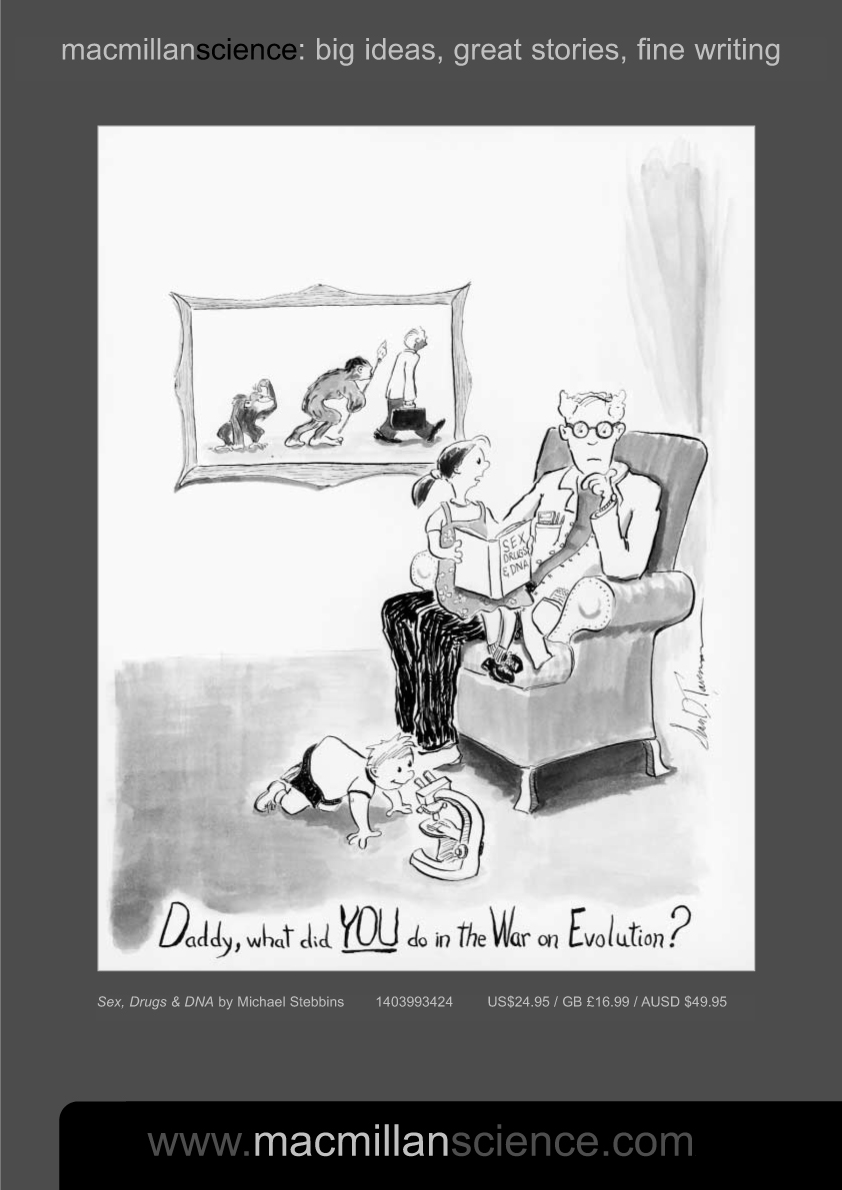
Padian A Racist? I Wonder...
I see that Dembski is ranting about Kevin Padian's recent defense of science talks given at Berkeley and Kansas City. He suggests that Padian's speech was highly offensive:
In two recent “defend science” talks, one at Cal Berkeley and the other at Kansas University, Padian singled out an Asian-American church that supports ID. In March, Berkeley’s IDEA Club sponsored two talks that I gave to packed houses on the Berkeley campus (go here). Some of the key members in that IDEA Club are also members of this church. Padian now explicitly names this church (Berkland Baptist Church) in his public talks and describes the members of the church that attended my lectures as “young,” “Asian,” and “fundamentalist,” and that this is “what we are up against today.”
Now I wasn't there, but I find it interesting that Dembski provides no link for a transcript, audio or anything else verifying exactly what Padian said or providing the context in which he said it (I also can't seem to find anything concrete on the internet). Given typical ID slight-of-hand with mined quotes, forgive me if I remain skeptical until I see some actual data on this. Or should I just be trusting Dembski's account?
(By the way, Samuel Chen has almost the same post up on his blog, almost word-for-word mirror image of Dembski's...apparently originality is not high on the list of ID character traits.)
Note Added Later: Well, I should have looked at Panda's Thumb first, since Nick Matzke has a great post about this - and you guessed it, it's looking like Dembski's playing fast and loose with the facts again...several commenters on Chen's blog also questioned the source...glad to know most of us have developed a nose for rat!
In two recent “defend science” talks, one at Cal Berkeley and the other at Kansas University, Padian singled out an Asian-American church that supports ID. In March, Berkeley’s IDEA Club sponsored two talks that I gave to packed houses on the Berkeley campus (go here). Some of the key members in that IDEA Club are also members of this church. Padian now explicitly names this church (Berkland Baptist Church) in his public talks and describes the members of the church that attended my lectures as “young,” “Asian,” and “fundamentalist,” and that this is “what we are up against today.”
Now I wasn't there, but I find it interesting that Dembski provides no link for a transcript, audio or anything else verifying exactly what Padian said or providing the context in which he said it (I also can't seem to find anything concrete on the internet). Given typical ID slight-of-hand with mined quotes, forgive me if I remain skeptical until I see some actual data on this. Or should I just be trusting Dembski's account?
(By the way, Samuel Chen has almost the same post up on his blog, almost word-for-word mirror image of Dembski's...apparently originality is not high on the list of ID character traits.)
Note Added Later: Well, I should have looked at Panda's Thumb first, since Nick Matzke has a great post about this - and you guessed it, it's looking like Dembski's playing fast and loose with the facts again...several commenters on Chen's blog also questioned the source...glad to know most of us have developed a nose for rat!
Sunday, May 07, 2006
Superstitious Paganism
I've been a bit behind lately, and several bloggers have already mentioned this, but I'm glad to see Catholic scientists calling creationism for what it is: a form of "superstitious paganism". From the article in The Scotsman:
Brother Consolmagno, who works in a Vatican observatory in Arizona and as curator of the Vatican meteorite collection in Italy, said a "destructive myth" had developed in modern society that religion and science were competing ideologies.
He described creationism, whose supporters want it taught in schools alongside evolution, as a "kind of paganism" because it harked back to the days of "nature gods" who were responsible for natural events.
Unfortunately, Catholics are still getting their information on science largely from George Sim Johnston, Michael Behe, Benjamin Wiker and Father John Neuhaus; which means they are still functionally illiterate about evolution.
Brother Consolmagno, who works in a Vatican observatory in Arizona and as curator of the Vatican meteorite collection in Italy, said a "destructive myth" had developed in modern society that religion and science were competing ideologies.
He described creationism, whose supporters want it taught in schools alongside evolution, as a "kind of paganism" because it harked back to the days of "nature gods" who were responsible for natural events.
Unfortunately, Catholics are still getting their information on science largely from George Sim Johnston, Michael Behe, Benjamin Wiker and Father John Neuhaus; which means they are still functionally illiterate about evolution.
An Answer for Dembski
In a comment on my latest post, no less a personality than William Dembski asked what it means by referring to "actual, bona-fide, peer-reviewed articles". I feel relatively convinced that he knows the technical definition of peer-review and was asking the question in a more rhetorical (perhaps pejorative?) manner. So I would like to oblige him with an answer:
It means having the guts to lay your methods and data out in front of the scientific community, those with a familiarity of standards and methods in science, so that others might replicate your work or use your data to further knowledge; or criticize you for trying play fast and loose with your work. It does not mean seeking scientific validity from a scientifically illiterate American public who are largely unable to make a distinction between intelligent design, astrology or alien abductions as scientific pursuits. (Of course, then again, neither can Michael Behe);
It means having the tenacity and talent to pursue supporting data for your hypotheses worthy of your colleagues' attention; it does not mean retreating behind the wall of public opinion when being rejected and complaining about "Darwinian Fundamentalism".
It means actually having data to present and testable hypotheses to explain what the data mean; it does not mean hiding the inadequacies of your hypothesis with the language of political and religious division;
It means letting the data you have stand on its own merits. It does not mean misrepresenting the evidence for competing theories in order to make yours more palatable;
It means have the intellectual and moral integrity to do the dirty work of science like those before you who were not initially believed, but worked hard to get more convincing data.
It means stepping up to the plate and learning to bat with the big boys...
It means having the guts to lay your methods and data out in front of the scientific community, those with a familiarity of standards and methods in science, so that others might replicate your work or use your data to further knowledge; or criticize you for trying play fast and loose with your work. It does not mean seeking scientific validity from a scientifically illiterate American public who are largely unable to make a distinction between intelligent design, astrology or alien abductions as scientific pursuits. (Of course, then again, neither can Michael Behe);
It means having the tenacity and talent to pursue supporting data for your hypotheses worthy of your colleagues' attention; it does not mean retreating behind the wall of public opinion when being rejected and complaining about "Darwinian Fundamentalism".
It means actually having data to present and testable hypotheses to explain what the data mean; it does not mean hiding the inadequacies of your hypothesis with the language of political and religious division;
It means letting the data you have stand on its own merits. It does not mean misrepresenting the evidence for competing theories in order to make yours more palatable;
It means have the intellectual and moral integrity to do the dirty work of science like those before you who were not initially believed, but worked hard to get more convincing data.
It means stepping up to the plate and learning to bat with the big boys...
Saturday, May 06, 2006
Creationist Quote Mining...Again
Afarensis has already corrected Intelligent Design advocate Luskin's errors on the meagerness of the human fossil record directly here and with great posts on just how much information you can get from fragmentary bones here, and here and with links to actual, bona-fide, peer-reviewed articles on the subject here and here. Luskin used quotes out of book review to give the impression that hominid fossil discoveries are limited to what could be held on a good sized table. Now it seems, as we all coud have guessed, that Luskin engaged in the typical creationist tactic of pulling quotes out of context to support your position. I bring this up only because we just discussed the early hominid record in my Anthropology 1 class and the students should be able log in here and see just why Luskin is wrong about the fossil hominid record given the great posts at Afarensis and our discussions in class. But I also wanted to ask a couple of questions. Luskin says the following about the fossil record and paleontologists:
This is especially poignant when one considers that their hypotheses are based upon little evidence...
So, advocates of intelligent design, a) what specific hypotheses has ID developed to test?; and b) what size tables are currently needed to hold data generated by ID? (cafeteria, picnic, Barbie doll house, what?)...
This is especially poignant when one considers that their hypotheses are based upon little evidence...
So, advocates of intelligent design, a) what specific hypotheses has ID developed to test?; and b) what size tables are currently needed to hold data generated by ID? (cafeteria, picnic, Barbie doll house, what?)...
Zooarchaeology and Family Living
Afarensis has nailed the, shall we say "eccentricities" of zooarchaeologists here. After one of the commenters to my blog relayed a story about collecting bones Afarensis followed up with one of his own. I love the idea of zooarchaeology stories, so by all means post here or at Afarensis and let's see how many we can get. The intersection between zooarchaeologists and their families and friends is particularly ripe ground. I have some blogging "catch-up" to do, so I won't post at length at the moment, but here are some teasers from my adventures in bone collection:
1) as Afarensis notes, maintaining a "zooarchaeological collection kit" complete with bags, labels, pens, buckets, etc. at all times in your truck because your wife REFUSES to allow you to put dead animals in hers (I missed a beautiful racoon on the side of the road the other day because of this...);
2) having a bone processing station in your backyard, in town, within site (and smell) of neighbors, and more to the point, actually designing it into your landscaping plan;
3) listening to your wife explain to her friends how, for years we actually had a "wall of bones" in our apartment;
4) yelling at your daughter (and then apologizing profusely!!) for having accidently knocked over (and forever mixing!) the two boxes of snake bones (one rattlesnake, one gopher snake) Daddy had balanced precariously on the edge of the table;
5) redeeming yourself with your daughter by helping her to "excavate" a cat skeleton in a nearby park in full view of joggers and bikers;
6) getting rid of the wall of bones for your wife, but now listening to her explain the poor Georgia O'Keefe imitation decor around the house using skulls O'Keefe never dreamed of;
7) boiling a deer head on the kitchen stove and thinking you could get rid of the smell by adding onions (Honey, it's no different than cooking a stew!!!);
8) leaving a blood trail across the parking lot of the Forest Service office from the cooler your buddy had given you containing an elk head;
9) having a good friend excitedly giving you a tour of the piece of property he just bought, only to have you mostly ignore him while collecting a mountain lion deer kill you happened to stumble across;
10) And finally, I don't have a story about falling in love over a "boiling jackrabbit carcass" that pughd posted on my previous blog, but that one's just too good to not mention....
More to come, but it's probably too close to meal time for most of you...
1) as Afarensis notes, maintaining a "zooarchaeological collection kit" complete with bags, labels, pens, buckets, etc. at all times in your truck because your wife REFUSES to allow you to put dead animals in hers (I missed a beautiful racoon on the side of the road the other day because of this...);
2) having a bone processing station in your backyard, in town, within site (and smell) of neighbors, and more to the point, actually designing it into your landscaping plan;
3) listening to your wife explain to her friends how, for years we actually had a "wall of bones" in our apartment;
4) yelling at your daughter (and then apologizing profusely!!) for having accidently knocked over (and forever mixing!) the two boxes of snake bones (one rattlesnake, one gopher snake) Daddy had balanced precariously on the edge of the table;
5) redeeming yourself with your daughter by helping her to "excavate" a cat skeleton in a nearby park in full view of joggers and bikers;
6) getting rid of the wall of bones for your wife, but now listening to her explain the poor Georgia O'Keefe imitation decor around the house using skulls O'Keefe never dreamed of;
7) boiling a deer head on the kitchen stove and thinking you could get rid of the smell by adding onions (Honey, it's no different than cooking a stew!!!);
8) leaving a blood trail across the parking lot of the Forest Service office from the cooler your buddy had given you containing an elk head;
9) having a good friend excitedly giving you a tour of the piece of property he just bought, only to have you mostly ignore him while collecting a mountain lion deer kill you happened to stumble across;
10) And finally, I don't have a story about falling in love over a "boiling jackrabbit carcass" that pughd posted on my previous blog, but that one's just too good to not mention....
More to come, but it's probably too close to meal time for most of you...
Monday, April 24, 2006
Eagle Lake Zooarchaeology Conference
Well, I won’t make it to the SAA (Society for American Archaeology) meetings in San Juan, Puerto Rico this year (damn!). However, locally the 3rd Annual Stanley J. Olsen Eagle Lake Zooarchaeology Conference will be held again at the CSU Chico Field Station on the shores of lovely Eagle Lake in northeastern California. For more information, please see the conference website. I would encourage any student zooarchaeologists out there to come out and present papers or posters.
Of course, zooarchaeological research and presentations are the main focus, but a cadre of us spends the wee hours of each morning fishing for the mighty Eagle Lake trout. Below you see a stringer, not of Eagle Lake trout, but Tui chub – not good eating, but all are now comparative collections at various institutions in California and Utah (for those of you unfamiliar with zooarchaeology culture, we have this eccentric habit of throwing any dead thing into a bucket to get the bones). Left to right: myself, Jay Bogiatto (CSU Chico Biology Department and Field Station Director), and Frank Bayham (Faculty, CSU Chico Anthropology Department).

Of course, zooarchaeological research and presentations are the main focus, but a cadre of us spends the wee hours of each morning fishing for the mighty Eagle Lake trout. Below you see a stringer, not of Eagle Lake trout, but Tui chub – not good eating, but all are now comparative collections at various institutions in California and Utah (for those of you unfamiliar with zooarchaeology culture, we have this eccentric habit of throwing any dead thing into a bucket to get the bones). Left to right: myself, Jay Bogiatto (CSU Chico Biology Department and Field Station Director), and Frank Bayham (Faculty, CSU Chico Anthropology Department).

Sunday, April 23, 2006
More Scripture To Live By
Now, most of us understand that the Bible cannot be taken seriously as a "moral manual", in part because of its own endless contradictions. As an example, I have always heard the Christian Right use Leviticus as justification for considering homosexuality an abomination. Of course, I have also heard that Leviticus prohibits a number of other things you don't hear about from the Right. However, I had never seen the whole list laid out until I saw this. This is so good I have to post the whole letter here...(I also think Laura Schlessinger has the intellectual capacity of a carp) --
Laura Schlessinger is a US radio personality who dispenses advice to people who call in to her Radio show. On her radio show recently, she said that, as an observant Orthodox Jew, homosexuality is an abomination, according to Leviticus 18:22 and cannot be condoned under any circumstance.The following response is an open letter to Dr. Laura, penned by a US resident, and then posted on the Internet. It's funny, as well as appropriate.
-----------------------------------------------------------------------
Dear Dr. Laura:
Thank you for doing so much to educate people regarding God's Law. I have learned a great deal from your show, and try to share that knowledge with as many people as I can. When someone tries to defend thehomosexual lifestyle, for example, I simply remind them that Leviticus18:22 clearly states it to be an abomination. End of debate. I do need some advice from you, however, regarding some other elements of God's Laws and how to follow them.
1. Leviticus 25:44 states that I may possess slaves, both male andfemale, provided they are purchased from neighbouring nations. A friendof mine claims that this applies to Mexicans, but not Canadians. Can you clarify? Why can't I own Canadians?
2. I would like to sell my daughter into slavery, as sanctioned inExodus 21:7. In this day and age, what do you think would be a fair price for her?
3. I know that I am allowed no contact with a woman while she is inher period of menstrual uncleanliness - Lev.15: 19-24. The problem is how do I tell? I have tried asking, but most women take offence.
4. When I burn a bull on the altar as a sacrifice, I know it creates a pleasing odour for the Lord - Lev.1:9. The problem is, my neighbours.They claim the odour is not pleasing to them. Should I smite them?
5. I have a neighbour who insists on working on the Sabbath. Exodus35:2 clearly states he should be put to death. Am I morally obligated to kill him myself, or should I ask the police to do it?
6. A friend of mine feels that even though eating shellfish is an abomination - Lev. 11:10, it is a lesser abomination than homosexuality. I don't agree. Can you settle this? Are there 'degrees'of abomination?
7. Lev. 21:20 states that I may not approach the altar of God if I have a defect in my sight. I have to admit that I wear reading glasses.Does my vision have to be 20/20, or is there some wiggle-room here?
8. Most of my male friends get their hair trimmed, including the hair around their temples, even though this is expressly forbidden byLev 19:27. How should they die?
9. I know from Lev. 11:6-8 that touching the skin of a dead pig makes me unclean, but may I still play football if I wear gloves?
10. My uncle has a farm. He violates Lev.19:19 by planting two different crops in the same field, as does his wife by wearing garments made of two different kinds of thread (cotton/polyester blend). He also tends to curse and blaspheme a lot. Is it really necessary that we go to all the trouble of getting the whole town together to stone them?(Lev.24:10-16). Couldn't we just burn them to death at a private family affair, like we do with people who sleep with their in-laws? (Lev.20:14)
I know you have studied these things extensively and thus enjoy considerable expertise in such matters, so I am confident you can help.Thank you again for reminding us that God's word is eternal and unchanging.
Your adoring fan.
Laura Schlessinger is a US radio personality who dispenses advice to people who call in to her Radio show. On her radio show recently, she said that, as an observant Orthodox Jew, homosexuality is an abomination, according to Leviticus 18:22 and cannot be condoned under any circumstance.The following response is an open letter to Dr. Laura, penned by a US resident, and then posted on the Internet. It's funny, as well as appropriate.
-----------------------------------------------------------------------
Dear Dr. Laura:
Thank you for doing so much to educate people regarding God's Law. I have learned a great deal from your show, and try to share that knowledge with as many people as I can. When someone tries to defend thehomosexual lifestyle, for example, I simply remind them that Leviticus18:22 clearly states it to be an abomination. End of debate. I do need some advice from you, however, regarding some other elements of God's Laws and how to follow them.
1. Leviticus 25:44 states that I may possess slaves, both male andfemale, provided they are purchased from neighbouring nations. A friendof mine claims that this applies to Mexicans, but not Canadians. Can you clarify? Why can't I own Canadians?
2. I would like to sell my daughter into slavery, as sanctioned inExodus 21:7. In this day and age, what do you think would be a fair price for her?
3. I know that I am allowed no contact with a woman while she is inher period of menstrual uncleanliness - Lev.15: 19-24. The problem is how do I tell? I have tried asking, but most women take offence.
4. When I burn a bull on the altar as a sacrifice, I know it creates a pleasing odour for the Lord - Lev.1:9. The problem is, my neighbours.They claim the odour is not pleasing to them. Should I smite them?
5. I have a neighbour who insists on working on the Sabbath. Exodus35:2 clearly states he should be put to death. Am I morally obligated to kill him myself, or should I ask the police to do it?
6. A friend of mine feels that even though eating shellfish is an abomination - Lev. 11:10, it is a lesser abomination than homosexuality. I don't agree. Can you settle this? Are there 'degrees'of abomination?
7. Lev. 21:20 states that I may not approach the altar of God if I have a defect in my sight. I have to admit that I wear reading glasses.Does my vision have to be 20/20, or is there some wiggle-room here?
8. Most of my male friends get their hair trimmed, including the hair around their temples, even though this is expressly forbidden byLev 19:27. How should they die?
9. I know from Lev. 11:6-8 that touching the skin of a dead pig makes me unclean, but may I still play football if I wear gloves?
10. My uncle has a farm. He violates Lev.19:19 by planting two different crops in the same field, as does his wife by wearing garments made of two different kinds of thread (cotton/polyester blend). He also tends to curse and blaspheme a lot. Is it really necessary that we go to all the trouble of getting the whole town together to stone them?(Lev.24:10-16). Couldn't we just burn them to death at a private family affair, like we do with people who sleep with their in-laws? (Lev.20:14)
I know you have studied these things extensively and thus enjoy considerable expertise in such matters, so I am confident you can help.Thank you again for reminding us that God's word is eternal and unchanging.
Your adoring fan.
Saturday, April 22, 2006
The Christian Downtrodden
I see that DaveScot has post at Uncommon Descent indicating that 48% of Americans feel that those with strong religious beliefs are discriminated against. I would simply point out the following:
31% of Americans believe in the accuracy of astrology;
48% of Americans believe that UFOs are aliens who have visited earth over the years;
52% of Americans believe that bigfoot exists;
And of course,
53% of Americans believe humans came about exactly as the Bible describes;
I'll just let these hang in the air...
31% of Americans believe in the accuracy of astrology;
48% of Americans believe that UFOs are aliens who have visited earth over the years;
52% of Americans believe that bigfoot exists;
And of course,
53% of Americans believe humans came about exactly as the Bible describes;
I'll just let these hang in the air...
Christians As Conservationists
The latest issue of National Parks has an article by Peter Illyn, executive director of Restoring Eden, a ministry working to help Christians appreciate nature and make meaningful changes consistent with an environmental ethic. I believe the intended message is that Christians, evangelical Christians in particular, must take a more active role in environmental conservation and protection because love of the Creator goes hand-in-hand with love of the Creation. As Illyn suggests:
For those with a religious faith, it’s really a simple concept: If we love the Creator, we must take care of creation. It’s a philosophy that puts environmentalists and evangelicals in the same boat—awkward companions to say the least. Although their divergent belief systems have led them to view each other with a fair degree of mistrust, they have much in common.
Reading this reminded me of a series of articles appearing in Conservation Biology last year. David Orr, an ecologist at Oberlin College, in an article entitled “Armageddon Versus Extinction” (Orr 2005a), writes exquisitely regarding the negative effects of conservative, evangelical Christian belief systems on science in general, and biological conservation in particular. A particularly strident belief in end-times philosophy, biblical literalism, and an eagerness to deny any science that counters Scripture have coalesced well with conservative goals of reducing constraints (particularly environmental ones) on business and development. Right-wing conservative Christians have been placed in positions of power in environmental regulatory agencies across the nation, and the effect has been to take down whatever thin veils of environmental protection existed, outsource those responsible for ensuring environmental regulation, and to restrict science unless it favors unconstrained economic advance (or particular scriptural views). The relationship between conservative Christian evangelicals and conservation biology is not altogether clear. In fact, it’s quite schizophrenic. As Orr notes,
On one side, belief in the imminence of the end-times tends to make evangelicals careless stewards of our forests, soils, wildlife, air, water, seas and climate.
Yet there is also the other side, expressed currently in National Parks by Peter Illyn, which sees significant scriptural precedence for environmental conservation, species protection and ecosystem restoration. The problem, as Orr notes, is that right-wing conservatives have played to scriptural inerrancy and an end-times philosophy to gain evangelical support and open the door to a “grand larceny” of our nation’s resources. And many Christian evangelicals have enthusiastically jumped at the political opportunity:
…by becoming an active political force on the extreme right wing of U.S. politics, conservative evangelicals have made an unholy alliance with the vendors of fossil fuels, climate changers, polluters, sellers of weapons, the military, imperialists, exploiters, political dirty tricksters who assume that the ends they’ve chosen justify whatever means they use, spin artists, those willing to corrupt scientific truth for political gain, and those for whom law and the Constitution are merely scraps of paper…But against the example of Jesus who refused to be tempted by the prospect of holding political power, conservative evangelicals are now complicit with the political forces sweeping us toward more terrible violence and the avoidable catastrophes of climate change and ecological ruin.
But in accepting a greater political role, these same Christian conservatives (I would throw conservative Catholics into this mix as well) have abandoned scriptural integrity (at least with regard to views on the environment) in favor of quenching a lust for power. Whether knowingly, or being unwittingly duped by the politically slick who effectively stroke evangelical egos, conservative Christians are “aiding and abetting” forces of environmental destruction.
Orr’s comments naturally drew fire from Christians who consider themselves conservationists and who pointed out a number of evangelical organizations concerned with environmental protection (Johns 2005; van Dyke 2005, Stuart et al. 2005 and several others in those issues). Responses also tended to emphasize the fact that many evangelical Christians are not conservative. Fine…great. I think it is fair to say that no matter the particular characteristic or the group of people to whom we refer, us scientific types are always assuming a Poisson distribution and are concerned with a couple of sigmas around the mean, NOT the tails. There’s no expectation that a given population is completely uniform…we’ll leave make-believe black and white distinctions to FOX news.
But if you consider conservative Christians as a group, it is very, very, VERY difficult to consider them, especially in this day and age, to be pro-conservation. I have no doubt Christian organizations exist that are sincerely concerned with protecting “God’s Creation” from unconstrained human growth and resource exploitation. The problem is that these groups are few and more importantly, they currently have no voice in the national debate on this issue. In many respects this is not their fault; the current conservative media machine dominating the airwaves did not arise overnight and neither will successful opposition to it. But there is something running through their counter-arguments for which they can be faulted. Despite attempts by moderate and “environmental” Christians to distinguish themselves from their conservative cousins, they are still hamstrung by a backdrop of apologetics that makes their case for preserving God’s creation appear forced at best, and at worst, insincere, perhaps even phony. It is not at all clear that they wish to distance themselves from the conservative take-over of Christianity so much as they want to maintain Christian unity. “Wait, Wait” they cry, “Christianity is not a bad thing”. I’m sorry, but let’s be blunt: Christianity in the hands of conservatives IS a bad thing.
In Orr’s first article he makes it very clear the time may be past for a tolerant approach to the conservative Christian assault on the environment. Using Sam Harris’s book, The End of Faith (2004) as a springboard, Orr writes:
In his view [Sam Harris] religious faith – unmoored from fact, data, logic, and the procedures of verifiability – poses a mortal danger to civilization. His book is rather like a stern reprimand for foolish and dangerous religious thinking that has pervaded human cultures and now, with dispersion of weapons of mass destruction, threatens to undo civilization entirely. This is not the time, Harris writes, to preach tolerance of views that are patently disgusting, violent, and dangerous on a global scale, but rather a time to call fundamentalists – Muslim and Christian alike – to account.
This confrontational approach did not sit well with the “environmental” Christian respondents to Orr’s piece. They preferred a strategy of “Christian discourse” with their conservative brethren. That in itself is suggestive of a position more in line with defending Christian unity than advocating biological conservation. In a response article (Orr 2005b) Orr parries this notion beautifully:
Fourth, Stuart et al. say they are most disturbed by my call “for confrontation rather than dialog with evangelicals.” But I did no such thing. What I did was to ruminate a bit on the costs and benefits of various strategies without settling on any one in particular…There is a deeper issue, however; Stuart et al. are afraid, I think, of being impolite, of giving offense. But what particular style of Christian discourse would they propose? Would it be that of Moses who shattered the Ten Commandments at the feet of the backsliding Israelites? Or that of the Old Testament prophets who called wayward people to task with unsparing honesty? Or that of Jesus? How was it that he proposed to “dialogue constructively” with money changers in the temple?...
As much as I would like to see a Christian force behind environmental conservation (we can after all, use all the help we can get), I do not see that Christian conservationists are sufficiently distancing themselves from conservatives. Until that happens, the term “Christian conservationist” remains somewhat of an oxymoron.
There is another problem I have with the concept of conservative Christian conservationists. None of the respondents to Orr’s article defended science as the means for identifying and implementing conservation efforts and environmental protection. Turning back to the current National Parks article, Peter Illyn writes the following:
My faith tradition teaches that humans are unique in all of God’s creation—only we are made in the image of God, and we alone have the divinely given capacity of self-awareness and of free-will. We alone create art and music, build tools, and construct language. Humanity has an exceptional place in the created order, but we seem to have forgotten that we were created last and designed by God not to be independent of the rest of creation. We were made from the dust of the Earth, we are still connected to the Earth, and we will return to the Earth. This is the epiphany of interconnectedness.
If Illyn invokes this as a religious metaphor, that’s great…but the view does nothing to aid in conservation goals. If it is intended to a statement of science, then we have serious problems that really lie at the heart of differences between science and religion for approaching environmental preservation and sustainability. Our “interconnectedness” with the rest of the earth is rooted in our shared evolutionary history and ecological relationships with every aspect of every ecosystem across the planet. Humans may have the cognitive ability to create oral, written and artistic facades of uniqueness that serve to convince us of a special position within the hierarchy of life, but we are still ecological beings. We suffer from pandemics of disease; we must find and use resources and structure our social lives around those resources; when those run out, we must find more; we must compete, fend off attacks, raise our young to compete in the world and successfully raise their own offspring. And, a la Eric Pianka, we are as subject to vagaries of population pressure as bacteria in a Petri dish. Our archaeological past tells us that the human species has survived only because technology mediated its effect upon us or increased the efficiency with which we extract resources. But technology has not altered fundamental principles of competition, resource extraction and depletion, reproduction…or mortality. Technology has only changed the scale at which humans function within ecosystems. And make no mistake…along the way, there have been casualties, lots of casualties. The archaeological record is replete with extinct civilizations (it’s what keeps us archaeologists in business!)…most of whom exhibited “faith” in some kind of god or deity. But extinction ignores religion.
Illyn’s article and those responding to Orr are full of biblical platitudes, but none help the advance of conservation. None acknowledge science, particularly evolutionary theory, as a basis for understanding environmental protection. And none offer to assault the powerful conservative Christian community head-on for being scripturally defective. Until environmentally concerned Christians are willing to sacrifice Christian unity for the objectives of environmental preservation it will be difficult to broadly paint Christianity as anything but a foe of the Creation.
Johns, D. M. (2005) Orr and Armageddon: building a coalition. Conservation Biology 19(6): 1685-86.
Stuart, S. N. et al. (2005) Conservation theology for conservation biologists – a reply to Orr. Conservation Biology 19(6): 1689-92.
Van Dyke, F. (2005) Between heaven and earth: evangelical engagement in conservation. Conservation Biology 19 (6): 1693-96.
Orr, D. W. (2005a) Armageddon versus extinction. Conservation Biology 19(2): 290-92.
Orr, D. W. (2005b) A Response. Conservation Biology 19(6): 1697-98.
For those with a religious faith, it’s really a simple concept: If we love the Creator, we must take care of creation. It’s a philosophy that puts environmentalists and evangelicals in the same boat—awkward companions to say the least. Although their divergent belief systems have led them to view each other with a fair degree of mistrust, they have much in common.
Reading this reminded me of a series of articles appearing in Conservation Biology last year. David Orr, an ecologist at Oberlin College, in an article entitled “Armageddon Versus Extinction” (Orr 2005a), writes exquisitely regarding the negative effects of conservative, evangelical Christian belief systems on science in general, and biological conservation in particular. A particularly strident belief in end-times philosophy, biblical literalism, and an eagerness to deny any science that counters Scripture have coalesced well with conservative goals of reducing constraints (particularly environmental ones) on business and development. Right-wing conservative Christians have been placed in positions of power in environmental regulatory agencies across the nation, and the effect has been to take down whatever thin veils of environmental protection existed, outsource those responsible for ensuring environmental regulation, and to restrict science unless it favors unconstrained economic advance (or particular scriptural views). The relationship between conservative Christian evangelicals and conservation biology is not altogether clear. In fact, it’s quite schizophrenic. As Orr notes,
On one side, belief in the imminence of the end-times tends to make evangelicals careless stewards of our forests, soils, wildlife, air, water, seas and climate.
Yet there is also the other side, expressed currently in National Parks by Peter Illyn, which sees significant scriptural precedence for environmental conservation, species protection and ecosystem restoration. The problem, as Orr notes, is that right-wing conservatives have played to scriptural inerrancy and an end-times philosophy to gain evangelical support and open the door to a “grand larceny” of our nation’s resources. And many Christian evangelicals have enthusiastically jumped at the political opportunity:
…by becoming an active political force on the extreme right wing of U.S. politics, conservative evangelicals have made an unholy alliance with the vendors of fossil fuels, climate changers, polluters, sellers of weapons, the military, imperialists, exploiters, political dirty tricksters who assume that the ends they’ve chosen justify whatever means they use, spin artists, those willing to corrupt scientific truth for political gain, and those for whom law and the Constitution are merely scraps of paper…But against the example of Jesus who refused to be tempted by the prospect of holding political power, conservative evangelicals are now complicit with the political forces sweeping us toward more terrible violence and the avoidable catastrophes of climate change and ecological ruin.
But in accepting a greater political role, these same Christian conservatives (I would throw conservative Catholics into this mix as well) have abandoned scriptural integrity (at least with regard to views on the environment) in favor of quenching a lust for power. Whether knowingly, or being unwittingly duped by the politically slick who effectively stroke evangelical egos, conservative Christians are “aiding and abetting” forces of environmental destruction.
Orr’s comments naturally drew fire from Christians who consider themselves conservationists and who pointed out a number of evangelical organizations concerned with environmental protection (Johns 2005; van Dyke 2005, Stuart et al. 2005 and several others in those issues). Responses also tended to emphasize the fact that many evangelical Christians are not conservative. Fine…great. I think it is fair to say that no matter the particular characteristic or the group of people to whom we refer, us scientific types are always assuming a Poisson distribution and are concerned with a couple of sigmas around the mean, NOT the tails. There’s no expectation that a given population is completely uniform…we’ll leave make-believe black and white distinctions to FOX news.
But if you consider conservative Christians as a group, it is very, very, VERY difficult to consider them, especially in this day and age, to be pro-conservation. I have no doubt Christian organizations exist that are sincerely concerned with protecting “God’s Creation” from unconstrained human growth and resource exploitation. The problem is that these groups are few and more importantly, they currently have no voice in the national debate on this issue. In many respects this is not their fault; the current conservative media machine dominating the airwaves did not arise overnight and neither will successful opposition to it. But there is something running through their counter-arguments for which they can be faulted. Despite attempts by moderate and “environmental” Christians to distinguish themselves from their conservative cousins, they are still hamstrung by a backdrop of apologetics that makes their case for preserving God’s creation appear forced at best, and at worst, insincere, perhaps even phony. It is not at all clear that they wish to distance themselves from the conservative take-over of Christianity so much as they want to maintain Christian unity. “Wait, Wait” they cry, “Christianity is not a bad thing”. I’m sorry, but let’s be blunt: Christianity in the hands of conservatives IS a bad thing.
In Orr’s first article he makes it very clear the time may be past for a tolerant approach to the conservative Christian assault on the environment. Using Sam Harris’s book, The End of Faith (2004) as a springboard, Orr writes:
In his view [Sam Harris] religious faith – unmoored from fact, data, logic, and the procedures of verifiability – poses a mortal danger to civilization. His book is rather like a stern reprimand for foolish and dangerous religious thinking that has pervaded human cultures and now, with dispersion of weapons of mass destruction, threatens to undo civilization entirely. This is not the time, Harris writes, to preach tolerance of views that are patently disgusting, violent, and dangerous on a global scale, but rather a time to call fundamentalists – Muslim and Christian alike – to account.
This confrontational approach did not sit well with the “environmental” Christian respondents to Orr’s piece. They preferred a strategy of “Christian discourse” with their conservative brethren. That in itself is suggestive of a position more in line with defending Christian unity than advocating biological conservation. In a response article (Orr 2005b) Orr parries this notion beautifully:
Fourth, Stuart et al. say they are most disturbed by my call “for confrontation rather than dialog with evangelicals.” But I did no such thing. What I did was to ruminate a bit on the costs and benefits of various strategies without settling on any one in particular…There is a deeper issue, however; Stuart et al. are afraid, I think, of being impolite, of giving offense. But what particular style of Christian discourse would they propose? Would it be that of Moses who shattered the Ten Commandments at the feet of the backsliding Israelites? Or that of the Old Testament prophets who called wayward people to task with unsparing honesty? Or that of Jesus? How was it that he proposed to “dialogue constructively” with money changers in the temple?...
As much as I would like to see a Christian force behind environmental conservation (we can after all, use all the help we can get), I do not see that Christian conservationists are sufficiently distancing themselves from conservatives. Until that happens, the term “Christian conservationist” remains somewhat of an oxymoron.
There is another problem I have with the concept of conservative Christian conservationists. None of the respondents to Orr’s article defended science as the means for identifying and implementing conservation efforts and environmental protection. Turning back to the current National Parks article, Peter Illyn writes the following:
My faith tradition teaches that humans are unique in all of God’s creation—only we are made in the image of God, and we alone have the divinely given capacity of self-awareness and of free-will. We alone create art and music, build tools, and construct language. Humanity has an exceptional place in the created order, but we seem to have forgotten that we were created last and designed by God not to be independent of the rest of creation. We were made from the dust of the Earth, we are still connected to the Earth, and we will return to the Earth. This is the epiphany of interconnectedness.
If Illyn invokes this as a religious metaphor, that’s great…but the view does nothing to aid in conservation goals. If it is intended to a statement of science, then we have serious problems that really lie at the heart of differences between science and religion for approaching environmental preservation and sustainability. Our “interconnectedness” with the rest of the earth is rooted in our shared evolutionary history and ecological relationships with every aspect of every ecosystem across the planet. Humans may have the cognitive ability to create oral, written and artistic facades of uniqueness that serve to convince us of a special position within the hierarchy of life, but we are still ecological beings. We suffer from pandemics of disease; we must find and use resources and structure our social lives around those resources; when those run out, we must find more; we must compete, fend off attacks, raise our young to compete in the world and successfully raise their own offspring. And, a la Eric Pianka, we are as subject to vagaries of population pressure as bacteria in a Petri dish. Our archaeological past tells us that the human species has survived only because technology mediated its effect upon us or increased the efficiency with which we extract resources. But technology has not altered fundamental principles of competition, resource extraction and depletion, reproduction…or mortality. Technology has only changed the scale at which humans function within ecosystems. And make no mistake…along the way, there have been casualties, lots of casualties. The archaeological record is replete with extinct civilizations (it’s what keeps us archaeologists in business!)…most of whom exhibited “faith” in some kind of god or deity. But extinction ignores religion.
Illyn’s article and those responding to Orr are full of biblical platitudes, but none help the advance of conservation. None acknowledge science, particularly evolutionary theory, as a basis for understanding environmental protection. And none offer to assault the powerful conservative Christian community head-on for being scripturally defective. Until environmentally concerned Christians are willing to sacrifice Christian unity for the objectives of environmental preservation it will be difficult to broadly paint Christianity as anything but a foe of the Creation.
Johns, D. M. (2005) Orr and Armageddon: building a coalition. Conservation Biology 19(6): 1685-86.
Stuart, S. N. et al. (2005) Conservation theology for conservation biologists – a reply to Orr. Conservation Biology 19(6): 1689-92.
Van Dyke, F. (2005) Between heaven and earth: evangelical engagement in conservation. Conservation Biology 19 (6): 1693-96.
Orr, D. W. (2005a) Armageddon versus extinction. Conservation Biology 19(2): 290-92.
Orr, D. W. (2005b) A Response. Conservation Biology 19(6): 1697-98.
Sunday, April 16, 2006
Bone Fragments and Archaeology
Afarensis had a great post yesterday on the value of fossil bone fragments for what they can tell us, not only about species, but behavior as well. I've been meaning to comment on this site: it is one of the better resources for anthropology on the internet. He has most of the major archaeology journals bookmarked (some with free content) and as a professional archaeologist I use Afarensis frequently to aid in my research. He even has links to papers written by undergraduate advisor while at UC Davis: Henry McHenry (which also lists my first "professional" publication - a Current Anthropology comment Henry and I wrote in 1986).
The post nails a number of points regarding the science of "reconstructing" the anatomy of individuals from small bone fragments, especially the manner in which creationists frequently dismiss fossils as telling us anything important. As Afarensis suggests, such a view has less to do with fragmentary fossils telling a valid story than with the gross misunderstanding creationists have of skeletal anatomy. Afarensis discusses the value of small fragments for interpretation in human paleontology, but the same goes for zooarchaeology - the study of animal bone in archaeological sites. With the right expertise, even small fragments can yield a large amount of information. Information, by the way, that is testable against other observations and data.
 This got me thinking about something else small (and large) fragments of animal bone can tell us; something that runs counter to the goals of Intelligent Design in particular: the nature of the Designer. The photo at left depicts a scatter of bones and bone fragments (they all happen to be from a zebra) around an obvious pile of ashes. Bone fragments include a skull fragment, ribs, and few vertebra, plus a collection of smaller fragments that all come from those same skeletal elements. This collection of bones and ash was "designed" in the sense that a Designer of higher intelligence was responsible for the patterning (in this case, the "Designers" happen to be Hadza hunters in Tanzania) and not "natural" agents such as lions, water transport or wind. Marks on many of the bones clearly come from the cutting action of knives and the pounding action of stones or other hard objects. Even small fragments of bone can identify the species and anatomical part from which they derive. Small fragments can also retain the evidence of "intelligent" involvement, such as cutmarks or unique fracture patterns.
 This collection is also designed (again by the same Hadza agents). Unlike the collection above, this shows different parts of the skeleton: lots of leg bones (femora, tibia, metapodials, carpals and tarsals, phalanges). Many of these also have the same tell-tale signs of human-induced damage from knives, rocks and other blunt instruments. Both assemblages differ markedly from "natural" bone assemblages that can be found on the African landscape (or any other continental landscape, for that matter). They are not like the bone assmblages left after lion kills, the scavenging of hyenas, or like collections from porcupines. They were not wind-blown, water transported or eroded into place. I also know
that this assemblage is different from the one above and suggestive of different behaviors on
the part of its human "designers". The study of both assemblages (and the data collected on each) is also a result of archaeological research (a particular kind of archaeological research called "ethnoarchaeology") and exemplifies the primary goal of archaeology.
Intelligent Design advocates frequently invoke archaeology as an analogy to the search for intelligent design in biological systems. But the archaeological study of bone assemblages, like other aspects of archaeology, shows clearly why it is far more advanced than intelligent design and why the latter fails as a science. Archaeology constantly generates and tests hypotheses about its observations; more to the point, these hypotheses specifically seek distinctions between the human designer and non-human counterparts. I can test observations about what makes hyena bone distributions different from human ones; I can test the physical attributes of cutmarks produced by cutting implements; I can test the distinction between carnivore damage and tool damage; I can test the bone pattern differences between kill sites and base camps; I can even test how water affects bone distribution. And in every case, the difficulty lies with empirically demonstrating that the designed assemblages are actually different from the "natural" assemblages...not the other way around. Historically, the assumption has generally been that this or that assemblage must have been designed by humans, simply because the discoverers could not conceive of anything in nature producing the same pattern. Of course, time and again, in the history of archaeology, it was shown that nature could easily come up with the same pattern. Designed complexity was not self-evident. Years of hard work, replicative studies and hypothesis testing were required to confidently tease human agents from non-human ones. Intelligent Design hasn't even attempted this kind of research.
Finally, as I've stated before, the explicit goal of archaeology is to understand the Designer. Patterning in the archaeological record, even apparently obvious patterns such as Easter Island stone heads or an obsidian arrowhead are only important in as much as they tell us something about their designers. The bone assemblages above tell me a lot about the circumstances under which they were produced. They even tell me something about the intentions and capabilities of the humans who produced them. Intelligent Design is not concerned about who the designer is...another reason why ID is not even closely related to archaeology.
 Nor does ID generate applicable knowledge. Look at this final photograph from a fossil bone assemblage in East Africa. Because of research done on the bone assemblages above, archaeologists know that it contains both cut-marks and carnivore damage; it has been affected by water, but was deposited largely by human (designed) action; it's patterning is similar to that depicted in the second photo above, suggesting it was the result of a particular set of behaviors on the part of its designer. More importantly, it tells us that its designer was not quite human and did not behave the same way as the modern humans who produced the two bone assemblages above did. It also tells us the designer was constrained by behavior, mental capacity, technology and access to resources.
Intelligent Design is not analogous to archaeology. It doesn't even come close.
The post nails a number of points regarding the science of "reconstructing" the anatomy of individuals from small bone fragments, especially the manner in which creationists frequently dismiss fossils as telling us anything important. As Afarensis suggests, such a view has less to do with fragmentary fossils telling a valid story than with the gross misunderstanding creationists have of skeletal anatomy. Afarensis discusses the value of small fragments for interpretation in human paleontology, but the same goes for zooarchaeology - the study of animal bone in archaeological sites. With the right expertise, even small fragments can yield a large amount of information. Information, by the way, that is testable against other observations and data.
 This got me thinking about something else small (and large) fragments of animal bone can tell us; something that runs counter to the goals of Intelligent Design in particular: the nature of the Designer. The photo at left depicts a scatter of bones and bone fragments (they all happen to be from a zebra) around an obvious pile of ashes. Bone fragments include a skull fragment, ribs, and few vertebra, plus a collection of smaller fragments that all come from those same skeletal elements. This collection of bones and ash was "designed" in the sense that a Designer of higher intelligence was responsible for the patterning (in this case, the "Designers" happen to be Hadza hunters in Tanzania) and not "natural" agents such as lions, water transport or wind. Marks on many of the bones clearly come from the cutting action of knives and the pounding action of stones or other hard objects. Even small fragments of bone can identify the species and anatomical part from which they derive. Small fragments can also retain the evidence of "intelligent" involvement, such as cutmarks or unique fracture patterns.
 This collection is also designed (again by the same Hadza agents). Unlike the collection above, this shows different parts of the skeleton: lots of leg bones (femora, tibia, metapodials, carpals and tarsals, phalanges). Many of these also have the same tell-tale signs of human-induced damage from knives, rocks and other blunt instruments. Both assemblages differ markedly from "natural" bone assemblages that can be found on the African landscape (or any other continental landscape, for that matter). They are not like the bone assmblages left after lion kills, the scavenging of hyenas, or like collections from porcupines. They were not wind-blown, water transported or eroded into place. I also know
that this assemblage is different from the one above and suggestive of different behaviors on
the part of its human "designers". The study of both assemblages (and the data collected on each) is also a result of archaeological research (a particular kind of archaeological research called "ethnoarchaeology") and exemplifies the primary goal of archaeology.
Intelligent Design advocates frequently invoke archaeology as an analogy to the search for intelligent design in biological systems. But the archaeological study of bone assemblages, like other aspects of archaeology, shows clearly why it is far more advanced than intelligent design and why the latter fails as a science. Archaeology constantly generates and tests hypotheses about its observations; more to the point, these hypotheses specifically seek distinctions between the human designer and non-human counterparts. I can test observations about what makes hyena bone distributions different from human ones; I can test the physical attributes of cutmarks produced by cutting implements; I can test the distinction between carnivore damage and tool damage; I can test the bone pattern differences between kill sites and base camps; I can even test how water affects bone distribution. And in every case, the difficulty lies with empirically demonstrating that the designed assemblages are actually different from the "natural" assemblages...not the other way around. Historically, the assumption has generally been that this or that assemblage must have been designed by humans, simply because the discoverers could not conceive of anything in nature producing the same pattern. Of course, time and again, in the history of archaeology, it was shown that nature could easily come up with the same pattern. Designed complexity was not self-evident. Years of hard work, replicative studies and hypothesis testing were required to confidently tease human agents from non-human ones. Intelligent Design hasn't even attempted this kind of research.
Finally, as I've stated before, the explicit goal of archaeology is to understand the Designer. Patterning in the archaeological record, even apparently obvious patterns such as Easter Island stone heads or an obsidian arrowhead are only important in as much as they tell us something about their designers. The bone assemblages above tell me a lot about the circumstances under which they were produced. They even tell me something about the intentions and capabilities of the humans who produced them. Intelligent Design is not concerned about who the designer is...another reason why ID is not even closely related to archaeology.
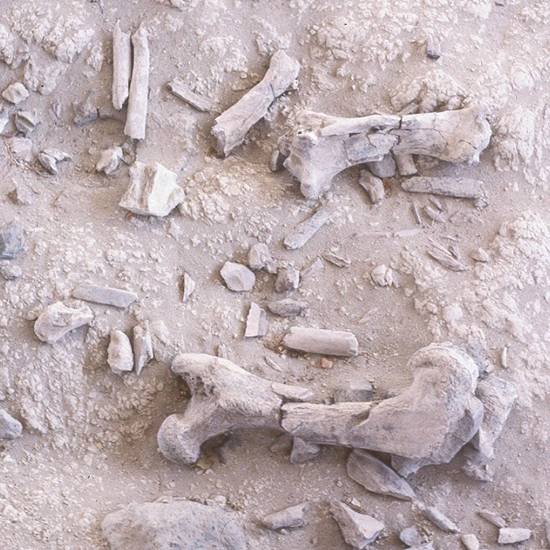 Nor does ID generate applicable knowledge. Look at this final photograph from a fossil bone assemblage in East Africa. Because of research done on the bone assemblages above, archaeologists know that it contains both cut-marks and carnivore damage; it has been affected by water, but was deposited largely by human (designed) action; it's patterning is similar to that depicted in the second photo above, suggesting it was the result of a particular set of behaviors on the part of its designer. More importantly, it tells us that its designer was not quite human and did not behave the same way as the modern humans who produced the two bone assemblages above did. It also tells us the designer was constrained by behavior, mental capacity, technology and access to resources.
Intelligent Design is not analogous to archaeology. It doesn't even come close.
Saturday, April 15, 2006
Scary Indeed
This, indeed is scary (from Pharyngula this morning). Where is the rest of the so-called Christian community on this? I'm sorry, but until I see some major rebellion against this coming from the less fanatical Christians out there then one can only conclude that Christianity in America is being represented fairly by these folks. If this is not the American Taliban, they're certainly the best candidate out there.
Fear and Loathing in Las Vegas
My apologies for not updating frequently but it was Spring Break and the family and I just returned from Las Vegas. I had intended to write while there, but hey, it's Las Vegas....
I have to comment on something, however. I never intended this blog to be a personal online journal, but there's something my family and I encounter a lot in Reno and Las Vegas that has just started to bother the hell out me, and it's something I've never told the rest of the family. But I have to come out now and tell the world (or at least the 20 people who visit my blog each day!) how I fell about...buffets. My kids in particular love to go to buffets, especially those at the bigger casinos: Nugget, Atlantis, Peppermill, Aladdin, Tropicana, Palms...you get the picture, we've been to quite a few. But I've come to realize that buffets are the epitomy of American largesse, greed, rudeness, self-rightousness and above all, gluttony. I've never seen so many people, packing so many pounds, move so fast to get to the last Chinese egg roll. Maybe it's because I've spent so much time in rural and bush Africa, seeing friends go without a decent meal for days and never complain that this is starting to get to me. Last week I encountered a relatively rotund older woman and her husband rudely cutting in front of people to get to a particular food item. (I would have understood if they had been going for the Tandoori Chicken kabobs, which the staff was having trouble keeping stocked; but they were aiming for the mounds of mashed potatoes and fried chicken!). Forgive me, but these two could have fed a pride of lions for a year, yet they had that look of panic on their faces like Death was on their heels if they didn't make their food quota for the day. I was thinking the whole time I would have loved to have airlifted most of the patrons in the place to the middle of the Kalahari just to see how many would make it to Gaborone on foot.
Now look, I'll be the first to admit hypocrisy. I'm overweight myself (althought not nearly as much as the majority of buffet patrons I encounter - plus I'm actively working on it). And I still go to buffets, so my actions are counter to my words on the subject. Nor am I against overweight people. But really, how much food does one person need?
I have to comment on something, however. I never intended this blog to be a personal online journal, but there's something my family and I encounter a lot in Reno and Las Vegas that has just started to bother the hell out me, and it's something I've never told the rest of the family. But I have to come out now and tell the world (or at least the 20 people who visit my blog each day!) how I fell about...buffets. My kids in particular love to go to buffets, especially those at the bigger casinos: Nugget, Atlantis, Peppermill, Aladdin, Tropicana, Palms...you get the picture, we've been to quite a few. But I've come to realize that buffets are the epitomy of American largesse, greed, rudeness, self-rightousness and above all, gluttony. I've never seen so many people, packing so many pounds, move so fast to get to the last Chinese egg roll. Maybe it's because I've spent so much time in rural and bush Africa, seeing friends go without a decent meal for days and never complain that this is starting to get to me. Last week I encountered a relatively rotund older woman and her husband rudely cutting in front of people to get to a particular food item. (I would have understood if they had been going for the Tandoori Chicken kabobs, which the staff was having trouble keeping stocked; but they were aiming for the mounds of mashed potatoes and fried chicken!). Forgive me, but these two could have fed a pride of lions for a year, yet they had that look of panic on their faces like Death was on their heels if they didn't make their food quota for the day. I was thinking the whole time I would have loved to have airlifted most of the patrons in the place to the middle of the Kalahari just to see how many would make it to Gaborone on foot.
Now look, I'll be the first to admit hypocrisy. I'm overweight myself (althought not nearly as much as the majority of buffet patrons I encounter - plus I'm actively working on it). And I still go to buffets, so my actions are counter to my words on the subject. Nor am I against overweight people. But really, how much food does one person need?
Subscribe to:
Posts (Atom)