Friday, September 22, 2006

National Museum of Kenya

In addition to previously commenting on the rediculousness of Bishop Adoyo and his insistence that human fossils be hidden from public view at the National Museum of Kenya, I had wanted to post some photos but had been having problems with getting them on the blog. I seem to have fixed that, so here we go....

I had the good fortune to conduct research in Kenya during the late 1980s and early 1990s on a game ranch just outside of Nairobi (near the town of Machakos). It was a wonderful experience, and of course I was able to spend some time at the National Museum (I even received fossil samples (non-human) from the museum for analysis in my dissertation). I always enjoyed the museum, particularly the outdoor "snake park" exhibits. Here are two of my favorites:


This guy was always fairly active for your typical crocodile...but what I really got a kick out of were the signs posted all along the fences:


I also loved the signs in the middle of the open area housing venomous snakes:


I really hope the museum rejects the insane opinion of a superstitious, mideaeval-thinking bishop who seems to be more comfortable with mythology than reason.

Richard Dawkins Foundation for Reason & Science

Via PZ and BigDumbChimp I was perusing a new website for the Richard Dawkins Foundation for Reason & Science. I agree with PZ - here's a charity I can send my tax-deductible donations to!!! But I was exploring some of the articles on the site and found this one by Johann Hari, which appeared in the London Independent on 21 September. The second paragraph in particular was too good to pass up:

Both Joseph Ratzinger and the Islamists calling for his decapitation believe they have direct access to an invisible supernatural being called “God”. Both believe this God wills them to make decisions that have led to the horrific deaths of tens of thousands of people. Both believe this God finds secular democratic Europe disgusting, an atheistic bog dominated by a “culture of death.” Both hate feminism and gay rights and sexual freedom. Both believe they are infallible, and that the billions who refuse to follow them are incurring the wrath of the Creator of the Universe. The only real difference is the name they give to this creature, and a few added textual tweaks on either side.

There are too many other good points in this article and I would recommend you read it yourself. However, just a couple more that struck a personal chord with me:

The tragedy is that when there are so many good reasons to hate Joseph Ratzinger, this week’s rioters have chosen one of the few bogus ones. For over a decade now, he has been one of the primary defenders of priests who go to the poorest, most vulnerable people in the world and tell them condoms are the cause of AIDS. In the past year, I have sat in two Catholic churches thousands of miles apart and listened while a Catholic priest told illiterate people with no alternative sources of information that condoms come pre-infected with AIDS and are the reason people die of it. In Bukavu, a crater-city in Congo, and in the slums ringing Caracas, Venezuela, people believed it. They told me they “would not go to Heaven” if they used condoms, and that condoms contain tiny invisible holes through which the virus passes – the advice their priest had doled out.

This is one of the main reasons I have a real distaste for missionaries. Their "logic" depends on being doled out to illiterate people - without that, there would be no message. And they use that position to convey some of the most inaccurate information available to people who don't know the difference. Having seen some of this first hand, I have to wonder if many of Africa's problems with poverty, disease, overcrowding and despotism aren't ultimately due to the incessant interference from missionaries. They'd be better off to kick missionaries of all stripes out of their country.

One more item from the article:

But there is a deeper philosophical repugnance to Ratzinger lying beneath these individual decisions. His recent lecture was devoted to the premise that the free pursuit of reason will lead all people to a rational belief in the Christian God described in the Bible. (You know – the God who explicitly supports slavery, commits genocide against the Amelkites, stones prostitutes, and feeds small children to bears). The Christian God is Reason Personified, while the Muslim God is “beyond reason” – hence the fuss. But this intra-superstitious squabble is not the real outrage.

However much he swears it is not, this argument is deeply anti-Enlightenment. The central insight of the Enlightenment is that there are two fundamentally different ways to understand the world. One is divine revelation, where a being contacts you from another realm and discloses some truth. (Another word for this is ‘hallucination’). The second method is reason – observing the world empirically, and drawing conclusions from the things we observe. The ultimate expression of reason is the scientific method. These approaches are fundamentally contrasting, and you cannot simply weld them together with contorted theological trickery.

By claiming that divine revelation leads to reason – indeed, is its central underpinning – Ratzinger is subtly attacking the core principles of the Enlightenment. There is nothing we can observe in the world that leads us rationally to conclude a magical creature created it. But Ratzinger wants to be able to claim the fruits of the Enlightenment, like science, without following its basic principles. Whenever people do try to stretch reason to accord with faith – as he demands – they invariably produce contorted, corrupted unreason like the absurdity of ‘intelligent design theory’ (which should be dubbed Creationism 2.0).

This is one of the primary reasons we left the Catholic Church. Its retreat from reason began years ago, with the realization in America that greater political power (and financial gain) could be obtained if it just re-interpreted its basic principles to be more in line with its conservative Protestant bretheren.

Read the article. And contribute to Dawkins' Foundation.

Bible Historically Valid?

I just saw this in the Sacramento Bee this morning:

SAN FRANCISCO -- The 9th U.S. Circuit Court of Appeals voted Thursday to reweigh its earlier decision that jurors may consider biblical passages on vengeance during death-penalty deliberations.

I started thinking, "Well, that's good, biblical passages on vengeance should not be introduced as "evidence" in trials", but then got to this bit of irony:

Although jurors are forbidden to base their decisions on facts not presented in the courtroom, the appellate panel said the passages were "not, in fact, facts at all."

If I'm reading this correctly, the original appellate decision was that it would be OK to introduce bible passages because, after all, bible passages "are not facts at all" and jurors can't use them to reach a decision. Am I missing something, or did the 9th Circuit Court of Appeals actually rule on the historical validity of the Bible?

Tuesday, September 19, 2006

Bishop Adoyo and the Kenyan Fossils

This story keeps getting discussed on a blogs and I’m glad. Bishop Adoyo, chairman of the Evangelical Alliance of Kenya continues to demand that hominid fossils in the Kenyan National Museum not be interpreted as evidence for evolution. In other reports he specifically requested removal of human fossil exhibits altogether or at least moving them to obscure corners of the museum. Of course, Bishop Adoyo is really an evangelical fruitcake who wanted the Kenyan national motto "Harambee" stricken because it originated from Hindu laborers (it simply means let's work together), identified devil worship at every level of society in Kenya (but mostly among the political opponents of Daniel Arap Moi, Kenya's corrupt president - why do evangelicals alwasy seem to support corruption?), claimed golfing clubs lead to the occult, and campaigned to have The Da Vinci Code banned in Kenya. The fact that he wants Kenya to relegate its wonderful human fossil collection (which is largely responsible for putting Kenya on the world map of recognition) to a closet at the back of the National Museum because it personally offends him shows just how culturally backwords this dipstick really is. I was also interested in the large number of Christians in Kenya he supposedly claims to represent. Interestingly, I could find no data on just which churches comprise membership in the Evangelical Alliance of Kenya. Most accounts suggest that this organization represents 13 million people (although the Wired story cited above suggests 9 million). Interesting, according to current stats for the Kenyan populations, Protestants comprise 45% of the 34 million Kenyans (approximately 15 million people). So, therefore Adoyo is claiming that a) almost all Protestants in Kenya are evangelicals, and b) they all follow Adoyo as chairman of the Evangelical Alliance. I find that incredibly hard to believe, especially since a large proportion of Protestant sects have no issue with evolution (but apparently none of these have representation in Kenya!). Fortunately, news reports largely indicate that the National Museum has not received phone calls requesting the removal of the human fossil exhibit, further suggesting that the actual number of people who closely follow Bishop Adoyo is more like...10.

Sunday, September 17, 2006

Look Kids, Real Christians!

Via Pharyngula, I came to this story and hope was renewed. After dealing with the fundamentalist crowd around this town, these are the kind of folks who could get me back into the fold....(well, maybe...). I particularly like the essay by Bishop Shelby Spong who has always been one of my favorite Christian writers. He describes "Crosswalk America" - a group of Christians who is trying to take Christ back from the fundamentalists. I particularly like their creed:

They walked to publicize something they called the ‘Phoenix Affirmations’ that involve these principles:
Christians must have an openness to other faiths

Christians must care for the earth and its ecosystem
Christians must value artistic _expression in all its forms
Christians must welcome and include all persons
Christians must oppose the co-mingling of Church and State
Christians must seek peace and end systemic poverty
Christians must promote the values of rest and recreation, prayer and reflection
Christians must embrace both faith and science

Also,

They wanted to demonstrate that those who are committed to Christ would not set the citizens of this land against each other over differing religious beliefs and practices. Their desire was to turn the present course of Christianity in America away from its divisive pro-war, anti-female, anti-gay public face, where those who disagree are relegated to an emotional status somewhere between being excommunicated and burned at the stake,to a religion identified with the words ‘love’ and ‘inclusion.’

Yep, that's more like the "They'll Know We Are Christians By Our Love" version that I was taught as a child, and less like the "Pro-Republican, Anti-Public Service, Pro-Own Anything You Can Get Your Hands On, Anti-Science, Pro Fetuses-Are-Holier-Than-Children, Demean Homosexuals and Athiests, Substitute the Bible for History and Reason" crowd that dominates Christianity today.

I bet the group Spong writes about doesn't think teachers only work 6 hours a day....

Agendas At The Lassen County Times

This is from an email message I received from the Managing Editor of the Lassen County Times discussing my suggestion that the Times is afraid of facts. I won't bother with the whole thing, but here are my comments (in black - the editor's comments are in red). The whole issue is that she's apparently upset that I think the Times has an agenda and that I accused them of being malevolent in their editorial on teachers. Well, I think they do have an agenda and the following comments explain why:

We are not afraid of facts; we have rules to go by. We will not bend our rules for you or anyone else. It is not good business practice and it leaves us open to have to publish everything even if it libelous. I am sure you as a Professor can appreciate that all institutions have standards and that is ours.

Well, I didn’t ask the Times to break the rules; in fact I specifically said that I realized the letter was over the limit imposed by the Times and that they were free to publish it as an editorial instead. I also said to either publish it in its entirety or not – I don’t care for the way the staff edits letters to conform to space limitations. I will also say this:
- my experience with the Times is that those “rules” are not hard and fast and plenty of people extolling the virtues of God and Country have been allowed letters beyond the 500 word limit (other points of view may occasionally be permitted in excess of the standard length but preference is clearly given to the conservative side);
- I also know from reading the Times that they frequently allow multiple opinion pieces and also allow some to run at absurd length (see my comments on the Bill Ashmore piece I responded to several months ago, also here and here – and which got a lot of play around the internet, thanks to PZ, Pandagon, Beware of the Dogma, and some others). The Times has the ability to accomodate more viewpoints than they typicall publish, but I think refuse to do so.

I read your opinion and disagree with many assertions about the staff's believes and why the editorial was written.

As I previously posted, I don’t know for sure what the staff as a whole believes. I can only surmise based on what they’ve written and regularly publish. I will note, however, that the very bottom of the editorial blasting teachers contains a list of people on the “editorial board” (which, let me clarify, is what I am really referring to when I indicate “staff”) that includes the publisher, managing editor, and news editor. Here is what I regularly accuse the editorial board on the Times of:
- they fail to back up their editorials and news reporting with facts, particularly when those facts disagree with their position; they appear not to do any research but generally take the Coulter, O’Reilly and Hannity route to intellectual development: if it doesn’t fit your model, ignore it and make stuff up that does.
- they use significant amounts of space in the paper conducting “ideological posturing”. In this case, what I mean is that they overemphasize fundamentalist Christian news and viewpoints and frequently downplay or denigrate other points of view (including other Christian perspectives);
- they selectively report; again, they emphasize certain perspectives and downplay others; they fail to consider the opinion of people knowledgeable in their fields of expertise;
- I believe they have an agenda, like many conservative papers, to evangelize the local community with positive stories about Christianity (specifically fundamentalist Christianity) while failing to report the factual errors often presented. They also fail to report (or purposely bury) other special interest stores (local kids working to promote a rock concert get a paragraph buried back a few pages; a couple of local kids in a Christian band get front page and half – for example).

This flows into the next series of comments:

To better understand your point of view can you take the time to explain what you mean by

The editorial was a purposeful and malevolent misrepresentation of teachers’ work efforts and it belies a broader underlying agenda that most of us suspect is behind the Times’ selective reporting efforts. [emphasis mine - she's quoting from my letter]

As managing editor I do not believe in selective reporting…I have had no problem publishing your opinions in the past, as you know, though on a personal level, I never agreed with anything you have written.

Ok, first, yes the Times has generally printed everything I’ve written; usually as a Letter to the Editor, but I have one editorial as well. That’s really not what I mean by “selective reporting” although my conversations with people on the street are that they reject far more objections to their weekly reporting than they let on.
This is what I mean by selective reporting:
- two local residents take a trip to Israel, work at an archaeological site and then get front page headlines for three issues on how they’re archaeologists “proving the Bible correct”;
- Carl Baugh, noted fraud in science, gets a fairly descent sized article on his visit to town;
- Missionaries get front page news headlines and several pages of coverage;
- Huge stories are run on the students rights to promote their religion publicly
- Stories are run on prayer circles at the high school
- Editorials criticize school teachers for getting upset that students are proselytizing to others in a setting in which students are forced to attend;
- Bill Ashmore, local pastor, gets an editorial the length of which I’ve never seen in the pages of the Times, making absolutely ignorant statements about geology, weather and God’s revenge on American for having gay people;
- Other pastors get editorial space writing absolute drivel and historically inaccurate statements regarding the Bible;
- A new pastor gets a half page devotion in the same issue the editorial board doesn’t bother with facts and blasts teachers as lazy and money hungry;
- Summer bible classes get incredible coverage;
- And the list goes on…

Certainly, other stories appear, but they seem to rarely get the headline coverage ascribed to fundamentalist Christian activities of the most mundane newsworthiness. Should the Times stop covering such issues…of course not. But they should damn well bring more balance into the picture and stop relegating positive stories about anyone who doesn't flaunt their Christianity to the back pages. Or ignore legitimate arguments against myth being presented as fact.

As for the managing editor not agreeing with any of my editorials or letters to the paper:
1) in response to inaccuracies presented as fact in a series of stories on local residents playing archaeologist in the Holy Land I made the following points:
- Carl Baugh is not a professional archaeologist, has never published a serious article, and his "discoveries" are all fakes; I have made similar points since starting this blog;
- The Times presented Carl Baugh and his group has being professional archaeologists who were invited by the Israeli government specifically to work on these sites; the Times also clearly gave the people of Susanville the impression that Carl Baugh was directing the excavations and not simply a volunteer working with actual professional archaeologists who were calling the shots and publishing the results - I questioned this in an editorial and follow-up Letter to the Editor and published a short article on it for the NCSE (Carl Baugh...Archaeologist?);

So because she doesn't agree with what I have written, I am to conclude that the Managing Editor of the Lassen County Times thinks Baugh is a credible, professional archaeologist, with legitimate discoveries?

2) In response to Bill Ashmore's ridiculously error ridden diatribe suggesting earthquakes are associated with gays, I suggested the following:
- Ashmore "selectively used" data (granted, citing someone else's book) to suggest there is a correlation between earthquake activity and the rise in gay rights activism; I simply looked at the real data and concluded otherwise.

So because she does not agree with what I have written, I am to conclude that the Managing Editor of the Lassen County Times thinks America is being punished for allowing gays within its borders and not taken a harder stance against them? I am also to conclude that she thinks geological data actually support this?

3) In a Letter to the Editor I wrote (not published, but I blogged about it) responding to talk about town that Susanville should start Bible classes at the public schools, I simply requested that if they do that, they should discuss everything about the Bible. Of course, that's not happening in public school Bible classes that are supposed to be objective.

So because she does not agree with what I have written, I am to conclude that the Managing Editor of the Lassen County Times thinks the Bible not only should be taught in public schools, but should be taught as historically accurate and from a "correct" fundamentalist perspective?

So, from all this should I really draw the conclusion that the Managing Editor at the Lassen County Times does not have an agenda?

Finally, this is just incredible:

The editorial has provoked many people though most have read it completely out of context.

I’ve heard from several teachers who talked to her that she now claims the editorial was read wrong and there is no intent to offend teachers. Here, word for word, are some comments from the editorial:

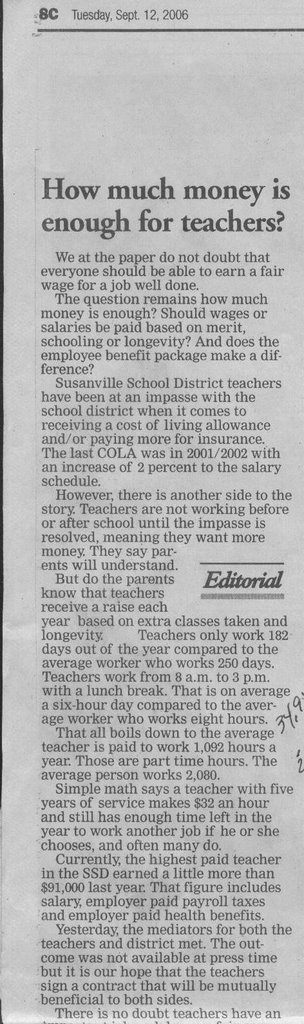
Teachers only work 182 days out of the year compared to the average worker who works 250 days. Teachers work from 8 a.m. to 3 p.m. with a lunch break. That is on average a six-hour day compared to the average worker who works eight hours...
That all boils down to the average teacher is paid to work 1,092 hours a year: those are part time hours. The average person works 2,080...
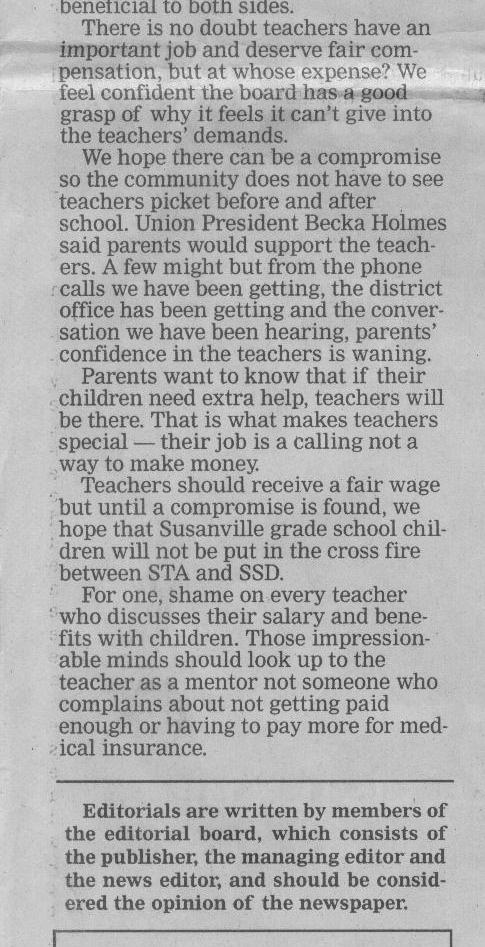
There is no doubt teachers have an important job and deserve fair compensation, but at whose expense?...

…their job is a calling not a way to make money.

How could she not possibly come to the conclusion that this would be offensive to teachers? First, the stats she reports are complete fabrication, made to make the teachers look like money-grubbing politicians.

Second, there are only two reasons to print this: either you’re really, really stupid and just don’t know what teachers actually do to get kids educated, or you have an agenda to make school teacher look bad and promote a lack of confidence in the public school system.

Well, I don’t think the managing editor is stupid....

Saturday, September 16, 2006

Revisiting the Lassen County Times Editorial Demeaning Teachers

The managing editor of the Lassen County Times has responded to an email message I sent and it appears my letter in support of teachers may be published afterall. However, I clearly touched a nerve with the editorial staff there, and will address that shortly.

I did want to revisit what I had written in a previous post regarding the Times editorial. I wrote it at the end of a long day, after hearing how upset the local teachers were and after consuming most of a bottle of wine. Shortly after writing that post (and getting the rejection) I also sent a very flippant email to the editor:

Sad to hear the Times is afraid of facts. Fortunately there are other avenues to get this out...
All the best,
Chris


In more sober reflection, I wanted to revisit the nature of what I had written and consider whether or not I had been out of line in my comments. It was certainly not the most thought-provoking piece I have written. So what did I say?:

- I posted the editorial in full and described what the teachers were actually asking for, which is a pay increase to cover increasing costs of medical benefits. The Times kind of indicates this, but then goes on to say: Teachers are not working before or after school until the impasse is resolved, meaning they want more money (emphasis mine). It think this is anti-public school code for "here they go again, the teachers want more money" and like conservative talk shows, it's taken out of context and meant to incite a negative response against teachers;

- I suggested that the staff at the Lassen County Times are right wing conservatives and largely fundamentalist Christian. Under this assumption I suggested that their opinions of issues and other groups of people are probably clouded under a particular perspective. I insinuated that they largely think their taxes should go to something other than public service and that they probably in no way questioned what they published about the teachers as being anti-Christian. On the contrary I suggested that on Sunday they will reinforce their belief in their superior Christian morality and never stop to consider that their actions are un-Christ-like. In retrospect, I reconsider painting ALL of the staff like this, but over the years of reading the Times I see no reason to back off that position in general - I don't know it for a fact, but I'd be willing to take most of it to Vegas...

- My reasoning for making this observation is that I see a clear connection between what I believe to be the broader cultural context with which a significant portion of the Times staff identifies and the published editorial. Christian conservatives, by and large, do not accept public service as a worthy goal of their tax dollars; they do not like the concept of public schools; they do not care for public school teachers, particularly outspoken ones; they do not like specific subjects being taught; and they prefer to have complete control over the kinds of knowledge to which children should be exposed. The editorial was simply projecting a belief I suspect is already being held by many on the Times staff.

I really see no reason to back away from what I previously said.

Friday, September 15, 2006

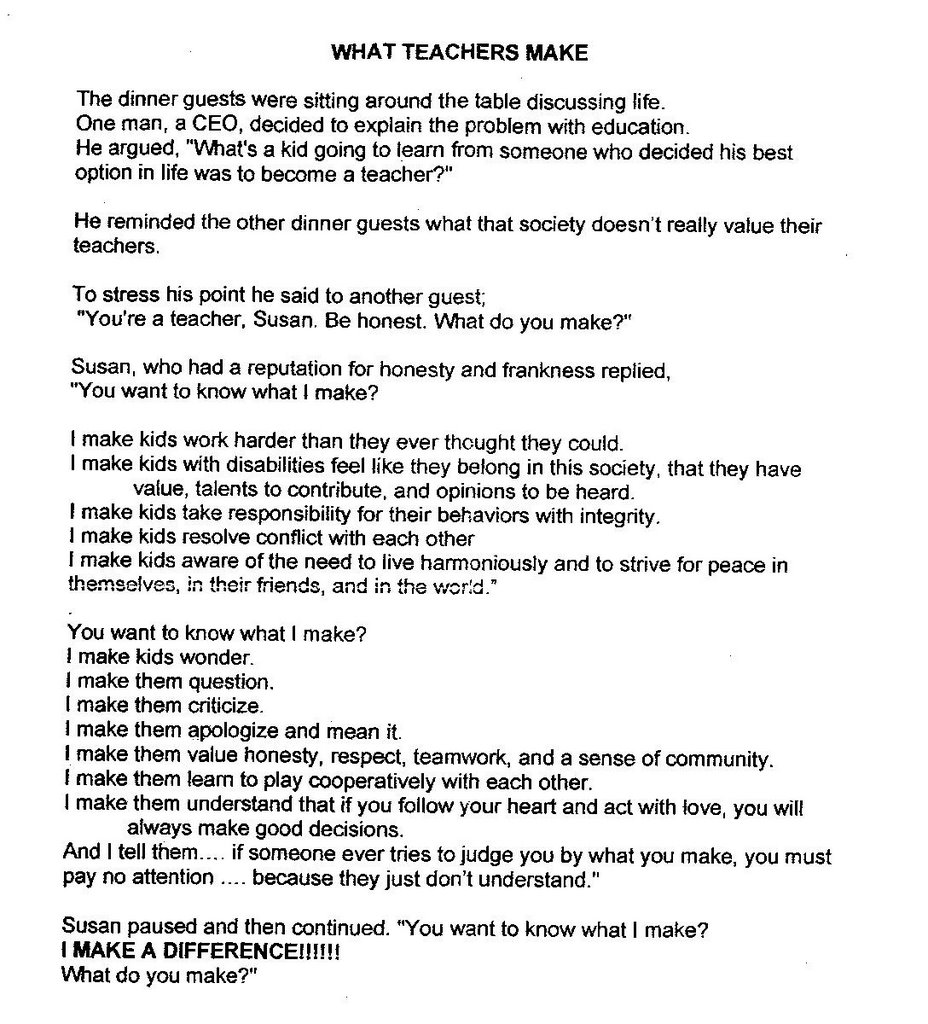
From The Archives...What Do Teachers Make?


As a further response to the ridiculousness of the Lassen County Times editorial this week, I'm re-posting this...

Thursday, September 14, 2006

Lassen County Times Propaganda


This is what the Lassen County Times published this week regarding the "worth" of teachers in our area. The story gets exceedingly worse than this, but I'll start here. Teachers in the local school district have not asked for a pay increase in 5 years. However, the district has decided to cap their benefits and the result is that without a pay increase, the increasing cost of benefits will result in a net pay loss. The teachers are only now asking for a pay increase to compensate for the cap in benefits. This is not extra money going to buy Cancun vacations...this is extra money requested to make up the difference for health insurance.

Instead of supporting the good work and public service of teachers, the right wingers at the Lassen County Times prefer to demean teachers and the job they do. The editorial staff consists of typical Christian hypocrites, who demonize the greater good of others and then pat themselves on the back at Sunday services for the "moral" choices they make during the week. They exemplify the kind of self-righteous idealogues who are so blinded by their own faith that they don't see the incredible harm they cause to others. Throw out the morals of the "Good Samaritan", because these hacks have traded in their morals for politics. Better to save tax money so we can add to our collection of OHVs (off-highway vehicles - sorry, this northern Californian, where status is measured by the number of OHVs you have and the height of your rig above the ground...personally, I've always felt that the higher your vehicle above the ground, the less competent you are in bed).

I wrote a letter to the editor (as I am wont to do these days), describing the usual lack of facts on which the editorial is based. Here is my submitted letter:

True to form, the Lassen County Times substitutes conjecture and ideological posturing for fact in its editorial on Susanville’s teachers (How much money is enough for teachers? September 12). Certainly the self-righteous tone of the editorial is consistent with the frequent evangelism and disdain for public service commonly expressed at the Times. And as usual, the errors are legion.

Am I really living in the Twilight Zone, or do only stupid people believe that teachers “work on average a six-hour day” and “only work 182 days out of the year compared to the average worker”? The data I researched suggests 50-60 hour work weeks are typical for the average teacher; certainly more for beginning teachers. School days are packed with student-focused work from the teachers’ arrival in the morning until their departure, often in the early evening. Class preparation, correcting homework, developing activities, not to mention administrative paperwork is usually completed outside of the “six-hour day” pay period. That’s non-compensated time, people. How many business men and women expect non-payment for services rendered? How many editors at the Times take work home with them? Apparently the Times must be using Haliburton math because the $32 per hour teachers’ make is now looking closer to $15 per hour. And what about those lunch breaks, the average of which for a teacher is 32 minutes? Taken within the calm serenity of the great outdoors, serviced restaurant or quiet lunchroom I suppose? Word I get is that it’s slamming down a sandwich while making sure the kids eat, getting the first bathroom break of the day, and making sure the next lesson is ready. Plus I bet they don’t even get to take that time off on their taxes. But then what about those long summer vacations teachers receive while the average worker slaves away. Ever heard of classroom clean-up? Class room preparation for next year’s class? How about taking classes and professional development? Is any of that compensated? Are we now down to paying our teachers $10/hour to educate the next generations?

I didn’t have to go far to find actual data on the effort teachers put into the education of children. I also know this from personal experience working with teachers. It really doesn’t take much effort to find real data on a subject, and the fact that the Times editorial staff commonly fails to back opinion with fact suggests ideological posturing on their part. Research is probably an anathema to the Times staff; after all, you might find data that runs counter to what you already believe, so best to state the belief and make the facts up to support it. The editorial was a purposeful and malevolent misrepresentation of teachers’ work efforts and it belies a broader underlying agenda that most of us suspect is behind the Times’ selective reporting efforts. Even the backhanded compliment contributed is disingenuous. Having the editorial staff at the Times refer to teaching as a “calling” is akin to the Pharaohs considering Hebrew bondage a “calling”.

Is teaching a calling? Absolutely (they’re certainly not getting paid enough to put up with all the bovine fodder dished out by the public on a regular basis). But the Times fails to seriously consider the implications of that statement, certainly in light of its own perceived purpose in the broader scheme of things. What a calling really means is that teachers’ efforts are further along the yardstick of moral relevance than most jobs. They sacrifice much in the achievement of a greater good. Their annual pay pales in comparison to big business, for example, which provides commodities but largely no redeeming social value. Yet in America today we accept, even applaud the obscene profits of oil companies while demonizing public servants asking for a meager 5% pay increase to help sustain the greater good. Where has our moral integrity gone?

Our teachers put in a lot more work than they get compensated for. The community would be wise to embrace and support this gift horse while it lasts. New data suggest that nationwide teachers are demoralized because of low pay, long hours, and lack of recognition. They’re leaving the profession in greater numbers and entering the field in fewer numbers. Think $90,000 is a lot of money for an experienced teacher? – in another decade the district might have to pay that just to get a young person interested in teaching on a temporary basis.

Shame on the Times for lacking the moral courage to stand up for teachers’ contributions to society and instead taking the cowards’ approach with innuendo, faulty data and cheapshots. Shame on the simplistic malcontents who think the need for some extra money to pay for medical insurance isn’t nearly as important as a yearly vacation to Cancun, outfitted hunting trip to Canada or the next addition to their personal OHV collection. And shame on anyone who thinks the number of digits on their paycheck is any relevant measure for the work they do when compared to that of a teacher.


Here is the response I received from the Managing Editor:

Thank you for your opinion. However, because you are not a member of STA I can only run you letter as a letter to the editor and it is 350 words to long. The Times reserves the right to edit letters, therefore according to you request, we will not publish your letter as it is currently written.
Thank you for your interest in the The Lassen County Times

Sincerely,

Barbara France
Managing Editor
Lassen County Times


Now, perhaps I actually am too arrogant to think that the mental midgets at the Lassen County Times have reverse breached some intellectual barrier that makes them think they could reject my insightful wit. Perhaps, because this is a teacher's issue, the Susanville Teachers Association (STA) should actually have priority in upcoming editorials. Reasonable positions, and I do not question them. But the excuse of exceeding the Letter To The Editor word limit by 350 words is fact-dodging bullshit. I've seen far longer "Letters" addressing the virtues of God, Country and Evangelical Fundamentalism printed before. What the Lassen County Times is engaging in is censorship.

Certainly to be expected from a paper that promotes narrow perspective as intellect, innuendo as fact, and information control as a God-given right.

Believe me, there's more to come....

Wednesday, September 13, 2006

Hope for America

Want to know where the glorious future of this nation resides? It is not in the war-mongering Christian nationalists who thrive on fear and intimidation. It is in the firm, quiet rebellion of America's youth against the tyranny of conscripted allegiance. Such rebellion is fitting with the expectations of our Forefathers:

...But when a long train of abuses and usurpations, pursuing invariably the same Object evinces a design to reduce them under absolute Despotism, it is their right, it is their duty, to throw off such Government, and to provide new Guards for their future security.....

A Terrorist By Any Other Name

Religious zealotry comes in all forms. This group has often disrupted archaeological sites in the Holy Land, claiming exclusive right to history. In the process they destroy unique archaeological values, all on the pretense of "protecting" their version of Jewish history. I notice the article uses the terms "zealots", "extremists" and "thugs" to describe this group of ultra-orthodox Jews. The only descriptive term missing seems to be "terrorist"....

Blogging Again

I'm back from the detail, but have been busy with teaching a new Archaeology and The Prehistoric World class at Lassen College, two correspondence courses in Biological Anthropology, working on two NSF grants, plus getting caught up on my regular job. Lots to discuss in upcoming posts, however: "advanced" English majors who can't tell the difference between "do" and "due"...environmental activists distorting science with the same regularity as intelligent design advocates...religous zealots disrupting archaeological excavations...and (the big one right now) our local paper's editorial explaining how teachers only work about half as much as regular folks and shouldn't be seeking a pay increase (which they haven't had for five years)...

So stay tuned....

Sunday, August 20, 2006

From the Archives: Hitler Was A Christian and Himmler Didn't Like Evolution

Through PZ and Raw Story I see that the wonderfully Ninth-Commandment-Committed James Kennedy is sponsoring an upcoming television special featuring none other than I-Walk-In-Christ's-Shoes Ann Coulter which will "connect the dots" between Darwin and Hitler. Those of us who can actually read know this will be pure Christian propoganda with limited fact, a dearth of appropriate context, a bevy of misquotes and absent volumes of data that don't fit the "Darwin Led to Hitler" conspiracy theory. In honor of this upcoming event, I would like to resurrect an old post of mine that touched on just this subject:

More on Farah's Lunacy
(From the March 2006 Archives)

Several days ago, Ed Brayton over at Dispatches from the Culture Wars, posted comments on an article by Joseph Farah at WorldNetDaily entitled “Hitler’s Evolutionists”. Farah, citing an article in Archaeology entitled “Hitler’s Willing Archaeologists” rehashes the worn out creationist “evolution-leads-to-Hitler” argument that attempts to link evolutionary theory with the rise of the Nazi regime. This is, of course, a subset of the broader philosophy espoused by creationists and some Christian apologists, that “everything bad is the result of evolution; everything good stems from Christianity”, whether it’s Nazism, Communism, Columbine, abortion or a whole additional host of social ills. Brayton makes short work of Farah’s latest twist on this creationist myth by pointing out that even a superficial perusal of history reveals a much different story; one that Farah would rather his readership not know about. Hitler’s own writing and speeches show clearly that if he justified his ideology with any philosophical position, it was Christianity. Hitler claimed to be a Christian, cited biblical passages to justify his ideology, and was clearly familiar with centuries of church history documenting anti-Jewish attitudes on the part of many prominent Christian figures. Despite this, Brayton correctly clarifies that Christianity is no more to blame for the development of Hitler’s ideology than is evolutionary science:

Now, the Christian would obviously argue that what Hitler did was distort the true aims of Christianity, and I would agree with them. It is folly to blame Hitler's ideology of hatred on Christianity; his pathology was far deeper than a mere religious belief. But by the same token, neither was he motivated by a zeal for science. He was a manipulator who used every possible means to convince his followers to go along with him and changed his rhetoric depending on the nature of the audience he was speaking to. This should be obvious to any thinking person, which of course leaves Farah out right from the start.

Farah is the poster-boy for the creationist tactic of creating data where none exist while simultaneously ignoring volumes of legitimate information that counters his position. Brayton illuminated Farah’s idiocy with the light of reason, logic and a more comprehensive look at a available information. I would have left the whole issue there except that, as an archaeologist, I was curious about the connection Farah was attempting make between archaeology, Hitler and evolutionary theory. So I bought a copy of Archaeology and looked at the original article. It took only a few paragraphs to realize something I’ve always suspected of Joseph Farah: he needs to learn how to read.

The article is largely about Assien Bohmers, a Dutch national with a scientific background in soils analysis, stratigraphy and archaeology, who joined Heinrich Himmler’s elite research institute, the Ahnenerbe. The Ahnenerbe’s official mission was to “…unearth new evidence of the accomplishments and deeds of Germanic ancestors”. However, in reality it was clearly designed to bring “scientific methods” to bear on the question of a Germanic “Aryan” ancestry preferred by Hitler. Not only were the researchers tasked to identify common physical features between Germanic people and human fossils that were already being excavated in Germany and France, they were also to demonstrate the cultural superiority of these ancestors of the master race by showing significant developments in material culture. In other words, they were to cherry-pick data to demonstrate a preconceived notion to the larger public: everything culturally good originated from the Aryans; everything culturally bad originated with inferior races.

In reading through the article after having read Farah’s take on it, there were a number of issues that struck me. Brayton points out that in his own article, Farah cops to the fact that Ahnenerbe’s researches were manipulating data to demonstrate a particular viewpoint but doesn’t catch the relevance to doing proper science. Brayton demonstrates that is precisely the opposite of what science does. But the original article goes further in depth on this point, and is completely ignored by Farah. Despite the overt coercion from Himmler on what the Ahnenerbe researchers were to produce, many were clearly questioning the results, precisely because they were aware of the totality of the data. Bohmers reported enthusiastically to Himmler that his data suggested the ancestors of the Germanic race did not migrate in from the east as previously supposed, but “…must have developed in greater Germany”:

Bohmers was well aware, however, that the European scientific community would be considerably less enthralled by these ideas. Indeed, his foreign colleagues would need serious convincing, for Bohmers knew that many European scholars scoffed at the science of the Third Reich.

As I read through this, the depth to which Farah himself manipulated the article’s data to demonstrate his own warped sense of history became increasingly apparent. But the most egregious example was to come. Farah either didn’t read the whole article or (more likely) specifically ignored the following gem:

Himmler also found time to take Bohmers aside at a gathering to convey his personal views on the subject of human evolution. It must have been an instructive conversation. As Bohmers later reported, Himmler dismissed outright the notion that the human race was closely related to primates. He was also outraged by an idea proposed by another German researcher that the Cro-Magon arose from the Neanderthal. To Himmler, both these hypotheses were “scientficially totally false”. They were also “quite insulting to humans.”

Himmler, head of the SS and Gestapo, the person whose activities and ideology Joseph Farah would most like to lay at the feet of evolutionary theory, did not believe in evolution! In fact, it is quite clear that Himmler’s ideas on the subject of evolution were exactly the same as…Joseph Farah’s!

There was a final parallel I couldn’t help but notice. In an opening paragraph to the article I found the following description of Himmler’s need to establish the Ahnenerbe, which was partly to correct the fact that scholars had not uncovered evidence of the designers of the “master race”:

The answer to this problem, in Himmler’s mind, lay in more German scholarship – scholarship of the right political stripe. So he created the Ahnenerbe, which he conceived of as a research organization brimming with brilliant mavericks and brainy young upstarts who would publicly unveil a new portrait of the ancient world, one in which Aryans would be seen coining civilization and bringing light to the inferior races…

The concept of conscripting “brainy young upstarts” to “publicly unveil” a new way of looking at things sounded vaguely familiar. And I didn’t have to go far to find where I had originally read it:

Scientific revolutions are usually staged by an initially small and relatively young group of scientists who are not blinded by the prevailing prejudices and who are able to do creative work at the pressure points, that is, on those critical issues upon which whole systems of thought hinge….The primary purpose of Phase II is to prepare the popular reception of our ideas. The best and truest research can languish unread and unused unless it is properly publicized….We intend these to encourage and equip believers with new scientific evidence's [sic!] that support the faith, as well as to "popularize" our ideas in the broader culture…

These are from the Discovery Institute’s Wedge document. Will ironies never cease?

Blogging More Frequently Soon

I'll be back to blogging more frequently soon. My temporary detail ends in two weeks and I'll be back home on a more regular basis after that. I had tried posting from my temporary location during the week but couldn't get my computer to connect over the phone lines there, which explains why my posts have been limited to the weekends. I'm also gearing up to teach An Introduction to World Prehistory at Lassen Community College for the first time this semester as well as a correspondence course in Physical Anthropology. Not to mention catching up with the family and getting the kids ready for college and eighth grade, respectively. So time has been limited.

However, in regards to my previous posts I will have some interesting case studes to relay to you that have to do with forest management and evolutionary theory. So stay tuned....

Part III: Conclusion

(Here's the last segment in my essay on the Forest Service and evolutionary theory. I rushed it a bit to get it on the blog, but the bottom line is that all resources management depends on Darwin evolution. There is nothing that Intelligent Design offers to maintain species, restore forest health, etc. Again, bear in mind that it was originally written for the public at large, although I'm pulling together a more in-depth article on the topic for peer-reviewed publication.)

Was Darwin Right? And Should the Forest Service Care?

Part III: Conclusion

IDT has no practical application to the management of natural resources that supercede or replace Darwinian natural selection. We now realize that species change can occur very rapidly, and each year there are more and more studies documenting measurable physical differences between populations in no more than a few decades. This is documented for a host of species including salmon, cichlid fishes, squirrels, rats, guppies, mosquitofish, finches, and a host of plant species. We depend on these evolutionary principles of species variability, inheritance and adaptation to develop management techniques to reach a desired ecosystem condition. There are, however, serious philosophical implications for natural resource management and conservation if IDT is legitimized as scientific inquiry through no other mechanism than public appeal.

The fact that IDT proponents have convinced the broader public that a non-scientific idea merits discussion alongside serious scientifically backed theories does not bode well for biological conservation and management science. Christopher Mooney, in The Republican War on Science, has documented a concerted effort by the current administration to either limit (in some cases outright censor) scientific research or promote scientifically vacuous ideas as legitimate science. While this occurs under all political philosophies, attacks on science have been particularly egregious over the last five years. Biologists, ecologists, foresters and others who maintain scientific approaches are increasingly forced to defend their conclusions against non-professional administrators with the ability to elevate baseless conjecture to the status of alternative theory in the public arena. Whether it is outright dismissal of solid data on sage grouse distributions without appropriate countering data or warping collection of blind test data on lynx to promote a public perception of unethical behavior on the part of agency biologists, the methods mirror those of IDT advocates. Other agencies are affected as well. The current re-write of the National Park Service management rules to eliminate any reference to evolutionary biology is a clear attempt to remove scientific approaches to management.

If there is an implication for natural resource management that stems from ID, it’s that conservation biology is irrelevant. It is, after all, not much of a logical leap to go from “we don’t need an explanation, the Intelligent Designer just did it that way” to “we don’t need to worry about causes for species extinction, it’s just all part of God’s plan”.
If it is true, as some ID theorists suggest, that the only way a cell could make a flagellum (or the only way some conifer species are more fire resistant than others) is if the characteristics were already coded for in their DNA. If this pre-structural coding is the result of intelligent design, then why bother limiting competition through selective harvesting? Moreover, is genetic information necessary for implementing management methods that take advantage of the genetic make-up of populations? Under evolutionary theory, the answer is decidedly “yes”; under IDT the practical applications of genetic information are absent. In response, IDT proponents may suggest that some combination of natural selection mechanisms and IDT principles is possible (another moving target!). But IDT does not apparently accept the evolutionary premises on which genetic variability, inheritance, adaptation and selection are based, therefore IDT has nothing useful to say about natural resource management. IDT proponents are not specific about the instances, locations and conditions under which Darwinian mechanisms might be overridden by Designer intervention. So if ID proponents accept some Darwinian mechanisms such as adaptation, then why not all? What separates some principles from others? With IDT there is no way for managers to predict the outcome of their management strategies and adapt to new conditions.

Of course the ultimate goal of IDT is not to develop testable hypotheses and build applicable knowledge to real world problems. If there is any goal of IDT advocates, it is to justify their personal belief in an omnipotent, intelligent designer. However, considering the prevalence of extinction throughout life’s history, the presence of genetic anomalies like mutation, and more importantly, the inherent ability of the human species to manipulate and change the environment seemingly at will, the broader implication of IDT is not an omnipotent designer, but rather a significantly impotent designer.

Land management agencies rely on Darwinian principles to maintain species, restore forest health, develop genetically appropriate species for reforestation, combat invasive species, promote sustainable ecosystems, and help protect the environment in which we live. Unfortunately, most agency scientists do not understand the nature of the creation-evolution debate or the impacts it has on their own fields of expertise. Biologists, ecologists and other environmental scientists within land management would do well to pay attention and get involved in debates over evolution and science. They can start by checking up on their local school districts to ensure their children are getting a proper science education. They can volunteer to present good science in the classrooms. They can publicly support teachers who are being pressured to offer non-science alternatives or find it easier to just stop teaching science. They can be more vocal in identifying the evolutionary principles underlying management to a broader audience. They can include more evolutionary theory in interpretation and public outreach. Our public lands are too important to be managed on anything but the best available science.

Sunday, August 13, 2006

Can The Book of Revelations Be Quantified?

We all know there is a terrorism Current Threat Level....but did any of you know there's also a Rapture Index?

Sunday, August 06, 2006

Part II: How is Darwinian Evolution Connected to Natural Resource Management?

(Here is Part II of the article I wrote concerning the relationship of natural resource management with evolution (. Remember, it was written with a general audience in mind. Commenters on Part I have already pointed out some of the glaring errors of IDT, but my intent was to start with the premise that IDT is valid and then ask the question later, IF it is valid, THEN it should have some bearing on basic aspects of every day science such as determining whether land management agencies use prescribed fire or "thin from below". This is part where I start to show that the emperor has no clothes...).


Was Darwin Right? And Should the Forest Service Care?

Part II: How is Darwinian Evolution Connected to Natural Resource Management?

There can be no mistake that natural resource management is based on Darwinian evolution. Pick up any major scientific journal covering forestry ecology and management issues and it becomes readily apparent that the contents are imbued with Darwin’s ideas, although the connection may not be obvious to the lay reader. Terms like “natural selection” and “evolution” are likely to be absent, and even Darwin’s name will be missing from most articles. In several randomly picked articles from recent (2005 or in press) issues of Forest Ecology and Management, I noted that the terms “Darwin”, “evolution” or “natural selection” occur only three times. However, terms like “adaptation”, “competition”, “differential reproduction”, “variability”, “mutation”, “mortality” and “survival” are mentioned in abundance. These are principles of evolutionary biology and depend on the broader concepts of Darwinian evolution in order to make sense. “Adaptation”, for example, has no biological meaning outside of an evolutionary context. I found these evolutionary principles further codified in more colloquial management language that also frequents research articles on which agency officials depend: “shade tolerant”, “fire-dependent”, “historical trajectory”, “best fit to existing conditions”, “trajectory of forest types”, “selective harvesting”, “fires favor the largest trees with the thickest bark”. The list goes on. These are clearly describing management applications of variability, competition, differential survival and reproduction, all bedrock principles of evolutionary theory. The language of forest management belies its Darwinian framework.

In an effort to be fair to IDT advocates I limited my perusal of resource management articles to those that had clear management implications and did not already clearly invoke evolutionary principles in their titles or abstracts. In reality, it is difficult to find examples of forest management research that do not explicitly invoke evolutionary assumptions. My point is that research articles not explicitly stating their evolutionary framework are clearly still assuming Darwinian principles to discuss management practices that would give us healthier forest resources. The research and management arms of the USDA Forest Service and other agencies tasked with land and species management cannot escape Darwin’s legacy.

But what of IDT as an alternative to Darwinian evolution? If IDT is a scientifically valid theory on a par with evolution, as its advocates insist, then what implications would this idea have for forest management? What mechanisms does IDT purport to offer as replacements for evolutionary theory? The problem is divining what IDT really is. Even allowing IDT the benefit of the doubt as a scientific proposal this is no easy task. Amongst ID proponents there is no consistent definition as to what IDT looks like as a scientific endeavor. Components of IDT are often criticized as a “moving target”, and clearly with justification. IDT proponents seem to generally accept the idea that species have a history and have changed through time; however, this position is not always clear. Many IDT advocates accept this premise for some species but are uncomfortable applying it to others (there seems to be no problem that camels exhibit an evolutionary trajectory, but there appears to be some discourse over whether the same can be said for humans). Some reject it outright. There is also some suggestion that this component of IDT is largely a façade, made to make IDT more palatable as a scientific idea and to avoid entanglements with religious ideas of creationism that are rejected by the court system.

Assuming IDT accepts Darwin’s concept of “descent with modification”, what it probably does not accept is its mechanism, although here again IDT is a moving target. IDT proponents appear to largely reject natural selection as a mechanism driving species change, suggesting that life particularly at the cellular level is too complex to have been derived by “natural” mechanism such as Darwinian selection. Many biological structures are considered “irreducibly complex” in that if one component is removed the system completely stops functioning. Given the apparent complexity of some biological structures, natural selection would have had to create the entire sequence with all of its parts in a single event. Or so the argument assumes. Clearly, they argue, natural selection is incapable of such a feat. Instead they suggest creation of species is guided, at least at some level, by an undefined Designer, and not through Darwinian natural selection. If natural selection is inherently flawed, as IDT proponents suggest, then concepts of adaptation, competition, and variability have no useful application under IDT. Natural resource management strategies essentially become nothing more than “shot in the dark” efforts.

IDT advocates would probably counter that some combination of natural selection mechanisms and IDT principles is possible, but again they offer nothing more than another moving target, against which it is impossible to draw testable hypotheses. That still begs the question of exactly where in the natural system mechanisms are thwarted by intelligent design imposed from above. IDT may or may not accept a historical relationship between species and it may reject natural selection as a mechanism driving species change, but either way IDT cannot describe functional relationships among living organisms that exist in absence of natural selection. IDT proponents are not specific about the instances, locations and conditions under which Darwinian mechanisms are overridden by Designer intervention, because the idea is immune from testable propositions.

Instead, IDT’s main argument falls on criticism of evolutionary theory. They constantly repeat the mantra: many biological features are irreducibly complex and cannot be the product of natural selection; the Cambrian explosion indicates the sudden occurrence of major animal body plans that cannot be explained by Darwinian principles; and no transitional fossils exist in the paleontological record to indicate species change as the result of an accumulative process like natural selection. Irreducible complexity seemed to initially catch the evolutionary research community off-guard when it was proposed in the early 1990s, but only for a moment. Solid research has since demonstrated time and again that supposed irreducibly complex systems can be reduced further and easily explained by natural selection. Components of supposed irreducible biological systems are now found to function quite well without some parts of the system, find “short-cut” pathways to accomplish the same function, or simply serve other functions. IDT activists have covered up the paleontological reality of the Cambrian explosion to give the impression that birds, reptiles, mammals, fish and insects arose suddenly some 500 million years. Not only did the so-called “explosion” last for tens of millions of years, but new research in the Pre-Cambrian period is showing a steady rise of complex features in organisms. Further, IDT advocates purposefully (or ignorantly) misuse the term “body plan”: no birds, no mammals, no insects, no reptiles and no fish are to be found in the Cambrian. These “groups” as we know them today all arise much later in time, their fossil histories marked in many cases by clear transitional steps. The suite of transitional fossils familiar to paleontologists in all areas of research belies the claim made by IDT advocates that none exist. The pine tree forests managed by the Forest Service are just such an example. The fossil record shows transitional steps from their origin in the Jurassic some 150 million years ago. Their slow accumulations of characters adaptive to drier (and more fire prone) ecosystems is clear. The fact that managers today take advantage of those adaptive characteristics is testament to the fact that evolutionary theory offers practical applications for ecosystem restoration and restoration of “healthy” forests. In contrast, IDT offers resource management nothing of practical value.

I have attempted to give IDT the benefit of the doubt as a scientific endeavor on a par with evolutionary theory as its advocates would like. It is clear, however, that IDT proponents cannot answer basic questions about their supposed theory, because there is nothing about ID for which one can form testable hypotheses. It violates a primary requirement of theory: that it generate testable hypotheses to determine its ability to explain natural phenomena. Its proponents will cry foul and claim a bias against IDT bordering on abject prejudice, simply because it has religious connotations. But the reality is that IDT is not science. IDT exists not because it has advanced scientific knowledge but because its proponents have waged a successful public relations campaign (much like astrology). It has used popular dislike of evolution and manufactured “controversies” in evolutionary theory to camouflage its lack of a scientific approach and inability to offer anything of scientific value.

Sunday, July 30, 2006

Part I: Nature of the Problem

(This is Part I of the article I introduced in the previous post. It describes (for a general audience, remember) the issue of IDT as a legitimate alternative to evolutionary theory and asks whether this would have implications for how we manage natural resources.)

Was Darwin Right? And Should the Forest Service Care?

Part I: Nature of the Problem
The yellow pines and white firs of Lassen National Forest in northeastern California may seem removed from the debate over teaching Darwinian evolution or Intelligent Design Theory to high school students, but in fact they are inexorably linked. The popular struggle over which version of science should comprise the foundation of biological thought also directly impacts the foundations of natural resource management. At their core, methods of resource management, be they ecological restoration, fuels reduction, invasive species eradication, selective harvesting or a host of other techniques, are derived from assumptions about the way in which the natural world, specifically forest ecosystems, operate. To the extent that management techniques provide us with a desired result they are successful precisely because they have gotten the underlying assumptions correct.

The assumptions to which I refer, are of course the mechanisms for how species reproduce, compete, adapt and subsequently change through time. Not quite 150 years ago, Charles Darwin referred to this as “descent with modification” and proposed the mechanism of “natural selection” as an explanation for how these processes work. Although the terms have come to have different meanings in different contexts, the broader concept Darwin advanced is more popularly recognized today as evolution. Individuals vary in their characteristics (some are shorter, some are taller; some reproduce faster than others; some resist fire more effectively, etc.) and these are passed from generation to generation. However, because of these character differences, some individuals are better able to cope with changing conditions in the environment. In effect, some individuals are better adapted to their environments and as a result, tend to leave more offspring than those who are less adapted. Over time, characteristics providing better adaptations become more common and the make up of the population appears different. Because many of these adaptations are physically apparent, later generations actually begin to look different from earlier ones. The numerous transitional forms we see in the fossil record, which show accumulated change through millions of years, are best explained by the processes of natural selection.

The reader is probably familiar with the concept of evolution through natural selection (what I refer to as Darwinian evolution), at least on a general level. And unless you have been living in a cave for the last several years, you are probably also familiar with the growing controversy over whether Intelligent Design Theory (IDT) should be taught alongside evolution in public school science classes. The components of IDT vary, but are summarized largely as follows: First, IDT proponents claim there is evidence for design among living organism and that natural selection is not sufficient to account for that design. In effect, there must be a Designer that is responsible for species’ origins. Although such a position has significant religious implications, serious IDT proponents make no claims about who or what the designer might be, maintaining that this question is irrelevant to the methods of revealing design in nature, which they consider a legitimate pursuit. The second component follows directly: IDT proponents claim theirs is an idea fully consistent with the framework of science and is not religious creationism in disguise. Third, IDT proponents argue that Darwinian evolution is flawed and that IDT serves as an alternative explanation for how the natural world operates. Taken at face value, these arguments for IDT would appear sufficient to legitimize it as a theory worthy of discussion in high school biology classes. So what do these two, supposedly legitimate, theories have to do with contemporary natural resource management?

In science, theories are not “educated guesses”, although this is the popular perception. Theories are well-substantiated explanations of some aspect of the natural world. More importantly, theories comprise a body of knowledge against which scientists can test new ideas. In effect, theories should guide practical applications of scientific knowledge. When a significant number of observations repeatedly fail to be explained by the theory, then the theory itself is in need of revision, or outright rejection and replacement by a different theory that better explains the scientist’s observations.

Two questions arise from this line of reasoning. First, does natural resource management rely on an underlying body of theory at all? Are the principles of natural resource management dependent on assumptions derived from more general statements about how the natural systems of the world develop, interact and change? Second, if there is indeed a greater body of theory forming the foundations of day-to-day decisions in natural resource management, then what are the implications if we change that theory? If principles of Darwinian evolution currently form the bedrock of biological thought, then what are the implications for how we manage natural resources if IDT is a viable alternative?

Upcoming Article Posts

Some time ago, while researching the "what practical applications does evolution have" issue, I wrote an article on the relationship of forest management and evolutionary theory. It was written for the layperson working in land management agencies and members of environmental groups - in fact, I had specifically written it for the audience of Forest Magazine. I even submitted some paragraphs, hoping they'd request the entire article for review, but I never heard back from them. Since then it has been gathering the equivalent of electronic "dust" on my hard drive. It does seem, however, that the blog might be a good forum for its debut.

So, I'll post the article in segments over the next couple of weeks (since I have not mastered the HTML art of providing you a "Read On" break in the post, it will be easier for me to post it in chunks. Plus it gives me something already written to post while I'm busy with my temporary job!). Let me know what you think.

So, expect the first portion of the article shortly...

Feeling Better....

Well, after that previous outburst, I'm feeling a little better. I'm back temporarily from my detail and so am at least trying to add a few things to the blog. However, I have encountered something interesting in the new job that I will blog about in detail upon my full time return in August. We all know the problem the political "right" has with evolution (and science in general), and we all comment on it frequently. But I'm encountering similar ignorance from some organizations and individuals on what we would consider the political "left" - certainly not near enough to counter the weight of anti-science BS coming from the right, but interesting nonetheless.

More to come....

Christian Morality at Its Finest (These Days)

I really hate to pick up blogging again being foaming-at-the-mouth angry, but the issue with the Dobrich family in Delaware really pisses me off. It is not the medieval mentality expressed by most of the people in Georgetown, Delaware that gets to me. It's not that Kenneth R. Stevens, businessman in Georgetown, is a waste of genetic material and an excellent reason why fetal tissue shouldn't be granted the celestial status the religious right wants (it might end in something like Stevens). Nor is it the fact the "Reverend" Jerry Fike knows as much about Christ's message as Ann Coulter knows about evolution. No, what really pisses me off is, WHAT HAPPENED TO ALL THE GODDAM CHRISTIANS WHO ARE SUPPOSED TO STAND UP FOR THE PERSECUTED AND THE DOWNTRODDEN???

I'll pick on my former church, the Catholics, but the same could be said for any other demonination. Where's the local priest standing up to this crucifixion of a family? Are there no Catholics in Georgetown? None in neighboring communities? Where's the outrage from the Bishop? Or is he too busy counting the money from the collection basket? Where's the Cardinal? Afraid to call your fellow "christians" on their despicable behavior? Or are you too busy sucking up to the politics of the religious right to be bothered with day-to-day morality? Or is it that you think a few blastocystes are actually worth more than the suffering of family at the hands of christian thugs? And where's the fucking Pope on all this? Too busy getting his feet washed? This is why I washed my hands of you bastards a long time ago...I know more atheists, gays and Muslims who individually act in more Christ-like morality in a single day than you sons-of-bitches could collectively do in a lifetime.

The people in Georgetown are despicable human beings and ANY Christian who does not publicly express outrage over this incident is complicit in the evil treatment of this family. I'll tell you one thing though: young Alex Dobrich has the right response:

The only thing to flourish, Mrs. Dobrich said, was her faith. Her children, she said, “have so much pride in their religion now.”
“Alex wears his yarmulke all the time. He never takes it off.”


You go, Alex. We all need to extend the middle finger of rebellion to these Georgetown scum and their advocates. And good Christians need to get off the fence, quit worrying about "Christian unity" and stand up for morality for a change.

Sunday, July 16, 2006

Missionaries and Morals

I recently received an email from a person in Europe mournful over my position on missionaries outlined in my post on End of the Spear. Two comments struck me. First, his experience seemed to have been much more positive and it reminded me that I did not adequately draw the distinction between long-time European missionaries and American ones. Europe of course has a historically long presence in Africa, and those missionaries I did have respect for inevitably came from Europe, had been there often for generations, knew local customs and language, and were there almost exclusively to help people. American missionaries, on the other hand, were only there to get "soldiers" for Christ, had no respect for local culture, would not even bother speaking the local language, and generally ran rough-shod over local people (any "success" they had, they bought by throwing money around). I wouldn't consider the distinction hard and fast, but in general that's been my experience. Nonetheless, I still do not consider "missions", be they European, American or otherwise, to be positive institutions over all - again, the whole idea is to destroy native culture and replace it with something else.

Secondly, he suggested that by lying to missionaries on a regular basis I was also engaged in dishonorable behavior. First, I only lied about the fact that I was working with directly with local people - it was none of their business anyway, and I certainly didn't want a truckload of missionaries descending upon the groups I was working with - for their sake, more than mine. I would consider this no more a dishonorable act than I would a native Iraqi lying to American military personnel (or an American lying to Al Qeada personnel). If you think lying to missionaries is bad, I knew researchers (very few, by the way) who absolutely refused to help them under any circumstances - "If God's on their side, let God help them" was the attitude.

Finally, a Christian commenting on my own moral behavior is the pot calling the kettle black. Christianity as a whole is not functioning as a good role model for behavior - this community has some serious house-cleaning to do before they can claim any sort of higher moral ground.

Intermittent Posting

My posts will be intermittent over the next couple of weeks. I've taken a detail (temporary promotion) as a District Ranger in a neighboring forest for 60 days - after the first week I can tell you that it's an interesting position and one requiring an understanding of the science behind the decisions to be made on forest management. More later.....

Saturday, July 08, 2006

Forget Kindergarten...We Need an Adult Reading Program

From Stranger Fruit this morning (via BoingBoing)...

58% of the US adult population never reads another book after high school.
42% of college graduates never read another book.
80% of US families did not buy or read a book last year.
70% of US adults have not been in a bookstore in the last five years.

As John points out, this goes a long way toward explaining why anti-evolutionism in particular, but anti-science in general, are so prevalent in the U.S. It also probably explains why Bush got elected twice...

Monday, July 03, 2006

What Archaeology IS NOT....

Archaeology has got to be the most publicly abused science in the world. These guys apparently never saw Stargate. There is of course, no archaeological data associated with any of this; just like there is no archaeological data (and no archaeologists) associated with this, this, this, this or this. Apparently any dumbass who picks up an arrowhead thinks he can interpret anything he sees on the ground. At best, these guys are frauds and liars...at worst, they destroy authentic archaeological information and should be jailed.

See this...BASE says this is part of Noah's Ark. It is not. It is a fucking rock. BASE personnel do not have the experience to tell basalt from coprolites. They have no knowledge of archaeological methods. They cannot produce a report on anything they claim to have found. People who buy into what these archaeology charlatans put forward can only be described as STUUUPID...

And as for the warning BASE puts on these photos,

This article and the pictures are copyrighted. You may quote the first couple of paragraphs and then link to this site but you CAN NOT duplicate the article in its entirety and you CAN NOT COPY ANY OF THE PICTURES without express written permission from Worldview Weekend, Brannon Howse and Bob Cornuke.

I suggest they look at something called Fair Use. (Yes, I've just extended the middle digit of my hand to you BASE bozos).

(Thanks to Afarensis, Dispatches, Hot Cup of Joe, Abnormal Interests and some others for having defended the archaeological profession from this kind of intellectual prostitution).

Ok, I feel better....

Want to Live in the 15th Century? - Go to Delaware

A great example of 15th Century behavior and what the Founding Fathers of this country were trying to prevent with the Constitution.

(Saw this at both Pharyngula and Dispatches from the Culture Wars)

Sunday, July 02, 2006

Teaching The King James Bible

I actually wrote this a couple of years ago and submitted it to the Lassen County Times, although it was never published (I'm not necessarily suggesting anything nefarious on the part of LCT - it is a bit long - just noting a historical fact). I know efforts to teach bible classes in public schools are still prevalent, so here is my advice to those seeking to do so (references to my being active in Catholicism are dated...in all honesty I'm tending more toward PZ on the subject, but that's another post for a later date):

I understand a petition is circulating around California in support of an initiative to teach the Bible (King James Version) in our public school system. I support this endeavor and would encourage all to sign. Unlike my more liberal friends, I firmly believe this country needs an open discussion of religion: there is far too much whining over one’s right to parade their religious perspective in the pubic square. Our Founding Fathers encouraged freedom of religion and we should take them at their word. Of course they also believed that public display requires public debate and it is important for students to gain the critical thinking necessary to distinguish fact from perspective. Presumably, the class would encourage questioning and debate, both of which are easily prompted by even the most superficial reading of the bible. I assume the class would start by reflecting on bible origins: its multiple authors, problems associated with translations from different languages, the variety of writing styles used (historic, poetic, metaphorical, etc.), who decided which books make up the bible, and similar points of discussion. Regarding the latter, I assume some discussion of the lost Christianities, such as the Gnostic Gospels, would be in order, as well as the historical contexts that prompted Irenaeus to envision and Constantine ultimately to endorse, the Nicene Creed in the fourth century AD. This is an important issue and should prompt students to appropriately question why the church hierarchy selected, as reflecting true Christianity, the Gospels that endorse a church hierarchy over those (Gnostic and other) that endorse the primacy of the individual in seeking God.

Similarly, I would think that historical, cultural and natural contexts are crucial to understanding the goals of the bible authors, and I know signers of the petition would want students to appreciate these nuances of biblical interpretation. Nothing is ever written in a vacuum. For example, while Sodom and Gomorrah were certainly destroyed, presumably at the hand of God, it would also be worth asking how else a population with infantile knowledge of geology might explain earthquakes and other natural phenomena 7000 years ago (the hand of God?). No doubt teachers will want their students to consider whether Genesis refers to an actual six-day creation or is best read as a metaphor not intended to contradict current science. I would certainly hope that the class would once and for all trash the popular myth that Christianity and evolution don’t mix. The fact is that not all Christians agree on how the Creation came about and the only justifiable course of action would be to offer all alternatives as an example of the wonderful diversity of Christian belief. For example, students might be asked to reconcile a literal interpretation of Genesis with the fact that 99% of all species on this planet are currently extinct. Or whether “random” selection as defined by Darwin is really much of an issue for a God of infinite time and space. Personally, I would also like to hear an explanation of who, exactly, Cain “knew” in Genesis 4:17 if Adam and Eve were indeed the first humans and Cain and Abel their direct (and only) prodigy. Regardless of the nature of a Genesis discussion, I would expect those teaching the class to encourage their Native American students to enlighten Christian students by presenting their own Creation stories. This will emphasize the fact that 1) creations stories are a vital part of almost all human cultures; 2) almost none of them are alike; and 3) there is no way to distinguish the historical “correctness” of any of them.

Given the many Christian sects in Susanville as elsewhere, teachers will have no choice but to emphasize the fact that not all Christianities look upon the Bible the same way. Some prefer a literal interpretation over one that’s more metaphorical. More “fundamental” sects of Christianity prefer the former. Catholics like myself are not as tied to biblical literalism as a cornerstone for faith in God. In fact, a recent Pontifical Commission referred to biblical literalism as “intellectual suicide” and of course, everyone knows that the Pontiff settled once and for all the fact that evolution has no adverse theological implications. It will be important for teachers to point this out to their Protestant students lest they be accused of religious bigotry. Of course Catholic students will need to understand that our Protestant brethren do not always hold with our own cherished beliefs. Catholics tend to deny that Jesus had any brothers or sisters, whereas Protestants generally accept that He did (even as a Catholic, I personally have to side with my Protestant friends on this one – although whether or not Jesus was married to Mary Magdalene is another question). And of course morbid fascination with the dark side of the Passion has historically been more a Catholic “thing” than a Protestant one, so I’ve been a bit surprised at the non-Catholic obsession with Mel Gibson’s film. Regardless, the film might be a useful tool for launching discussions about the search for the historic Jesus in our forthcoming public school bible classes. Mr. Gibson is convinced that the film accurately portrays events as they are described in the Gospels. While that might be the case, the real question is whether the Gospels themselves are historically accurate. I would hope that the students of our Bible course discuss the fact that the Gospels were written as late as a century after the events depicted in the Passion and no Gospel author was actually present at Jesus’ trial. This observation, combined with the cultural context of a heightened Jewish-Christian antagonism during the First Century AD, should lead our students to discuss whether the Gospel authors didn’t actually contrive some events in order to spurn separation between the two religious communities. Similarly, a brave teacher might raise the question as to whether the seemingly prophetic passages are nothing more than “post-hoc accommodating arguments” developed by Gospel authors who already knew what Isaiah and the other Old Testament authors prophesized and were simply writing the passages to meet the expectations. A really brave teacher might raise Shelby Spong’s thesis (and he’s not alone) that the virgin birth is a superfluous myth not intended to be taken literally by the Gospel writers.

Archeological evidence is often cited in biblical interpretation and a bible class would be a good place to address archaeology’s role. Being an archaeologist myself, I would encourage this (and volunteer my own expertise to the classroom) particularly since most Christians have this annoying habit of confusing theology and history. No doubt, archaeology has identified a number of places named in the Bible, and some events are corroborated with physical evidence. But others are not. Demonstrating that the walls of Jericho fell (they did, but no less than 17 times through several millennia) is one thing, but to follow that with the conclusion that Israelites accomplished the task through divine intervention is a matter of faith, not archaeology. After all, Schliemann found Troy, but that doesn’t make Cyclops and Medusas real creatures by default. Interestingly, archaeology has been unable to find evidence of an Exodus out of Egypt despite claims to the contrary, but has recently identified evidence of Noah’s flood event. Demonstrably catastrophic in nature, the flood was actually confined to the Mediterranean Basin, although it certainly appeared to be “worldwide” from the limited perspective of those it affected. And just to get this off my chest: the Shroud of Turin is not old enough to be from the time of Christ, despite the methodological gymnastics engaged in by the critics of carbon dating.

Finally, I would hope that students, particular those who have faith in whatever God they personally choose to accept, would ask the question: if I have faith in God, does it matter whether the earth is six thousand years old or several billion? Certainly to some it will. There will be those who find logic in the assumption that Christ’s resurrection cannot be true if God’s creation wasn’t also limited to a literal six days. And that’s fine. There should be a place at the public table for those beliefs. Just as there should be a place at the public table for those of us who have found God without the crutch of biblical literalism. Or those who have alternative beliefs. Or those who profess no belief at all. I would assume that the signers of the petition have the intention of fostering such a diversity of opinions and ideas as they relate to the Christian bible…or am I wrong?

Saturday, July 01, 2006

Catholics Condemn Philanthropy

Well, this friggin' figures...

Update on My Letter to the Lassen County Times

Ok, they did publish my letter to the editor in this week's version of the Lassen County Times. A couple of things: First, it was printed in total and unedited, but the LCT Editor seemed to take offense that I suggested the paper would probably never allow a rebuttal of the same length. At the end of my letter, she wrote:

Editors Note: Anyone who wants to rebut Mr. Ashmore's Where I Stand will be treated to the same criteria. This paper welcomes a rebuttal of any length

Ok, fair enough. I'll just keep that one handy for future reference. I will point out, however, that A) The Lassen County Times spends a lot of space promoting Christian viewpoints; B) I have NEVER seen a "Where I Stand" editorial of that length at any time in the LCT; and C) my own "Where I Stand" editorial (not on the same subject) some time ago, was definitely edited, presumably for space (in all fairness, the editing did not seriously affect my overall point, but nonetheless it was shortened).

Second, a second letter questioning Pastor Ashmore's "correlation" was also published in the same issue, but the author took a much different tact on the Ashmore piece that was really interesting. Matt Mullin wrote:

Let me see if I understand what the author of this article was saying....His god is manipulating the natural forces of the earth, and creating anomalies with the world's economies, in order to murder millions of innocent humans for the purpose of teaching the surviving humans a lesson about morality.

His god is willing to murder thousands of innocent humans in retaliation for what the author describes as the murder of innocent humans through abortion. Those living an alternative lifestyle choose to publicly celebrate that lifestyle, and BAM, his god murders other innocent humans as punishment...

Yep, you have to wonder what kind of god people like Pastor Ashmore serve. Mullin ends his letter with impeccable logic:

If the author is correct in his rather gnostic description of his god's behavior, perhaps it is better to choose eternal damnation, rather than serve such an evil being.

On the other hand, if the author is wrong (and I suspect he is), his discourse only acts to fan the flames of intolerance, and promote the oppression of those with views, lifestyles and beliefs different from his own.

Amen, brother.

Note: There may yet be an Act III to this saga...the LCT often publishes letters in response to letters from the previous week. I'll let you know if anything further develops.

The "Pharyngula Effect"

Ok, I know some of you bloggers out there have experienced the "Pharyngula Effect", but it just amazes me when it happens. Here are my daily average stats for visits on Northstate Science:
Notice the really big spike today - pretty much all of that is due to PZ linking to my Lassen County Times letter to the editor (I'll update everyone on that in a moment). Hopefully, everyone also saw the longer post I initially wrote on the subject. I have to give credit to Afarensis who also significantly helps my stats when he links to something I've written, but when PZ links to it, get ready for a ride! (This happened once before in April - log on in the morning and I'm at 20 hits...then PZ links and an hour late it's 1200+...).

So, PZ, if I ever get back to the Midwest, I owe you a beer (or two!)....