Thursday, January 18, 2007

Clearing Debris at the Pool of Siloam

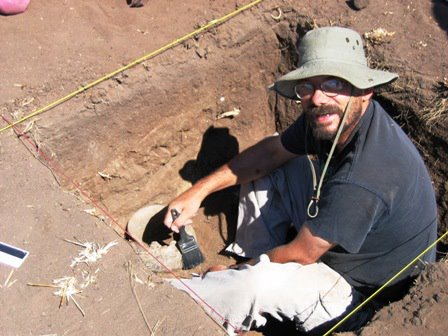
While wondering the internet universe this evening I entered the world of self-proclaimed "archaeologist" Willie Dye and caught this picture on his website:


The picture has the following caption: "Dr. Willie Dye and team working at the Pool of Siloam, Jerusalem (The steps are being carefully excavated)".

The caption leads the uninitiated to assume three things: 1) Dr. Willie Dye has a legitimate degree and professional experience in archaeology; 2) it somewhat implies that he is in charge of the excavation and has a "team" (also implying some degree of prefessional expertise in archaeology) working under him; and 3) they are all engaged in careful, methodologically excavation that requires some degree of expertise.

My biggest issue with so-called evangelical/fundamentalist "Biblical Archaeologists" is the relatively large number of them who have no legitimate degree in the discipline, no formal training in its methods or theory, and absolutely no track record of producing viable data in publication. Yet they continue to portray themselves as "archaeologists" to the masses of uninformed waiting breathlessly to hear that the "professionals" have verified their belief system with "science". This picture and its caption reminded me that both Willie Dye and Carl Baugh visited my little corner of the world years ago (invited by two local boys who had joined Baugh and Dye's "team") and hawked their creationist and "bible-verified-by-archaeology" snake oil to our local community. Never ones to miss an opportunity to proselytize, the editorial staff at The Lassen County Times ran a number of articles on the trip and made every effort to imply that these guys were legitimate archaeologists, conducting important archaeology that was proving the bible correct in every way, and that they were leading the excavations because of their expertise in the field.

Willie Dye and Carl Baugh have no legitimate credentials in archaeology. They have no professional experience in archaeology. They have no publications in archaeology. They are not archaeologists. They and their "team" were volunteers (or part of the many "bible" tours offered by vendors looking for a quick buck). The photo shows them clearing debris, not "excavating carefully". They probably helped out quite a bit and enabled the directors of the project (who were not Baugh or Dye) to get some work accomplished, but their "expertise" was nothing you couldn't have taught a bright ten-year-old in an afternoon. This picture further reminded me of a previous post on the subject of archaeology and its abuse by creationists. Here's a short passage on the nature of public archaeology, volunteerism and the potential for non-professional fraud:

Third, archaeology’s greatest public benefit can also be its greatest weakness. Some aspects of archaeology, unlike other disciplines, are quite amenable to non-professional public involvement. Volunteers are not only welcomed, but frequently encouraged to participate in professional excavations. Digging square holes is not quantum physics, and most people with an interest in the past can be taught to dig and screen dirt with the best of us. Don’t get me wrong: there are frequently times when finesse, experience and skill are required for intricate excavation of special features and the skill level of most non-professionals is inadequate to the task – it is here where the professional archaeologist will usually take over. But a significant part of most large scale excavations is removing lots of dirt and not finessing the excavation of intricate features. Volunteers certainly make valuable contributions to archaeology and some gain a measure of expertise (I work with a few) – but they are not professional archaeologists. Excavation is really only a minor part of archaeology: it is the analysis and interpretation that requires significant expertise in the method and theory of archaeology, the ability to adhere to the methods of science, and skill at formulating cohesive arguments. Most non-professionals know the limits of their often significant contributions. Some, however, pick up a piece of pottery and suddenly become self-proclaimed experts in the field…and creationists will rush in and create expansive expertise out of shoveling dirt for a day faster than you can say “Indiana Jones”. We certainly have the usual creationist cast such as Carl Baugh, Willie Dye, Richard Fales and Clifford Wilson claiming to be professional archaeologists when they have no academic training, no professional field experience, and no track record of having produced reviewable contributions to the discipline. But there are also a growing number of Christian volunteers, willing to pay to participate in archaeological fieldwork in the Holy Land, who then return home to go on the “lecture circuit” and recount how their archaeological experiences are “proving the Bible correct”. Many clearly participate in order to gain a measure of professional authenticity that they then parade in front of home audiences. This is bad enough for archaeology, but it also broadly translates into the perception that these people can speak authoritatively on science in general. After all, they’ve participated with professional archaeologists on professional excavations. If they know something about potsherds, they must also know something about the failings of “macroevolution”, right?

As I said, archaeology's greatest benefit, but also its greatest weakness. It is unfortunate that archaeology is not subject to the same strict legal consequences for quackery as medicine. If that were the case I suspect that Baugh, Dye and most other fundamentalists would have lost their licenses or been jailed long ago.

Will The Real Indiana Jones Please Stand Up?

Today's Chattanoogan is reporting that Dr. Scott T. Carroll, Professor of Ancient Studies and Co-Director of the Center for the Study of Antiquity at Cornerstone University in Grand Rapids, Mi., is the "Indiana Jones of Biblical Archaeology"...

Really? I thought Bob Cornuke, the President of B.A.S.E. was...

Or was it Ron Wyatt?

Hell, they all look alike...

Wednesday, January 17, 2007

Frosty's Bibllical Literalism Laid Waste

A number of bloggers have already posted really cognizant discussions on the absolutely clueless drivel to which Frosty and his school board buddies wish to subject children. Ed, John and of course, PZ have some comments. And Matt has a very interesting post on why Gore's film may not be the best tool for a science class - he may be right. However, none of them hold a candle to the brutally frank essay by John Rickards entitled Bible Replaces Brain. John Rickards is in Britain, which has been experiencing its own creationist investation; but after reading about Frosty, John went off:

That was, of course, until I read this joyous little story, serving once more to prove that old Monty Python adage that there’s bugger all intelligent life down here on Earth.

“The information that’s being presented is a very cockeyed view of what the truth is,” Hardison told the Seattle Post-Intelligencer. “The Bible says that in the end times everything will burn up, but that perspective isn’t in the DVD [of An Inconvenient Truth].”

Wow. On behalf of humanity, I’d like to thank you for playing. And this woman has spawned seven kids. Which means that while, in any just universe, she should be chemically castrated for the good of the gene pool, it’s too late and those poor, poor little buggers are already doomed. It’s right up there with the famous quote by Reagan’s Secretary of the Interior, James Watt: “We don’t have to protect the environment. The Second Coming is at hand.”

It gets even better when he blows a hole the size of Kansas in this idea that we should have "fair and balanced" treatment on both sides of an issue:

Some things don’t have fair and balanced opinions on both sides - they just have the right one and the wrong one. I’d like to present you an opinion to balance your view that cars run on petrol fed into an internal combustion engine by teaching kids that in fact they’re powered by little gremlins working treadmills under the bonnet, and that if you can’t see them it’s because your mind only sees the illusion they want you to see.

Somehow I doubt you’d want that taught in schools. But if I’d said it a couple of thousand years ago…

Of course the underlying reason for such inane ideas is the concept of biblical literalism:

Biblical literalism - the belief that the book is true in its entirety and should be held as such - is inherently stupid. I say “inherently” because even without thinking about anything else, the Bible is full of contradictions and varying duplicates of the same story, which by their nature can’t all be true...

...I don’t recall seeing a serious push to have geocentricism taught in schools, nor the theory that the stars are crystal spheres, nor that disease is caused by either demonic possession or the wrath of God. Nor is anyone lobbying Washington or Parliament to have slavery or polygamy allowed for the faithful, or to have adultery (including the thought of adultery) punishable by death. Nor do they seem to be mounting much opposition to, say, the war in Iraq, or indeed to wars in general, nor, in many cases, the death penalty. Despite all that “love thy neighbour”, “turn the other cheek” and “don’t kill” stuff that peppers the Bible, and in particular the New Testament...

...Why not? Because these people are so used - and, as children, so heavily indoctrinated - to having the chosen mouthpieces at the top of their churches tell them what to think, what today’s Threat To The Faith is, what “evidence” there is of this or that, that they are wholly incapable of doing anything but parroting this shit back....I’m not suggesting that creationists and other Biblical literalists are hypocrites. No. I’m suggesting that they’re idiots.

Dangerously psychotic fanatics of subhuman intelligence who were turned into such by organisations which prey on adults whose only crime is to be confused, scared and uncertain, and on children with the great misfortune to be born to members or in member-riddled areas and who are deliberately, cynically and criminally brainwashed when they are too young and too undeveloped to defend themselves from people abusing positions of authority they do not deserve.

Saying that you should be allowed to treat someone as a second-class citizen and abuse them freely because the Bible says so, saying that the world is going to end in fire and then the faithful go to heaven and that this should be portrayed as a sensible alternative to learning about the evidence and reasoning behind global warming because it’s in the Bible, saying that there’s no real evidence for evolution and that creationism is an equally solid theory because, after all, it’s in the Bible, is no more than a kind of shorthand. A shorthand for saying, “Hello, I’m either terminally brainwashed and in desperate need of deprogramming or I’m so horribly mentally deficient that there are tapeworms in my own intestines capable of more cogent thought than me. In any case, I shouldn’t be allowed to tie my own shoes without supervision, let alone decide how society should function or what children should be taught, and certainly not to actually produce any progeny of my own.”

If Frosty is going to aire his personal views in public then he deserves no less a response.

Four Stone Hearth at Aardvarchaeology!

The newest edition of Four Stone Hearth is up at Aarvarchaeology! If you're into the exciting world of anthropology, check out the submissions! Forgive the shameful plug, but make sure you look at the exchange between Martin, myself and some other bloggers like Afarensis regarding historic preservation. Makes for some interesting reading.

And you guessed it! The next edition of Four Stone Hearth will be hosted here at Northstate Science on January 31. I'm looking forward to seeing all the new submissions.

Tuesday, January 16, 2007

Utah Buttars Backs Baloney Bill

Wacky Utah Congressman D. Chris Buttars is at it again:

He wants a state law to stipulate that individual expressions of religious faith are protected on public property.

This is a short article, but the one-liners are absolutely fabulous:

...Buttars is back again with another legislative solution desperately seeking a problem...

Like last year's creationism bill, Senate Bill 111 was created with no intelligent design.

Forget about dogs that won't hunt. This is a bird that won't fly. It has wings of concrete, an easy mark for any lawyer -- which Buttars isn't.

Buttars might have responded to his constituent that the U.S. Supreme Court has already ruled that students can express themselves as long as they don't disrupt school. But that would have taken away his opportunity for religious posturing.

National Park Service Clarifies Position on Age of the Grand Canyon...Possibly

Apparently the National Park Service has just officially clarified its position on the creationist book being sold at the Grand Canyon and declared the following:

In a statement issued by the National Park Service (NPS) Chief of Public Affairs, David Barna, on January 4th, the agency contends that park rangers have been instructed to "use the following explanation for the age of the geologic features at Grand Canyon…The principal consensus among geologists is that the Colorado River basin has developed in the past 40 million years and that the Grand Canyon itself is probably less than five to six million years old."

The Grand Canyon will, however, continue to sell the book in the visitor center bookstore, although in the "inspirational" section and not with the science books. As the article notes, this is the first time the National Park Service has officially distanced itself from the creationist book, which is good, but it still doesn't explain the following:

* Why did the Park Service approve it for sale? Under agency rules, park officials are only to allow display materials of the highest accuracy and which support approved park interpretive themes in its bookstores;
* What happened to the "policy review" on the book promised in public statements and in letters to members of Congress by Barna and other NPS officials?
* Why has NPS refused for the past five years to issue the pamphlet entitled "Geologic Interpretive Programs: Distinguishing Science from Religion" providing guidance to park rangers and other interpretive staff on how to answer questions relating to creationism, evolution and related topics?

I was unaware that the NPS refused to issue a pamphlet providing guidance to park rangers on the difference between science and creationism. That sounds suspicious...So is this:

The Barna statement notes "This book is sold in the inspirational section of the bookstore" but omits the fact that this "inspirational" section was created after PEER exposed the fact that the book was being sold as a "natural history." The inspirational section now includes anthropological works on Native American culture but no other work remotely resembling the Vail book.

I'm sure RangerX will have some more enlightening comments on the subject, given his inside sources (I just checked...he does, although it's not what I suspected). In that regard, it is probably good that the book is still on sale, given that there may be some unforseen benefits for science in the park.

"Our only point is that the Park Service should stop selling the book with a government seal of approval," stated PEER Executive Director Jeff Ruch. "Nonetheless, we are delighted that the Park Service has, after three years, finally chosen to publicly and unambiguously acknowledge that the Grand Canyon is the product of evolutionary geologic forces."

RangerX's concerns aside about misinformation regarding what the on-the-ground interpreters are being told, I'm glad to see NPS formally clarifying their position...I think.

Monday, January 15, 2007

High School Teacher Stands Up For Evolution

Another brave high school teacher defends evolution in a public format! He could have accessed far more data to support his points than by relying on Wikipedia, but he nonetheless demonstrated why a previous letter writer to the Ventura County Star was depending on ignorant readers to make his case.

Dembski a Modern Galileo?

An interesting discussion on why teaching evolution is important. I followed a few more links on this blog and found this discussion on why intelligent design advocates Dembski and Wells are not the Galileo's of our day, despite the fact that the intelligent design crowd often considers them as such:

Galileo's peers held him in almost universally high regard. So did Einstein's. So did Wegener's. Not all of their peers may have agreed with them, but those peers did recognize their genius. And why would they not? Each of these fellows made excellent and profound contributions to science throughout their lives.

On the other hand, with very few exceptions, Dembski's and Wells' peers in the scientific community seem to hold them in poor regard, mainly because of the paucity of their output and general poor quality of that which they have produced. Certainly they are not luminaries.

And then later, this zinger:

William Dembski doesn't have very impressive output either. He sure has a lot of degrees for someone who has contributed so little to science. Notice that he has far more contributions of a religious nature than a scientific bent. [emphasis mine]

Someone outside of the natural sciences isn't fooled by the propaganda machine of the ID activists.

Saturday, January 13, 2007

Excellent Questions from Aardvarchaeology!

Martin at Aardvarchaeology posted some excellent questions regarding my brief comparison of Swedish and American heritage preservation laws. Here's my attempt at some answers:

From Martin:

What happens if a member of the public makes a clearly prehistoric find on federally owned land, without digging or damaging anything, and alerts the local authorities? For instance, a collection of lithics from the erosion slope of a stream gully or the edge of a quarry. (I'm sure he or she would not be held in error.) Who owns such finds?

Excellent question and it reminds me that I was remiss in explaining something important about the law and its consequences. I can tell you that most of us with adminstrative responsibility for historic preservation would not be prosecuting someone who found something and brought it in to our attention (I say most only because there are probably one or two exceptions out there in the larger cultural resource management world). I am personally very greatful when someone alerts me to a site or artifact they've found. I try to believe that most people collect these things because they have an interest: if I can steer that interest away from casual collecting and into something less destructive, I try to take that tact: I'll go out to the site with them; enlist their help to record the site or catalog the artifacts, etc. I do believe education is our best defense against systematic looting. I think we gain more by working with the public rather than lecturing them. I would still prefer it if folks didn't actually pick up anything and just alerted me or someone else to the area's location. Still, I'm not going to slap the cuffs on if you happen to bring something in! We try to save the ARPA prosecutions for people digging or systematically stripping a site.

To this end, the Forest Service specifically has a program called Passport In Time that offers volunteer opportunities for people interested in archaeology or other aspects of historic preservation to work side-by-side with professional archaeologists. In this way members of the public can participate, feel a sense of contribution, and hopefully understand why we archaeologists get a little anal retentive regarding artifact collections from sites. There are other programs in other agencies and often we just look for local volunteers to help us with something without going through a formal program.

Nonetheless, in answer to Martin's question: the artifact is still considered government property and the person would have to turn it over to officials.


What percentage of interesting sites are on federally owned land? E.g., how many of the known Moundbilder mounds? In other words, is the federal legislation relevant in the greater number of cases? Or is it simply a question of trespassing laws keeping archaeological surveyors off privately owned land, so that such land forms white spots on the distribution maps?

Very good question, and one that's not easily answered. Out west, where most of the broader tracts of federal land are located, we probably have a significant number of the known sites on public land. However, there are still lots of those "white spots" (and yes, they really are white on many of our maps) where we have private or state land. Many private areas as you might imagine also have significant sites, however, largely because many of those places were homesteaded or deeded over many generations and tend to occur on the same locations that many Native Americans found attractive. Interesting that you should mention the Moundbuilders: I actually worked for the Burial Sites Preservation Office in Wisconsin in the 1980s and early 90s and we were tasked with preserving many of the mound locations (largely because they were shown in most cases to contain burials). I'm taxing my memory somewhat, but I believe the site protection legislation that passed the Wisconsin state assembly in 1987 specifically protected mounds, even on private property. So again, the short answer to Martin's question is that "it depends". Some communities and states have excellent preservation laws in place (particularly those in the east, where there is less federal land and historic preservation has traditionally fallen to the states and local communities) - others do not.

In regards to "interesting sites": I'm assuming we're talking about important sites that might contribute something of value (data, uniqueness, documentation of significant event, etc.). In the U.S. these would be sites eligible for the National Register. We've found approximately 20% of the sites we formally evaluate are eligible for the National Register. This figure might be skewed somewhat, given that we tend to formally evaluate smaller sites that aren't likely to be considered eligible anyway. This leads me to a question for Martin, however: it sounds as though Sweden's National Heritage Board is roughly equivalent to our National Register of Historic Places...are all sites in Sweden automatically registered with the Heritage Board once identified, or is there a similar "evaluation" process to determine if a site is eligble for registration?


My post didn't say much about sites and land development. Does the US evaluation of an area in advance of e.g. a road development differ with regard to who owns the land? Can the authorities force private land owners to admit archaeologists for surveying in such a case? In Sweden, a road or gas pipeline development will usually operate with a wide corridor of potential placement in the early stages of the project, and then the final placement within the corridor will be influenced by the results of archaeological and biodiversity evaluations. Which of course cover the entire corridor regardless of who happens to own the land.

The short answer to both questions is "yes", although again "it depends". Most projects tend to be either federally or state funded. If federally funded (in any amount) the project must comply with NHPA, so archaeologists must be allowed to survey and if necessary evaluate and mitigate before the project can proceed, even if through private property. State laws again vary, but here in Calilfornia, generally the same thing applies. CEQA (California Environmental Quality Act) laws require some degree of historic preservation compliance similar to those at the federal level, although I'm not thoroughly familiar with all the regulations at the state level (being federal, if we're involved at all our processes and procedures generally supercede everyone else so I haven't had the need to be completely up to speed on state and local laws!). Afarensis and Carl might be able to wade in here on their perspectives for the situations in Missouri and Texas.

At the local (generally county or city) level of government, the stipulations again vary widely across the states, but most seem to have some kind of protection for historic resources. Generally this occurs via the permitting process. In many places you can't get a permit to put that 2000 square foot garage up until you've had the area cleared by a professional archaeologist.

On the planning end for bigger projects, it sounds like Sweden and the U.S. are somewhat similar. Our planning efforts fall under the National Environmental Policy Act (NEPA) which includes provisions for considering all kinds of issues: water, wildlife, economic, fisheries, botany, and of course...historic resources. We generally try to plan projects within the context of understanding where all the potentially affected resources might be so before project implementation so that there's little need to suddenly change project plans when we sudenly find that the only habitat in the state for the red breasted doodle bug is right in road path. If we do the planning correctly, the hypothetical situation with the Giza pyramid I noted previously should rarely happen.


Did I understand correctly, that a US landowner may dig or dynamite any site on his land as long as it doesn't contain graves? Scareee!

I'm not entirely up on the laws governing private property and I'm sure again, "it depends", but yeah, that's pretty much my understanding. Bear in mind, however, that unless he's just throwing sticks of dynamite for something to do after church on Sunday, he's probably engaged in digging or blowing something up for some kind of permitted project (via county, state or feds). As such, he's most likely needed to have archaeologists conducting survey and raising awareness of any sites that might be located in harm's way.

Again, excellent questions! Hopefully I've gone some distance toward answering them, but I'm more than willing to entertain follow-ups.

Don't forget everyone: Aardvarchaeology is hosting the next edition of Four Stone Hearth - get your submissions in!!

Friday, January 12, 2007

Lassen County Times In Review: Jan 9 Edition

Well, time for the weekly review of LCT items and I have to say not much caught my eye or piqued my interest this week. Brad Jenks responds to Patricia Ausmus over the Iraq war discussion, although not very well. Jenks clearly thinks there was a significant link between the Iraqi's, specifically the Hussein government, and Al-Quaeda, therefore the invasion of Iraq was justified. Jenks asks, "Which side of the debate is believable?" Well, I am inclined not to think it's his side. Everything I've read suggests that if you take a few items out of context it's easy to show a direct link, but when looked at as a whole the picture is not clear at all. This seems to be the conservative mode of operating, however, whether it's creationism, economics, religion, Nancy Pelosi, or the war in Iraq - lift a few things out of context and create a story as if it were complete (then call everyone who disagrees with you a liar, as Jenks does). Lift a few disparate pieces of my life out and I bet Brad could concoct a relatively believable story that I'm linked to Al Quaeda terrorists: I have Muslim friends in Africa; I've been to Nairobi and Dar es Salaam on many occaisions; I presented a study of Marxist approaches to archaeology in a graduate seminar once; I'm not fond of fundamentalist Christian religion; I also made "Distinquished Expert" in rifle competition, and was actually in East Africa in 1993 when the first World Trade Center bombing attempt was made. So, using what counts as logic these days on FOX: maybe I know something about firearms, hence I possibly know something about gunpowder, hence it's probable that I know something about other explosives, hence it's likely I've used C4, hence it's almost certain my Muslim friends use C4, hence it's beyond doubt they're members of Al Quaeda, hence I must be a member of Al Quaeda - besides which, I flunked the "Do You Want The Terrorists To Win?" test, so that must seal the issue). I'm sorry, but that kind of logic occurs in spades among the neo-cons.

Another letter refers to the potential closing of Cornerstone Christian School. I hate to be cruelly blunt, but this is clearly not a heartbreaker for me. I don’t care for private schools, especially those run by fundamentalists of any religious stripe. With very few exceptions they are centers of indoctrination and an opportunity to isolate children from a larger world perspective. The woman who writes in confirms everything I suspect about the world of private Christian schools:

They start and finish their day with prayer. They pray before meals. They learn the Bible.

Are the children told the Bible is a Bronze/Iron Age text, written by people with no knowledge of science, very little understanding of the broader world around them and writing with some clear political agendas?

Then there’s this:

They learn morals and values and love for one another.

Here again we have the “you can’t be a moral person unless you’re a Christian” bovine fodder argument, which leaves out most of the rest of the world and the millions of people born before 33 A.D. I’m glad to see Dawkins, Harris and a host of other people are starting to trash this line of thinking on a regular basis. Agnostic Mom just announced that she has two articles in the upcoming book on secular parenting edited by Dale McOwen entitled, Parenting Beyond Belief. I would recommend that the person concerned with the closing of Cornerstone pick up a copy and try to understand that there are millions of good people out there who live joyful, moral, family lives without having to buy into second millennium BC mythology.

Finally this:

…I ask that you include Cornerstone in your prayers that God would bless them with more students…

What makes her assume God actually wants the school open? Did she stop to consider the possibility that, even if God exists, He may actually want the school closed because it fails to allow children the freedom of curiosity to explore the wonders of a larger creation without the intellectual shackles of biblical literalism? Of course, declining enrollments may have nothing to do with God. It could just be that most parents want their kids to grow up with more of an open mind and a better ability to the world in its wider context.

Until the Jan 16 edition....

Historic Preservation in Sweden and the U.S.: A Brief Comparison

Earlier this month, the great new blog Aardvarchaeology (Martin Rundkvist) posted a discussion of preservation issues in Sweden that got me to thinking further about the state of preservation law in the U.S. Martin suggests that to his knowledge Sweden may have the strongest legal protection for sites and finds in the world. That may be the case – some of the provisions of Swedish law as Martin describes them would definitely enhance archaeological site protection here if implemented.

So what does American law say? Well, to quote the guru of cultural resource preservation law in the U.S., Thomas King, the initial answer has to be: “it depends”. Unfortunately the American penchant for letting no legal vacuum go unfilled has created a sometimes bewildering array of laws, statutes, regulations and policy regarding historic preservation in this country. Martin’s post on Swedish antiquities law starts with a very simple (and here, frequently asked) question: who owns an archaeological find made by a member of the public? Martin indicates that in Sweden, the important legal relationship is between the authorities and the finder, not the landowner, in large part apparently because there are no trespassing laws in Sweden (a totally alien concept here in the states). At a certain level, the same applies here in America.

In the U.S., historic preservation on public lands (Forest Service, BLM, National Park Service, Reclamation, Fish and Wildlife – any lands owned by the federal government) is governed by federal laws, most prominently the National Historic Preservation Act (NHPA) and the Archaeological Resources Protection Act (ARPA). Note that these two laws are the most frequently implemented, but there are a host of other laws that protect cultural resources: American Antiquities Act, Abandoned Shipwrecks Act, Historic Sites Act, American Battlefields Protection Act; there are even some statutes in the Internal Revenue Code and Department of Transportation Act that have a bearing on historic preservation. The National Park Service website has an updated list of federal laws that govern cultural resources: at last count over 50 federal laws exist that touch issues of historic preservation in some way.

So in answer to Martin’s question regarding whether or not a member of the public can collect artifacts or excavate sites on federal (publicly owned) land, the answer is absolutely not. Members of the public not legally authorized to collect or excavate are considered in violation of any of a number of laws (ARPA being the primary one) and can be prosecuted with fines, jail time or both. Those of us charged with protecting archaeological resources on public land spend a good deal of time trying to prevent the illegal collection of artifacts, usually through a two-pronged approach: educating the public on the need to protect cultural resources and vigorously prosecuting those who fail to heed the educational message.

It is principally ARPA that regulates excavation and collection on public lands. Under this statute, the government may issue excavation permits for those with legitimate interest and expertise (usually professional archaeologists interested in research) to conduct archaeological excavations on public lands. The regulations regarding who may or may not excavate are clear. In this context I have always found it amusing that Carl Baugh, Willie Dye, Richard Fales and several other creationist “researchers” claim status as archaeologists or paleontologists, yet none would ever be issued an excavation permit under ARPA. They all lack legitimate credentials, education and experience necessary to be considered the principle investigator or director of an archaeological excavation on public lands in the U.S.

ARPA clearly prohibits excavation of archaeological resources on federal land. However, there are those who believe that ARPA maintains an exception for the casual collection of arrowheads and historic things not over 100 years old from surface contexts. The provision of ARPA specifically reads as follows:

…No item shall be treated as an archaeological resource under regulations under this paragraph unless such item is at least 100 years of age (16 U.S.C. § 470bb(1)).

And then later…

Nothing in subsection (d) of this section shall be deemed applicable to any person with respect to the removal of arrowheads located on the surface of the ground (16 U.S.C. § 470ee(g)).

I know of some folks who carry a copy of ARPA with them when the collect arrowheads or historic bottles believing that the so-called “arrowhead exception” will protect them from prosecution as long as they’re not digging. They are in for a shock if they ever get caught. In 1996 the Fifth Circuit Court of Appeals upheld a conviction by a lower court ruling against a defendant claiming rights to collect under the “less than 100 years” and arrowhead exceptions in ARPA. Basically the court found that even though the law does not specifically deal with artifacts falling within those categories for prosecution under ARPA, the law does not specifically assume “transfer of rights” for those items when found. The court further emphasized that the government did not intend to allow for collection of these items from archaeological contexts of any kind, surface or otherwise. Finally, the court pointed out that even if such were not the case, ARPA specifically notes that other statutes allow for the government to prosecute for collecting artifacts of any type in any archaeological context (surface or otherwise):

This exception is not intended to encourage removal of arrowheads from public lands, butrather to exempt such removal from the civil and criminal penaltyprovisions of the ARPA. See 16 U.S.C. § 470ff(a)(3); 36 C.F.R. §296.3(a)(3)(iii)…Also, the ARPA expressly provides that the removal of arrowheads can be penalized under other regulations or statutes. See, e.g., 49 Fed. Reg. 1016, 1018 ("regulations under other authority which penalize [the removal of surface arrowheads] remain effective.").

The clear message is that no member of the public can excavate on public land without a permit (and the requirements for granting those are explicit); nor can they collect artifacts of any kind. Other public lands (state, county, municipality, etc.) are governed by a dizzying array of state and local laws as you might imagine – some more lax than others. In general, those state regulations of which I am aware tend to follow the federal lead and prohibit or severely restrict artifact collecting and archaeological excavation.

However, Martin’s question regarded the collection on private land. Of course, in the U.S. trespassing laws come into effect and you can’t just walk on to anyone’s land and start collecting without permission. Assuming permission or you’re the landowner, however, there are very few regulations preventing you from collecting antiquities on your own property. Generally excavating or “robbing” burials is the exception. [The Native American Graves Protection and Repatriation Act (NAGPRA) has spawned a series of state and local statutes regarding the protection of human burials (including non-Native American in some cases). This has become another major law at the federal level (which I have to deal with on a frequent basis in my capacity as Forest Archaeologist) but it is also having effects at other levels. See Afarensis’ series of excellent posts on the issues regarding Kennewick – this was a major NAGPRA issue]. It looks like collection on private land in the U.S. is significantly different from the case in Sweden. Martin reports:

…let me also emphasise that the landowner has very few rights with regard to the sites on his land. They sit on his property, but they are themselves in many ways property of the state. He can't dig them, he doesn't own any finds from them, he is forbidden to change his current agricultural methods on the sites for something more destructive.

This is clearly not the case in the U.S. With few exceptions, the landowner effectively owns the site and its contents. I’m not as certain with regard to the sale of artifacts in the U.S., if obtained legally, but illegally obtained artifacts are prohibited from sale under ARPA. There are other interstate commerce clauses that may also come into effect here.

Apparently, the Swedish rules cited above apply to multiple artifacts coming from a single location. Individual artifacts recovered in isolation fall under different rules depending on the level of precious metal content. In effect, the Swedish landowner doesn’t own complete sites and their contents, but they and other members of the public may be allowed to own isolated artifacts under some circumstances.

In this regard, I would have to agree with Martin and suggest that the preservation laws in Sweden (at least for private property owners) are better than those here. Given Martin’s brief discussion, I think would go so far as to say that if I had the power, I would gladly consider an “isolated artifact” exception (even perhaps on federal land) in exchange for government ownership of all archaeological sites and their contents on all lands, including private. Public interest in historic preservation would be better protected if cultural resource sites could not be considered private property.

One thing Martin alludes to but doesn’t discuss in depth is protection of cultural resources during “project” implementation (road/building construction, timber harvesting, livestock grazing, etc.). For those of us responsible for the protection of cultural resources on public land in the U.S. this is about 95% of our job: ensuring that “undertakings” don’t adversely affect historic properties. Our guiding legislation in this regard is the National Historic Preservation Act (NHPA). NHPA is complex and its implementing regulations are contained in the Code of Federal Regulations 18 CFR 800, specifically in reference to Section 106. Whole classes are taught on Section 106 of the NHPA and its implementing regulations but basically it boils down to this: before an undertaking can take place, the effect of that undertaking on historic properties must be considered. This assumes several things. First, you have to know if any historic properties exist within the project area, so you have to find any sites that might exist. This typically means some kind of survey is required (not necessarily a typical intensive archaeological survey either, but that’s a different issue). Secondly, you have to determine if these sites are important. “Historic property” actually has specific meaning under the regulations: it’s a site that has been determined eligible for the National Register of Historic Places (NRHP). This might be similar to Sweden’s National Heritage Board. Whether a site is eligible for NRHP listing or not is usually determined through formal evaluation of the site. Finally, if a site is determined eligible, any adverse effects from the undertaking have to be determined and mitigated if they cannot be avoided.

The whole process is complex. The regulations largely discuss how sites are to be located, evaluation procedures, determinations of effect, and potential mitigations. A couple things of general interest: It is often assumed that this regulation “protects” historic properties. Legally it does no such thing. All the law requires is that we “take into consideration” the effects of a project on the resource. Let’s say we’ve done our survey and located the Giza pyramid in the middle of our planned road construction route. Ok, it’s clearly an eligible property (it’s unique, meets certain criteria, has the potential to add to our understanding of prehistory or history, etc.). So what do we do? Well, the road is planned to go right through it, so clearly our project will have an “adverse” effect to the pyramid. The easiest “mitigation” would be to avoid impacting the site and re-route the road. But let’s say we can’t. Can we still put the road through? Yes. We would have to meet with a bunch of interested parties and decide a course of action: we could dismantle the whole thing and rebuild it somewhere else; we could just excavate the hell out of it and recover as much information as possible; we could document the whole thing with photos, drawings, etc. Once we agreed on a course of action and completed what we all agreed to do, the bulldozers could go forth. Legally, the pyramid will not stop the road. I emphasize legally, because there are other considerations that obviously come into play: economic and public opinion/political. Clearly a lot of people are probably going to be upset over the destruction of the Giza pyramid and they will bring pressure to bear on those who want to put the road through. Also, all of those mitigation measures cited above are extremely costly, and it may be more economically feasible to move the road rather than bear the cost of mitigation. In fact, generally archaeological sites are “protected” on federal land in this manner: it’s easier economically to just change the project design.

Again, regulations at the state and local levels vary widely, but these also seem to follow the primary goals of federal legislation. When we turn to private land, the situation is different and does not appear to follow the Swedish pattern. Martin notes that the farmer in Sweden:

…is forbidden to change his current agricultural methods on the sites for something more destructive.

In the U.S. the farmer can pretty much do what they want. There are a couple of exceptions, however. On the local level, county planning usually requires identification of cultural resources on the landowner’s property before they will issue a building, land exchange, parcel split or other permit. Again, this varies considerably across the country.

A private landowner may also be required to comply with NHPA regulations if he receives any sort of federal funding for his project. Federal grants for vegetation management around wildland/urban interfaces, for example, require NHPA compliance before the money can be released. This is what we call the “federal handle”…the project may not actually be located on federal land, but if it is being even partly financed with federal dollars, then NHPA (and other) regulations apply.

I’m not sure how these regulations stack up against those in Sweden (and they are far more complex than I have discussed here - even with regards to private property). It is clear, however, that regulations such as these have gone a long way toward protecting cultural resources around the world. More stringent applications certainly wouldn’t hurt and we might follow Sweden's lead in this regard.

Wednesday, January 10, 2007

O'Reilly The Raging Catarrhine

I'm beginning to like MSNBC's Joe Scarborough.

He recently asked media psychologist Caryn Stark to watch a clip from FOX's The O'Reilly Factor and analyze Bill O'Reilly's body language. Her assessment? O'Reilly acts very...well...primate-like. More than that, O'Reilly is apparently acting like a frenzied, territorial catarrhine:

He's screaming. And he starts flailing his hands around, and that's typical primate behavior that shows that "this is my territory; I'm protecting it."

Actually, an obsessed, raging, territorial catarrhine:

He obsesses about his points. He mentions liberal. You're going to see it again. There you go, over and over again. "I'm obsessed with this point about being a liberal and I'm going to let you know, and I'm going to use my fingers for emphasis, and I'm going to make a lot of noise and a lot of fury about nothing." So, I don't think we have to pay too much attention to what he's doing because he's enjoying himself, and he's doing a lot of, "here's my territory, and I'm going to protect it."

There was always something familiar about O'Reilly's constant caterwauling about "liberals" and Stark's analysis reminded me of it: recollections of my primate behavior classes in college. O'Reilly behaves much like Rhesus macaques I remember watching (I was going to say baboons, but they're too dignified).

Grades Due!

Ok, this is not my preferable method for grading, but then again, there are times....

(via Higgaion)

Sunday, January 07, 2007

An Inconvenient Truth

One of the things I enjoy most about blogging is this developing sense of community within the blogosphere. You “meet” so many people of different walks in life, share ideas, argue and just generally expand your knowledge of the world around us. This morning I was greeted with a nice email from RangerX thanking me for the reasoned response I had to his updated post on the Grand Canyon issue. I started perusing his blog and stopped on the entry discussing global warming and Al Gore’s movie, An Inconvenient Truth. I haven’t seen Gore’s movie, but after reading RangerX’s blog, I’ll be adding it to my Amazon list:

But in the new documentary, “An Inconvenient Truth,” directed by Davis Guggenheim and featuring Al Gore, I learned that "out of 925 recent articles in peer-review scientific journals about global warming, there was no disagreement. Zero.” I also learned that while there is a 100% agreement by scientists, 57% of non-scientific newspaper and magazine articles question the fact of global warming and 43% support it. The energy industry, much like the tobacco industry, waged a disinformation campaign to “reposition global warming as a debate” when there is no serious debate.

The last line is particularly telling. Substitute “creationism” and “intelligent design” for tobacco/energy industries and “evolution” with global warming and the same thing can be said about the war over Darwinian theory today: anti-evolutionists have created a debate where there is none. I have not spent a significant amount of time on the global warming issue, but the actual “science” that I’ve read indicates no real controversy over the issue – global warming is real its primary cause is anthropogenic (humans). One need only read Chris Mooney’s Republican War On Science to begin to comprehend the incredible distortions of science the Republicans have promoted, solely to benefit their business or fundamentalist backers.

Interestingly, RangerX also draws what I believe to be an appropriate analogy between the demise of past civilizations and our current environmental problems:

I remember a guided hike I conducted in Zion National Park called “In the Footsteps of the Ancients?”. In this program, I compared our modern society with that of the extinct Anasazi, or Ancestral Puebloans if you will, and asked if we, too, might be literal following their same path of climate change and environmental disaster. On my hike, I referred to global warming and said that while we ultimately cannot know what the results will be, we do know that we are having an impact and that our every action has a result. I stepped in the sand for effect and said that we can’t walk without leaving a footprint.

Our archaeological research increasingly demonstrates that civilization collapse is significantly linked to environmental abuse coupled with environmental change. I once remember conservative talk-show host Rush Limbaugh referring to what he considered to be irrelevancy of environmentalism. He stated that humans cannot possibly destroy the earth. Absolutely true, but that’s never been the issue with environmentalism. What we can do, quite easily with today’s technology, is render the planet inhabitable for humans; minimally we can shift the environment to such a degree that hunting and gathering might become more productive than industrialization.

RangerX ends his post with this comment by Roger Ebert on his review of Gore’s movie:

As Roger Ebert wrote in his review, “In 39 years, I have never written these words in a movie review, but here they are: You owe it to yourself to see this film. If you do not, and you have grandchildren, you should explain to them why you decided not to.”

Sounds like good advice.

Saturday, January 06, 2007

A Chance To Promote Lassen County

Ok, here's one that ought to get the staff at the Lassen County Times hot under the collar. Evolution Sunday is coming up on February 11, 2007. What should we do here in Lassen County to mark the event?

Grand Canyon Creationism One More Time

I was still thinking about the Grand Canyon issue this morning and saw a follow-up post up by RangerX. Both RangerX and National Parks Traveler, former NPS employees, seem confident that the "on the ground" discussion of the Grand Canyon's age isn't being slighted in favor of fundamentalist protectionism. Nonetheless, I suspect both probably share my unease as a federal employee that "direction" is a "top down" process and changes in administration personnel, including their personal beliefs can still filter down to the lowly GS-7 interpreter doing the talking to the public. So, I was gratified to see RangerX's comment:

I could be wrong about anything I've written; that's the basis of the liberal scientific method: We must all take seriously that any of us at any time could be wrong. Anything else is fundamentalism.

Not only is this a good attitude to have with specific reference to the Grand Canyon issue, it also happens to be a great philosophical statement in general (Ken Ham needs to think about this!).

There is still the issue of the creationist book remaining on sale at the park bookstore and promises from the NPS administration to review the situation that have yet to be completed. However, RangerX put an interesting spin on the sale of the book that makes me want to consider opposition to it the park context:

Finally, when people buy Grand Canyon: A Different View, they are supporting the Grand Canyon Association. The GCA in turn gives its proceeds to the NPS to be used to further its scientific educational mission. So by purchasing the book, creationists financially support the use of real science by interpretive park rangers. This is an irony worth preserving.

If the book is as hot an item as some creationists would leave us to believe, I'm thinking we ought to just stay quiet about the whole thing.

Friday, January 05, 2007

Bill O'Reilly Considered A Republican "Suck-Up"

I'm trying make a concerted effort to avoid discussing national politics in general, but this was just too good to pass up. Media Matters For America is reporting that MSNBC's Joe Scarborough finally got fed-up with "I can dish it out but I can't take it" O'Reilly and his recent smear merchant tactics regarding NBC and MSNBC:

On the January 4 edition of MSNBC's Scarborough Country, host Joe Scarborough responded to Fox News host Bill O'Reilly's attacks on NBC and MSNBC by asserting that O'Reilly was "way off base on MSNBC, on NBC, and certainly on me. And I challenge you to debate me anytime, anyplace, anywhere."

Yeah, like that's going to happen. Referring to his critical assessments of Bush & Co., Scarborough continued:

"That doesn't make me liberal, that makes me conservative. That may make you, though, a suck-up, if you defend the Republicans that have done that to this country and to our party over the past six years."

So why is O'Reilly so upset with MSNBC? Probably because Keith Olbermann is eating into his ratings big time.

Lassen County Times in Review: January 2 Edition

I've decided to start what will hopefully be a weekly post on our local newspaper, the Lassen County Times. As readers of this blog know, I (and others, by the way) have taken frequent issue with the LCT for its general lack of research, error-plagued reporting and editorials, and general fundamentalist Christian proselytizing. Hopefully, this will serve as an "alternative" to the LCT, at least in regards to commenting on specific topics and issues (more to the point, identifying where the LCT gets it wrong). However, I'll generally be limiting my comments to articles and editorials that come out about those topics that interest me most: namely science and religion. I'm really not interested in the city council (Kurt can spend his time on that) or the County Board of Supervisors, or other local politics, except as they relate to national issues in science and religion.

First, what to name the series? My mind is drawing a creative blank this morning, so I'll temporarily call it Lassen County Times in Review (followed by the date of the issue). If any of my local readers want to suggest something more profound or witty, by all means please let me know. Also, if any of the readers would like me to specifically comment on something or wish to provide me with further information on a topic the LCT missed or falsely reported, please let me know.

For this week:

- The "Community Perspective" column features an editorial by ProtectMarriage.Com discussing the recent decision by the California Supreme Court to review a lower court's decision to uphold Proposition 22 and "California's other traditional marriage laws". The article is pretty descriptive of the process until it gets to the last paragraph:

The ProtectMarriage.com is a broad-based coalition of organizations, churches, and individuals who believe that marriage's foremost purpose is the raising of healthy children in a family with a mom and a dad.

Once again, a bunch of misguided people, on the basis of belief and not facts, make idiotic statements and seek to force the rest of us to abide by their belief system. Read Dispatches From the Culture Wars for some great comments and articles on the this issue, including the fact that the Christian right has hijacked the meaning of "family"; that the Christian Right is actually making it more difficult for gay families to be successful; that the Christian Right largely uses talk of "family values" as political cover; that Christian Right abnormal obsession with this issue is actually hurting efforts to stem teen suicide; as well as some of the best reasons why many of us in heterosexual marriages support gay marriage.

-In the Letters to the Editor section, Northstate Science regular Chuck Garner absolutely devastates local Bushy Brad Jenks. Jenks has been responsible for the usual tripe about "if you're not with Bush on the war in Iraq you either don't support our troops or you're a traitor" and last week focused his attention on another local (and frequent LCT letter writer) James Ausmus. Garner jumps all over Jenks for questioning Ausmus' patriotism:

As it happens, Mr. Jenks, James' second son (of three) John, is serving with the US Army in Iraq. I think it's safe to say he supports the troops.
What he doesn't support is what this brainless Bush Administration does to the troops, but that's only common sense, something that the American people seem to be recovering after five years of shear lunacy.
A dwindling minority of Bush loyalists are still trying to conflate support for the troops with support for the administration's disatrous policies but sorry, Mr. Jenks, you can't ride on the coattails of real patriots any longer.

Way to go, Chuck! Patricia Ausmus (James' wife, I believe) also chimes in with her own letter in response to Jenks. She has a couple of particularly on target points:

Perhaps Brad should expand his horizons and turn off the Fox propoganda channel to get his facts...

and later...

It must be extremely hard to remain one of those 13 percent of Americans who still support the man in the White House. It hurts to be on the losing team, doesn't it?

Ouch! An ad hominem backed up with data! The best I can be accused of is a "self righteous, anti-God, humanistic dribbler". Jenks should actually be proud of the higher level of criticism he's getting...

Not much else of interest...LCT seems to be pretty quiet. Until next week....

Flood Geology Revisited

An update on the Grand Canyon flap...

See Kurt Repanshek's blog response to the suggestion that National Park employees were not allowed to discuss the geologic age of the Grand Canyon for fear of upsetting Christian fundamentalists. Unfortunately, it appears that PEER seems to have exaggerated the claims (or at least cannot produce their inside source):

Today that wait was vindicated, as word came from Hart that PEER's allegations -- that "Park employees are not allowed to reveal the true age of the formation for fear of offending Christians," that "In order to avoid offending religious fundamentalists, our National Park Service is under orders to suspend its belief in geology," and "Employees of the park are not permitted to give an official estimate of the canyon's geological age, and are instead required to reply with 'no comment' if posed with the question" -- are totally false.

Repanshek did what we all must do from time to time: sit back, take a deep breath, and question whether what we're being told is actually true. However, this is what happens when "new knowledge" is added to existing knowledge, forcing us to logically change our views about a situation. Ken Ham at Answers In Genesis sees changing one's mind about something as a weakness - so, following his example, we should ignore Repanshek and just stick with our original story...

(via Red State Rabble)

On Megafaunal Extinctions and Talking To Creationists

One of the primary reasons I was so lax about posting last November is that I was making several presentations on a project I have been involved in for more than a year. Ironically, this project is related to the subject of Ed Brayton’s post sometime back on Ken Ham's response to new research from Australia suggesting Pleistocene megafauna may have survived abrupt climatic change and went extinct as a result of human predation.

This is a significant and longstanding controversy in both archaeology and paleontology. We know that megafauna species went extinct worldwide during the latter stages of the Pleistocene epoch, although the timing of the extinctions varied from continent to continent. In most cases, extinctions appear to coincide not only with environmental changes (glacial advances and retreats) but also with the arrival of humans on the landscape. The question of course, is which factor (changing environments or human hunting) bears the brunt of the responsibility for Pleistocene extinctions. This is not merely an academic question: there are significant implications for how we envision aboriginal people across the world with respect to environmental protection and conservation. There is a general public perception that aboriginal populations (in North America, Native Americans) were traditionally wise stewards of the land who had a minimal impact on the “natural” landscapes. This view has been challenged over the last decade (correctly, in my view) on the basis of new archaeological evidence. There are major implications for this view if megafaunal extinctions can be traced to overhunting by human populations.

My interest in this is also more than just academic. Not only do questions remain concerning the primary cause of Pleistocene extinctions, but there are other questions concerning which species survived the extinctions and are considered “native” to their geographic locations today. Most of the animals we know and love today (bears, deer, foxes, golden eagles – taking California as an example) were also present during the Pleistocene. Why they survived and mammoths did not is a question tied directly to the issue of Pleistocene extinctions. More to the point, most game management agencies create policies specifically designed to conserve (or preserve, in the case of the National Parks) these species for a variety of human interests (hunting, fishing, photography, environmental health, etc.) under the assumption that they are native species (i.e. found in their current ranges since the close of the Pleistocene some 10,000 years ago). “Invasive”, “exotic” or “non-native” species are those that were not present at the close of the Pleistocene and have been subsequently introduced into an area. Management practices generally see such species as “bad” for the environment and managers are directed to eradicate such species from the environment. I am directly involved in research on one supposed casualty of Pleistocene extinctions in California, the wild turkey (Meleagris galopavo). At stake is the management of this species in California, with California Fish and Game and other groups considering it a “non-native” species not present in the state until its first artificial introduction here in 1877, and the National Wild Turkey Federation arguing that it is a native species, present at the close of the Pleistocene and perhaps persisting through some if not most of the Holocene.

I will leave a summary of the current research for a later post. However, I had several experiences with members of the audience, particularly those from the National Wild Turkey Federation. This organization is comprised of men and women who are enthusiasts about turkey hunting. More than that, however, this group has one of the greatest grasps their prey’s biology, behavior and management than almost any game animal constituency group that I’ve been involved in. They are also responsible for obtaining, maintaining and rehabilitating large tracts of land for public access (any time we can keep large tracts of land out of private hands is a good thing). I really enjoy being with these folks.

Many, as you might expect, are highly conservative, particularly with regards to religion (I still haven’t figured out the causal relationship between being religious, having firearms and shooting animals!). My presentation naturally focused on the paleontology and archaeology of wild turkeys in California. As I said, I’ll leave the current results for another post, but the presentation clearly crossed tens of thousands of years – well outside the 6000 year boundary artificially imposed by advocates of Young Earth Creationism. Nonetheless, I received many compliments on the presentation. One gentleman, however, did question my feeling on the use of radiocarbon dates. I engaged him in polite conversation and came to realize two things:

First, he prefaced his statement with “As a Christian…”. I don’t think I’m going to allow folks to get away with this anymore. This is nothing more than conversational code for “I’m not allowed to believe in science if it contradicts how I’ve been told to interpret the scripture, therefore I need to question anything you say”. There is absolutely no room for considering alternative viewpoints when you start a sentence “As a Christian…”. You’ve just told me that no matter what evidence I bring forth, no matter what logic is used, you will not be able to fathom the possibility that you’re wrong and have misinterpreted (or have been mislead) about everything you understand. Moreover, there is absolutely nothing in the Christian religion that specifically requires anyone to jettison reason and logic based on centuries of developing, naturalistic science in favor of a particular interpretation of Bronze and Iron Age texts. Scriptural interpretations are inseparable from personal opinion – on that level one is as good as another.

Second, my approach with folks like these has always been to try to educate, not argue. We sat down at a table for lunch with several other folks and I continued to engage him on this topic. I pointed out that radiocarbon dates are just fine; we scientists have no valid reason to doubt the vast majority of dates that have been derived from fossils, bones, pottery shards and the like. Then I suggested to him that perhaps his reading of scripture was in error: that there was no real reason to assume “as a Christian” that the bible was not meant to tell him anything about biological origins or history, or for that matter, did not even track Middle Eastern history with much accuracy. He did admit that scripture could be read several ways and did not press the topic further and we enjoyed a good lunch together talking about turkeys and hunting methods. Whether he was convinced by my polite rebuttal is uncertain; at minimum he knew that I was familiar enough with scripture and history to understand that any further discussion would also entail critically those personal views of his that prompted him to question the science that was being presented.

While I can get very combative in my views here on Northstate Science, I still think the best approach in public is deal with the creationism/evolution debates in polite and respectful, but firm, manner. I understand that such views are important to the people who maintain them…but I also think they are wrong. I also believe that most people in an audience (or lunch group) really don’t know what they think and are willing to hear all kinds of explanations. I also try to take the tact that it’s not the hard core creationists I’m trying to reach; it’s the other 30 people in the room who are interested and need to know the creationist is not telling you the whole story.

When we broke for lunch, my creationist friend went off one way and one of the other individuals at the table said something to the effect, “I always thought that 6000 year stuff was kind of a fairytale, not meant to be taken literally. It doesn’t affect my faith and the real world is much more interesting”. Several others nodded in agreement.

See what I mean?

Four Stone Hearth

For those interested in all things anthropological, the next edition of Four Stone Hearth is being hosted by Aardvarchaeology. Get your submissions in before January 17. I'm afraid I missed most of the last Four Stone Hearth sessions, so I'll be making a better effort this time around.

By the way, Northstate Science will be hosting the following Four Stone Heart on January 31.

Thursday, January 04, 2007

Better Believe In A Christian God...Or Else

A close relative (who shall remain anonymous) sent me the following letter, certainly with concern for my agnostic ways and the good intent of convincing me to see the light:

Subject: FW: what the BIBLE says about death

Death is certain but the Bible speaks about untimely death! Make a personal reflection about this. Very interesting, read until the end…>>

It is written in the Bible (Galatians 6:7): “Be not deceived; God is not> mocked: for whatsoever a man soweth, that shall he also reap.

Here are some men and women who mocked God:

JOHN LENNON:> Some years before, during his interview with an American Magazine, he said:> “Christianity will end, it will disappear. I do not have to argue about> that. I am certain. Jesus was ok, but his subjects were too simple, Today> we are more famous than Him” (1966). Lennon, after saying that the Beatles> were more famous than Jesus Christ, was shot six times.>>
TANCREDO NEVES (President of Brazil):> During the Presidential campaign, he said if he got 500,000 votes from his> party, not even God would remove him from Presidency. Sure he got the votes,> but he got sick a day before being made President, then he died.>>

CAZUZA (Bi-sexual Brazilian composer, singer and poet):> During a show in Canecïo ( Rio de Janeiro ), whilst smoking his cigarette,> he puffed out some smoke into the air and said: “God, that’s for you.” He> died at the age of 32 of AIDS in a horrible manner.>>

THE MAN WHO BUILT TITANIC:> After the construction of Titanic, a reporter asked him how safe the Titanic> would be. With an ironic tone he said: “Not even God can sink it” The result:> I think you all know what happened to the Titanic.>>

MARILYN MONROE:> She was visited by Billy Graham during a presentation of a show. He said the> Spirit of God had sent him to preach to her. After hearing what the> Preacher had to say, she said: “I don’t need your Jesus”. A week later, she> was found dead in her apartment.>>

BON SCOTT:> The ex-vocalist of the AC/DC. On one of his 1979 songs he sang: “Don’t stop> me, I’m going down all the way, down the highway to hell”. On the 19th of> February 1980, Bon Scott was found dead, he had been choked by his own vomit.>>

CAMPINAS/SP IN 2005> In Campinas, Brazil a group of friends, drunk, went to pick up a friend. The> mother accompanied her to the car and was so worried about the drunkenness of> her friends and she said to the daughter - holding her hand, who was already> seated in the car: “MY DAUGHTER, GO WITH GOD AND MAY HE PROTECT YOU.” She responded: “ONLY IF HE (GOD) TRAVELS IN THE TRUNK, CAUSE INSIDE HERE IT’S ALREADY FULL”> Hours later, news came by that they had been involved in a fatal accident,> everyone had died, the car could not be recognized what type of car it had> been, but surprisingly, the trunk was intact. The police said there was no> way the trunk could have remained intact.> To their surprise, inside the trunk was a crate of eggs, none were broken.>>

Christine Hewitt: a Jamaican Journalist and entertainer,said the Bible (Word> of God) was the worst book ever written, in June 2006 she was found burnt> beyond recognition in her motor vehicle.>>>

Many more important people have forgotten that there is no other name that> was given so much authority as the name of Jesus. Many have died, but only> Jesus died and rose again, and he is still alive.>> JESUS!!!>> P.S: If it was a joke, you would have sent it to everyone. So are you going> to have courage to send this?. I have done my part, Jesus said “If you are> embarrassed about me, I will also be embarrassed about you before my> father.”>> What benefit does it have, if a man gains the whole world but loses his> soul? What can man give in exchange of his soul? (Matthew 16:26).

Unfortunately, this piece of contrived propaganda has been making the rounds for some time. As noted on the website Crazy Christian Emails, this letter is “…a nice little mix of urban legend, hearsay, threats, and ignorance”. And as with most Christian “knowledge” these days, what is NOT included says far more than few snippets cut out to support a personal conviction. Kurt Vonnegut reached 84 last year and John Lennon made his statement in 1966 but wasn’t murdered until 1980 – God’s Angel of Death needs some target practice! And by the way, Mark David Chapmen, Lennon’s murderer, was a born-again Christian and went to a Christian college – so much for Christians maintaining a higher moral standard than atheists). The last one is a Christian myth, with no data to substantiate the claims - much like Darwin's mythical recanting on his deathbed. If I were to take a rational, scientific approach to this (as a thinking person), I would have to ask the following:
-What are the data on the lives and deaths of “active” Christians (none die horribly? None die at a young age?)? Do they die at a lower rate and greater age than atheists?
-Eight examples hardly comprises a valid statistical sample in a world of several billion people; How does the rate and age of death among atheists worldwide compare? Since this requires specific “Christian” allegiance, how do those rates compare among Muslims? Jews? Hindus? Wiccans?

In answer to that last question, I found some data to see what was not being presented in that letter regarding the relationship between atheism and age at death. Here are some famous atheists and their quotes:

"All thinking men are atheists."
Ernest Hemingway, Died in 1961 at age 62


"I do not believe in a personal God and I have never denied this but have expressed it clearly. If something is in me which can be called religion than it is the unbounded admiration for the structure of the world so far as our science can reveal it."

"I cannot imagine a God who rewards and punishes the objects of his creation, whose purposes are modeled after our own -- a God, in short, who is but a reflection of human frailty. Neither can I believe that the individual survives the death of his body, although feeble souls harbor such thoughts through fear or ridiculous egotism."
Albert Einstein, died in 1955 at age 76


"I am an atheist, out and out. It took me a long time to say it. I've been an atheist for years and years, but somehow I felt it was intellectually unrespectable to say that one is an atheist, because it assumed knowledge that one didn't have. Somehow it was better to say one was a humanist or agnostic. I don't have the evidence to prove that God doesn't exist, but I so strongly suspect that he doesn't that I don't want to waste my time."
Isaac Asimov, died in 1992 at age 72


"Religion is based . . . mainly on fear . . . fear of the mysterious, fear of defeat, fear of death. Fear is the parent of cruelty, and therefore it is no wonder if cruelty and religion have gone hand in hand. . . . My own view on religion is that of Lucretius. I regard it as a disease born of fear and as a source of untold misery to the human race."

"Fear is the parent of cruelty, therefore it is no wonder if religion and cruelty have gone hand-in-hand."
Bertram Russell, died in 1970 at age 98


"All religions bear traces of the fact that they arose during the intellectual immaturity of the human race – before it had learned the obligations to speak the truth. Not one of them makes it the duty of its God to be truthful and understandable in his communications."

"The most serious parody I have ever heard was this: In the beginning was nonsense, and the nonsense was with God, and the nonsense was God."

"There is no devil and no hell. Thy soul will be dead even sooner than thy body: fear therefore nothing any more."
Freidrich Nietzsche, died in 1900 at age 56


"The wretchedness of religion is at once an expression and a protest against real wretchedness. Religion is the sigh of the oppressed creature, the feeling of a heartless world, just as it is the spirit of unspiritual conditions. It is the opium of the people."
Karl Marx, died in 1883 at age 65


"I don't think we're here for anything, we're just products of evolution. You can say 'Gee, your life must be pretty bleak if you don't think there's a purpose' but I'm anticipating a good lunch."
James Watson, still living at the ripe age of 78


"Faith is believing something you know ain’t true."

"If Christ were here now there is one thing he would not be -- a Christian."

"It (the Bible) is full of interest. It has noble poetry in it; and some clever fables; and some blood-drenched history; and some good morals; and a wealth of obscenity; and upwards of a thousand lies."

"A man is accepted into a church for what he believes and he is turned out for what he knows."
Mark Twain, died in 1910 at the age of 75


More where these came from. There are no data whatsoever to suggest that atheists and agnostics live less productive lives than bible-believers. Their deaths come from the same mixture of life events, overall health, genetics and statistical life expectancy as everyone else on the planet. If God is indeed loosing an Angel of Death on the population to kill all those who don’t follow him then the best that can be said is that the Angel acts much like evolution…randomly.

Wednesday, January 03, 2007

Night At The Museum Mentions Evolution: Answers In Genesis Issues Warning To Children

Ken Ham's group is nothing if not predictable. Now they have a beef with Ben Stiller's new movie Night At The Museum because of references to evolution. Mark Looy, Answer in Genesis CCO, watched the movie at the invitiation of his local U.S. Congressman who told him the move had some "evolutionary content". I saw the movie on New Year's eve with many of my relatives and noted the same evolution comments Looy and his congressman seem concerned with, although Looy is magnaminous at the end of the paragraph:

The evolutionary content in the movie includes: 1) stick- and stone-wielding brutish Neandertals, who come alive in their exhibit and, as clueless cavemen, try to make fire; 2) a declaration by Robin Williams, who portrays US President Teddy Roosevelt,3 that monkeys are our “primate brothers,” and that if we didn’t have the monkeys, “there’s no us”; 3) a night-guard (the film’s main actor, Ben Stiller) is chastised by Teddy after having a spat with a monkey and is asked the question: “Who has evolved? Who has evolved?” (i.e., you or the monkey?). But the evolutionary content is not very dominant in what, after all, is a film of fantasy-comedy. It shouldn’t be considered an evolutionary propaganda piece.

But Looy isn't satisfied that the film didn't exhibit overt evolutionary tones. The very fact that some references are made is enough to warrant AIG putting a "parental guidance" sticker on the film:

At the same time, this film demonstrates once again how evolutionary beliefs continue to permeate the Western culture...Accordingly, some caution should be offered for those parents who are thinking of taking their children to see Night at the Museum...Discerning parents should be aware of this, and if they still decide to see the movie with their children, they should offer the correct, biblical teaching of biological origins in order to counter the evolution presented in the movie.

Yes, make sure you shield your children from the fascinating and testable world of scientific discovery and instead indoctrinate them in Bronze Age mythology. Then they can be assured of accurately citing passges from ignorantly written text and justify thier comfort in a world devoid of useful knowledge. Everything AIG parents are advising their kids on biological origins is at the best misrepresented and at worse, absolutely false. It's no wonder such restricted education has been described as child abuse.

Looy does find a nugget within the film that fits his purpose:

I did find myself agreeing with one aspect of the movie. In a scene, a docent tells a group of young people that the more you know about the past, the better you’ll be prepared for the future. Indeed, as people examine the real history of the world according to the Bible (which is a main theme of AiG’s museum), we hope they will come to the realization that their future will only be secure if they place their trust in a historical Christ, and believe the Bible’s accounts of His death, burial, and resurrection 2,000 years ago—which He accomplished to save us from our sins so that our eternal future will be secure with Him in heaven.

So according to AIG, studying the past is valid only so long asit is accomplished according to the Bible - more to the point, AIG's particular version of biblical interpretation. What a travesty of education! Once again, Ken Ham and AIG can only get their distorted worldview across by preying on young, impressionable minds and ignorant parents. And they call atheism immoral.

God Could Not Be Reached For Comment

I always saw behind the curtain of the "You're Going To Hell" threat. Hell doesn't exist except in the primitive minds of those would would use it as a weapon to get stupid people to follow them. It's always been a political tool. Besides, any god who would allow such a place needs to be rebelled against anyway. So I have to admire the young folks who extend their middle finger to those who would use the threat of hell to control them by taking the Blasphemy Challenge.

(Hat tip to Afarensis).

Can Fundamentalists of Any Religious Stripe Be Trusted With Archaeology?

This is interesting. An Israeli archaeologist is expressing concern over the lack of publications on anything being researched in the occupied territories. Dr. Rafi Greenberg of Tel Aviv University particularly points to the lack of oversight in archaeological research and the potential for significant loss of irretrievable information on the history and prehistory of the area. Of principle concern is the lack of professional archaeology being maintained in Palestinian areas:

The main problem, though, Greenberg says, is documentation. "We were taught in university that archaeology is the planned destruction of an antiquities site," Greenberg notes. "A dig that does not conclude with an orderly publication is pretty much tantamount to antiquities theft."

This is a very good summation of how seriously professional archaeologists take the methods and goals of archaeology. Without proper documentation reporting the methods and results of the archaeological fieldwork, one might as well be looting archaeological sites rather than feigning archaeological excavation. When they’re not forging data outright, creationists like Carl Baugh who claim to conduct field research produce absolutely no reports on their efforts (largely because they don’t want anyone to highlight the shoddy work they are conducting) and cannot be considered archaeologists or paleontologists. More than the lack of professional credentials, they lack the work ethic necessary to demonstrate that they are anything other than looters of history.

Dr. Greenberg comments further:

Greenberg believes that excavating in occupied territory is problematic. "An occupying force arrives from outside and makes unilateral decisions, without consulting the local residents," he says. "Archaeology has social significance, because you are taking part of the landscape and giving the archaeologists a kind of veto power over it. That's why archaeologists must be transparent; we must report to the public on what we are doing. We, as historians, must be sensitive to such matters. We have to know that what is being done in the territories is a crime."

But beyond this, Greenberg is simply concerned that parts of the history of the Land of Israel will be lost. "Because of the lack of supervision over what is happening in the territories," he says, "there is a vast gap between what was excavated and the information we have about those excavations. We have no guarantee that this gap will be closed in the future."

Many of the comments following the article express concern with Muslims destroying archaeological evidence of Jewish ancestry in the area. These comments are a testament to the power of archaeological research for addressing questions of cultural ancestry, the paranoia of those who need archaeological research to substantiate their belief system, and the great potential for religious zealots to destroy archaeological or textual evidence that does not support their own theological interpretations. The danger of archaeological research lies in giving any religious group management over the archaeological record. The comments generally single out concern with Muslims destroying Jewish history. Does anyone reasonably think that Jews would not destroy Muslim history? That Christians would not destroy Muslim history? That any of these three wouldn’t destroy pre-6000 year paleolilthic sites that lend credence to the fact that all sacred texts have no credible description of history? Archaeology is best kept in the hands of secular scholars, with research credentials, a history of publication and the integrity not to destroy archaeological evidence.

Russia Falls Victim to Creationist Whining

Here's one to make those of us in favor of logic and reason depressed: Russia is experiencing its first lawsuit to have creationism taught alongside evolution in science class:

The case revolves around 16-year-old Mariya Shraiber, who says her biology text presents a one-sided version of life's origins based on Darwin's theory and is dismissive of the view that God made man. The lawsuit challenges Darwin's theory as anti-religious, atheistic and unproven. It quotes the textbook as referring to biblical teachings as "legends" and calling it "stupidity" to assume that God created the world.

Anti-reglious? Maybe, but SO WHAT? I swear, Christianity is becoming a religion of whiners who see nothing inherently good about their religion other than the political clout it can give them. Christian creationism lacks the evidence necessary to allow it it to compete as a viable alternative in science classes. It lost that battle centuries ago when it failed to account for mounting evidence that life on this planet is billions of years old, that it changes through time, and that it goes extinct. I do not think the Russian textbook should be calling the idea that God created the world "stupid", if it in fact did - it is not the place for a science textbook to do so (it's a judgement call, not a verifiable scientific principle). However, calling biblical passages "legend" or "myth" is perfectly acceptable, particularly when it comes to addressing whether the bible provides any scientific foundation for the study of biology - it does no such thing.

Once again, those bringing the lawsuit set up the usual straw man argument about Darwin, Stalin and Hitler:

He, like the lawsuit, contends that Darwinism, while not a political ideology, stems from Marxist-Leninist ideology; after all, both Darwin and Karl Marx, who is said to have offered to dedicate Das Kapital to the scientist, wrote of grand struggles for survival.

Darwin stems from Marxist-Leninist ideology? I thought the usual argument is the other way around - that Marxist-Leninist ideology (or Hitler's fascism) stemmed from Darwin. This relationship has been debunked over and over again. The only way to make such a linkage is to 1) absolutely lie about Darwin and his ideas; 2) absolutely ignore the Christian backgrounds of both despots (as well as the Christian symbolism they used in their rise to power); and 3) absolutely forget about a very long Christian history of using ancestral texts to justify equivalent slaughter of fellow human beings because they weren't of the correct religious "type".

Here's another old wives tale that always makes me laugh: the Darwin-leads-to-lack-of-morality argument:

"If we want to have a high level of morality, not just in Russia but all over the world, we have to challenge Darwin's theory," Vuima said. "Darwin's theory kills morality. It denies the copyright of God."

You can believe that if you wish, but data show quite the opposite: red states don't do any better at promoting "Christian" values than blue states, and in fact probably do much worse. More to the point, it is difficult to see how the Bible can be a standard for morality when so much of it is actually violent and perverse. This is just more clear evidence to me that Bible-believing folks largely throw reason out the window and have to contantly create "facts" out of thin air to support the fantasy world they live in. Too bad Russia is falling victim to the religious plague upon freedom and democray that is currently sweeping the world.